First Seen
2023-11-08T05:56:43+00:00
simple-description (qwen3.5_2b-q8_0)
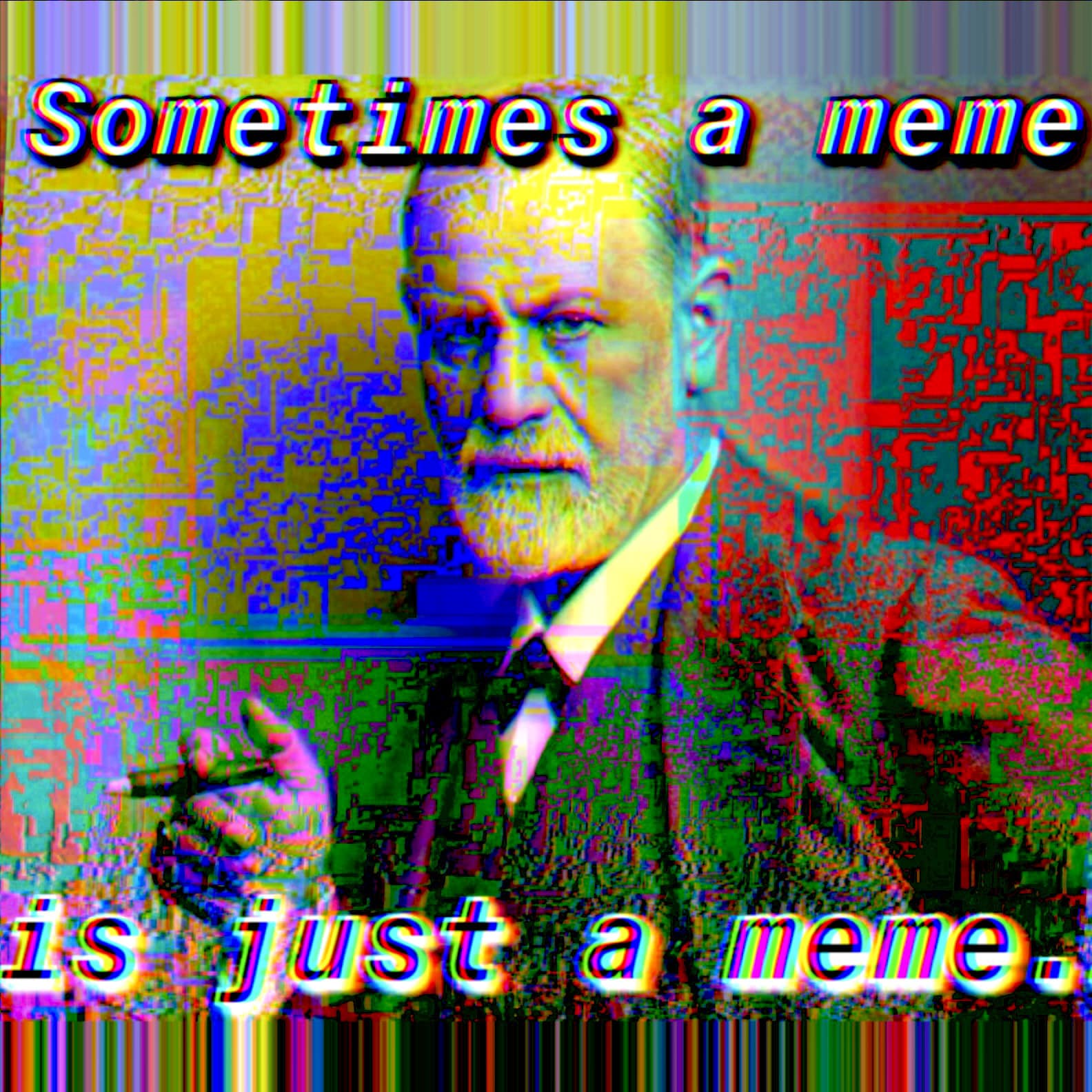
This image acts as a self-referential joke by using the word "meme" within its text to explain the concept of the meme itself. It plays on the idea that whatever content is being shared is inherently funny by stating, "Sometimes a meme is just a meme." The heavy, distorted, and glitchy visual style further emphasizes a meta-humor that mimics corrupted or "internet-savvy" aesthetics.
simple-description (llama3.2-vision_11b)
The meme is a screenshot of a psychiatrist's couch, with the words "Sometimes a cigar is just a cigar" written above it. This phrase, coined by Sigmund Freud, is often used humorously to imply that something is simply what it appears to be, without deeper meaning. In this context, the meme is likely poking fun at the idea that a psychiatrist's couch is just a couch, rather than a symbol of Freud's psychoanalytic theories.
detailed-analysis (gemma3-27b-vision)
Okay, let's break down this image through various theoretical lenses. It's a rich piece for analysis because of the juxtaposition of the figure, the text, and the distorted aesthetic.
Visual Description
The image is a portrait of Sigmund Freud, the founder of psychoanalysis, rendered with severe digital distortion. The distortion manifests as vibrant, glitch-like bands of color (primarily red, green, and blue) that run vertically across the image, obscuring portions of Freud's face and suit. The text "Sometimes a meme is just a meme" is superimposed, "Sometimes a meme" in a yellow/gold banner at the top, and “is just a meme” in a similar banner at the bottom. Freud is depicted holding a cigarette. His expression is relatively stoic, though the distortion could be interpreted as reflecting internal turmoil or fragmentation. The overall aesthetic is deliberately chaotic and unsettling.
Postmodernism
This image is deeply rooted in postmodern sensibilities. The intentional visual 'errors' and distortions are a key element. This glitch aesthetic deliberately challenges notions of "originality", "authenticity," and "representation" central to modern thought.
- Simulacra & Simulation: The image can be seen as a simulation of a simulation. It’s a portrait of a historical figure, rendered digitally, and further deconstructed by the glitch. It asks us to question what is "real" or "authentic" in a media-saturated world where copies of copies are increasingly commonplace. The text reinforces this, suggesting that even seemingly profound concepts ("Freud", "psychoanalysis") can be reduced to a fleeting, ephemeral form like a meme.
- Deconstruction: The image deconstructs the authority traditionally associated with figures like Freud. By visually fracturing the portrait, it challenges the idea of a stable, coherent identity or a fixed interpretation of his ideas.
- Irony and Playfulness: The pairing of a serious intellectual figure with a mundane, internet-centric phrase (“sometimes a meme is just a meme”) is fundamentally ironic and playful. This undermines the seriousness traditionally associated with psychoanalysis.
Foucauldian Genealogical Discourse Analysis
Applying a Foucauldian lens allows us to examine how power operates through the "discourse" surrounding psychoanalysis and its current instantiation in meme culture.
- Discourse and Power/Knowledge: Psychoanalysis, as a discourse, creates systems of knowledge and power. It established a way of understanding the self, desire, and the unconscious. This image, however, challenges that discourse. By reducing Freud to a meme, it disrupts the established authority of psychoanalytic thought.
- Genealogy: A genealogical approach would trace the history of ideas surrounding psychoanalysis—how they emerged, the power structures that supported them, and how they have changed over time. The image could be seen as a moment in this historical trajectory, a point where high theory is being "flattened" by the forces of internet culture.
- Fragmentation of Subjectivity: The glitch aesthetic visually represents the fragmentation of the subject, a concept explored within psychoanalysis itself. But the image pushes this further, suggesting that even our understanding of the self is now subject to the chaotic forces of digital culture.
Critical Theory
Within the broad scope of Critical Theory, this image can be seen as commentary on the commodification of intellectual thought and the impact of mass media on culture.
- Culture Industry: The image reflects the idea that even complex intellectual systems like psychoanalysis can be absorbed and reduced by the "culture industry," losing their critical edge in the process. The meme format is a prime example of this: it simplifies and repackages ideas for mass consumption.
- Loss of Aura: The original "aura" of Freud's work (its perceived authority, depth, and significance) is diminished by its reduction to a meme. This loss of aura is consistent with the fragmentation and disengagement often critiqued by critical theorists.
- The spectacle: The image can be read as a form of spectacle, a visual display that prioritizes surface appearance over depth of meaning. The glitch aesthetic itself is visually arresting but ultimately obscures the underlying subject matter.
Let me know if you’d like me to elaborate on any of these sections or explore other theoretical frameworks!
simple-description (llama3.2-vision)
This meme features a photo of Sigmund Freud, a famous psychologist, with a serious expression. The text "Sometimes a meme is just a meme" appears above the image, while the text "is just a meme" is below it. The image is likely meant to be humorous, poking fun at the idea that some memes are simply... well, memes.
tesseract-ocr
SOUSEWSS 2 ie ™~ ’ a a ae a r . . - a, irony Se beh ee a ca | ae *. | aa ° ave q ~~ od = y abo , . ae fie : a! ee : Se " — iF Ges ‘ ; —— " ; : Ba eee eG oe x a = le a 4 : ae — 4} oan 8 = A . Ai ce ae i aaa, — ave tie ame eee we , @ = ae rw > Rs : tS ne ~ ate Nie. a ag ae ee Tew it b : ew Be <— : oy. | a res ae ct) Nee aes it i CP ae a ee eae eet = <a Or, a 4 Fa eee | Ne AS SY Ye a a ' 7 : a . on ee z praca She Ly : i. = ae | ae hr “ _ rar Beste ap. ae ee ae te oA | Wee De | eae Jam ce ae | : ~ Or iw’ =) ta aS Be Sit¢ oo PNeMer it CAT Tai