First Seen
2024-01-31T03:19:14.055578+00:00
simple-description (qwen3.5_2b-q8_0)
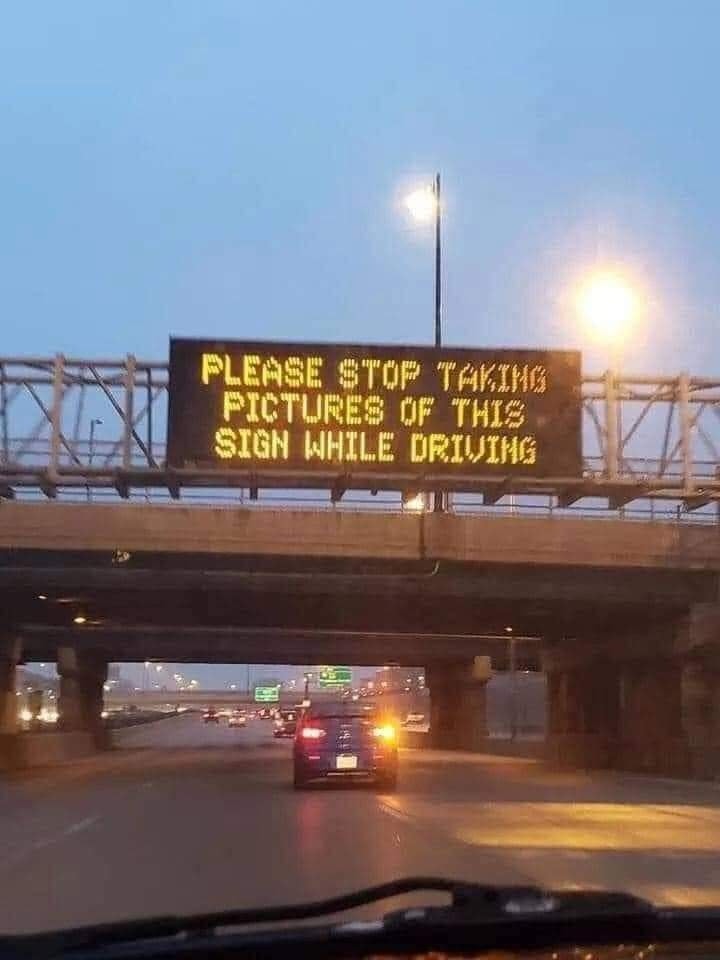
This meme is a clever example of meta-jokes, where the humor relies on the viewer understanding the sign's intention to prevent it from being useful. The digital sign at the top reads in yellow text on a black background: "PLEASE STOP TAKING PICTURES OF THIS SIGN WHILE DRIVING." It is a self-referential warning: the sign is there to discourage drivers from stopping at it, but it only stops being functional once the reader decides to become one of those drivers.
simple-description (llama3.2-vision_11b)
The meme is a screenshot of a highway sign that reads "PLEASE STOP TAKING PICTURES OF THIS SIGN WHILE DRIVING" in a humorous and ironic way, as it's a sign that's being photographed by drivers. The meme is likely used to poke fun at the absurdity of people taking selfies or photos of mundane things while driving, and the sign's message is a tongue-in-cheek warning to not do so while behind the wheel.
detailed-analysis (gemma3-27b-vision)
Okay, here's an analysis of the image, broken down into sections based on the theoretical frameworks requested. I'll only include sections where the frameworks feel particularly relevant and can be meaningfully applied.
Visual Description
The photograph depicts a digital road sign hanging over a highway. The sign’s message, in bright yellow, reads: "PLEASE STOP TAKING PICTURES OF THIS SIGN WHILE DRIVING." The sign itself is the subject of the photograph, creating a meta-commentary. Below the sign, we see a highway with moving vehicles, including a red car with visible taillights. The scene is lit by a mix of ambient daylight and artificial light sources, potentially streetlights or highway lighting. The image appears to have been taken from within the cab of a vehicle, evident from the dashboard visible in the foreground. The overall impression is one of irony and a playful acknowledgment of the spectacle created by the sign itself.
Foucauldian Genealogical Discourse Analysis
This image is rich for Foucauldian analysis. The sign doesn’t simply offer a safety directive. It performs a disciplinary function. It's not merely asking drivers to refrain from taking pictures; it’s actively constructing and policing the behavior of drivers.
- Power/Knowledge: The sign operates through a power/knowledge complex. The authority granting the sign its weight assumes that taking pictures while driving is inherently dangerous. This isn’t presented as an opinion, but as a fact. It then disseminates this ‘knowledge’ and enforces it through the implied threat of surveillance and potential consequences (traffic stop, accident).
- Discourse: The sign initiates a discourse about driving, safety, and spectacle. It assumes drivers are engaging in a practice (taking pictures) that is deemed problematic, thereby defining that practice as a deviation from the norm. The sign itself creates the problem it attempts to address by calling attention to it.
- Genealogy of Control: One could trace a genealogy of this type of sign. It belongs to a broader trend of roadside warnings, traffic control devices, and increasingly visible attempts to manage driver behavior. This is tied to the evolution of transportation systems, the rise of automobile culture, and an increased emphasis on risk management. The sign isn’t an isolated incident; it’s a manifestation of a historical development of control mechanisms.
Postmodernism
The image embodies several key tenets of postmodern thought:
- Meta-Narrative & Irony: The sign about being photographed is itself a photograph. This reflexive quality highlights the self-referentiality of culture. It acknowledges that the sign itself is a spectacle, designed to be noticed and documented. The irony is heightened by the fact that posting the picture of the sign, as evidenced by the photo itself, is precisely what the sign discourages.
- Simulacra & Simulation: The sign is arguably a simulacrum - a copy without an original. The problem isn’t necessarily the act of taking a picture, but the idea of taking pictures while driving becoming a problem. It's the representation of the act that the sign is addressing. This ties into Baudrillard’s ideas about the hyperreality.
- Deconstruction of Authority: The plea “PLEASE STOP…” is almost comically ineffective. The very act of placing this sign invites the behavior it seeks to prevent. The authority issuing the directive is undermined by the predictable response of its audience. The sign becomes a running joke.
- Fragmentation and Loss of Meaning: The sign is essentially commenting on the constant flow of information in society and the tendency to document everything, even mundane situations. It's a recognition that meaning is often lost in the endless cycle of documentation and reproduction.
Critical Theory
From a critical theory perspective, the sign can be viewed as an example of how power operates in contemporary society, specifically through the control of spectacle and the normalization of surveillance.
- Culture Industry: The sign contributes to the "culture industry," a concept explored by Adorno and Horkheimer. It's a form of mass-produced communication designed to manage and control individuals.
- Ideology: The message implicitly reinforces an ideology that prioritizes safety and conformity. It frames any deviation from that norm (taking a picture while driving) as a potential threat.
- Commodification of Experience: The sign’s existence points to a broader societal trend of commodifying experience. The urge to document everything, and share it on social media, transforms life into a spectacle to be consumed.
I've tried to provide a nuanced analysis based on the frameworks you requested. It's important to remember that these theoretical lenses aren’t mutually exclusive, and often overlap in their insights. Let me know if you’d like me to elaborate on any of these points or explore other theoretical perspectives!
tesseract-ocr
{ Cd a0 a mR TON AT Y l eat : f § HED TOP Apa } b ia a i> NN pee ae oe fname i ~ owas 3 S555 SS SS Se) ee ee eae eos oe i a : Lo, = = el parle 4 a. Se oa 7 = aes : i oe = i La - © a . Ps
simple-description (llama3.2-vision)
This meme is a photo of a digital highway sign that is normally used to display traffic updates or warnings. However, in this case, the sign is displaying a humorous message that is not related to traffic at all. The text on the sign reads: "Please stop taking pictures of this sign while driving."