First Seen
2024-05-28T23:38:34.641890+00:00
simple-description (qwen3.5_2b-q8_0)
This meme is a "meta" joke because it plays on the irony of trying to understand a joke by reading the text itself. It mimics a billboard trying to explain a message, where the billboard says, "hey look at me," but since the viewer is just looking at the screen, the billboard is effectively looking at the billboard. The humor suggests that the billboard is reading the text, but the irony is that the billboard is the one doing the reading.
simple-description (llama3.2-vision_11b)
This meme is a humorous example of a "dumb" or "dull" conversation between a user and a chatbot, highlighting the absurdity of a conversation where the user asks the chatbot to explain the meaning of a simple phrase, "I can explain it in 20 seconds. Are you still with me?" The meme is a commentary on the frustration of trying to explain complex ideas in simple terms, and the absurdity of asking for an explanation of something that's already obvious.
detailed-analysis (gemma3-27b-vision)
Okay, let's break down this image and accompanying text through several critical lenses.
Visual Description
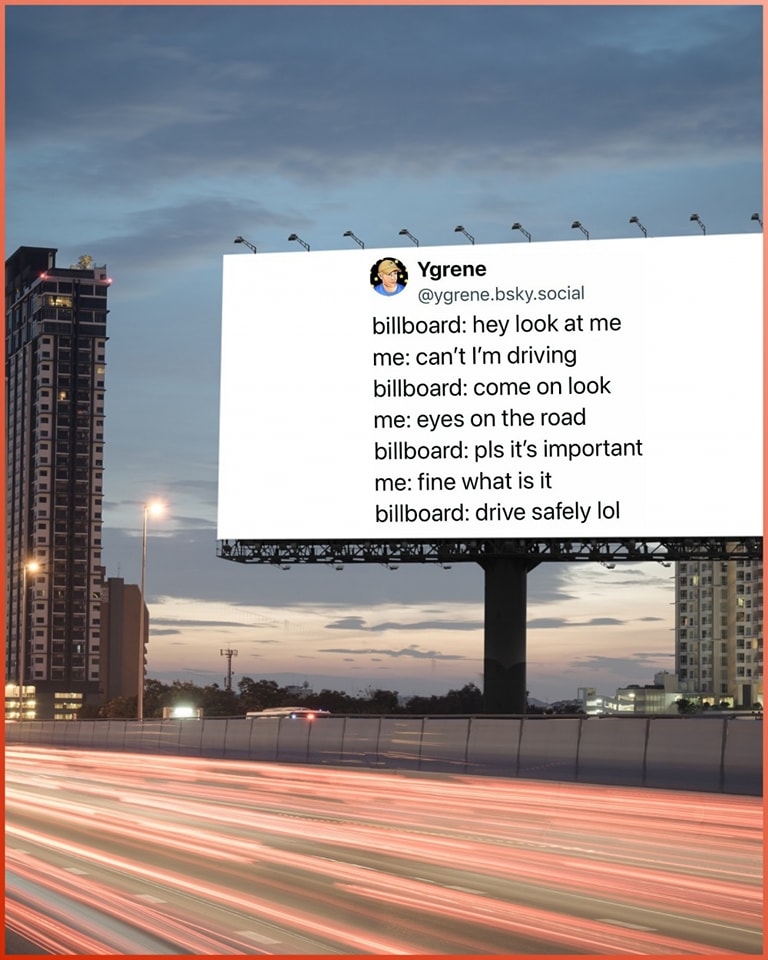
The image presents a nighttime urban landscape, dominated by a wide highway bridge. The bridge appears to be a major transportation artery. The sky is a muted, dusky blue-grey. Bright, blurred streaks of car headlights and taillights indicate moving traffic. A tall modern building is visible in the background, and several streetlights illuminate the scene. The most prominent element of the composition is a large digital billboard suspended above the highway, presumably directing messages to drivers. The overall mood is one of motion, urban density, and a slightly melancholic atmosphere. The image has a slightly grainy quality, possibly indicating it's a photo taken in low light.
Foucauldian Genealogical Discourse Analysis
The text exchange between the narrator and the billboard can be read as a miniature power dynamic. Foucault’s work focuses on how power operates not as a repressive force, but as a productive one, shaping knowledge, discourses, and ultimately, our subjectivities. Here, the billboard attempts to constitute the subject ("you") as a consumer of its message. The billboard's insistence – "hey look at me," "come on look," "pls it's important" – is an exercise of disciplinary power, trying to draw the driver’s gaze and thus, control their attention. The driver’s responses – “can’t I’m driving," "eyes on the road" – represent a resistance, albeit a practical one, to this disciplinary effort. The billboard's final “drive safely lol” is interesting because it masks its controlling agenda behind a friendly, caring tone, further solidifying its power. The discourse itself is about attention, safety, and control within the modern urban landscape. A genealogical approach would trace the history of how billboards and advertising have come to exert this control over public space and individual attention, shaping our perceptions of need and desire.
Critical Theory
From a critical theory perspective (drawing from the Frankfurt School like Adorno and Horkheimer), this image and text expose the alienation inherent in modern capitalist society. The billboard represents the commodification of attention; even driving, a practical necessity, is interrupted by the demands of advertising and consumption. The driver’s struggle to “keep eyes on the road” signifies a desire to maintain agency and focus on the real task at hand, resisting the constant bombardment of stimuli. The “lol” at the end of the billboard’s message serves as a cynical nod to the absurdity of it all – the relentless attempt to insert marketing into every aspect of life. This echoes the idea of the “culture industry” where authentic experience is replaced by standardized, commercially driven products and messages. The scene highlights how our very consciousness is increasingly shaped by forces beyond our control.
Marxist Conflict Theory
The scene exemplifies class conflict in a subtle way. The billboard is a product of the capitalist system, owned by corporations attempting to generate profit through advertising. The driver, navigating the highway, can be seen as a worker engaged in the process of production (commuting to work, transporting goods). The billboard interrupts this process, demanding attention for a different purpose—consumption. This illustrates the inherent conflict between the needs of production and the demands of capital accumulation. The billboard isn’t concerned with the driver’s safety per se, but with their potential as a consumer. Even a plea for safety is ultimately geared towards maintaining the driver’s capacity to participate in the capitalist system.
Postmodernism
This image and text strongly resonate with postmodern themes. The fragmented dialogue and the juxtaposition of a practical activity (driving) with the intrusion of advertising embody the loss of grand narratives and the blurring of boundaries between reality and simulation. The “lol” at the end represents a key postmodern trait: irony and self-awareness. The billboard’s attempt at connection feels hollow, acknowledging the impossibility of authentic communication in a media-saturated world. The scene suggests that meaning is not inherent but constructed through signs and symbols – the billboard, the road, the traffic, the dialogue – which are all constantly shifting and destabilized. The driver's resistance is not a rejection of modernity, but an attempt to navigate it with a degree of skepticism and self-awareness.
Queer Feminist Intersectional Analysis
While this image doesn’t immediately present overt themes of gender or sexuality, an intersectional analysis can reveal subtle power dynamics. The billboard’s insistent need to capture attention can be viewed as a form of visual violence—an interruption of the driver’s agency and bodily autonomy. Historically, advertising has often been used to reinforce patriarchal and heteronormative standards. The image can thus be read as a microcosm of a larger system where visibility and attention are often controlled by dominant power structures. Further, the driver’s response—simply wanting to “keep eyes on the road”—can be interpreted as a refusal to engage with the hyper-visual, often objectifying gaze of the advertising industry.
I hope this breakdown is helpful! Let me know if you'd like me to elaborate on any of these points.
tesseract-ocr
F , a Ygrene # @ygrene.bsky.social billboard: hey look at me me: can't I'm driving D billboard: come on look me: eyes on the road billboard: pls it's important 2 me: fine what is it aes = billboard: drive safely lol — Pees ——— oe tialede bie, a ——— SS — —S— ~S = =
simple-description (llama3.2-vision)
This meme is a humorous exchange between a person and a billboard. The person is frustrated that the billboard is not paying attention to them and is instead displaying a generic message. The text on the billboard reads: "In 2-3 sentences, describe this meme for someone who cannot see it. Include any text that appears in the image."