First Seen
2023-05-10T21:03:36+00:00
simple-description (llama3.2-vision_11b)
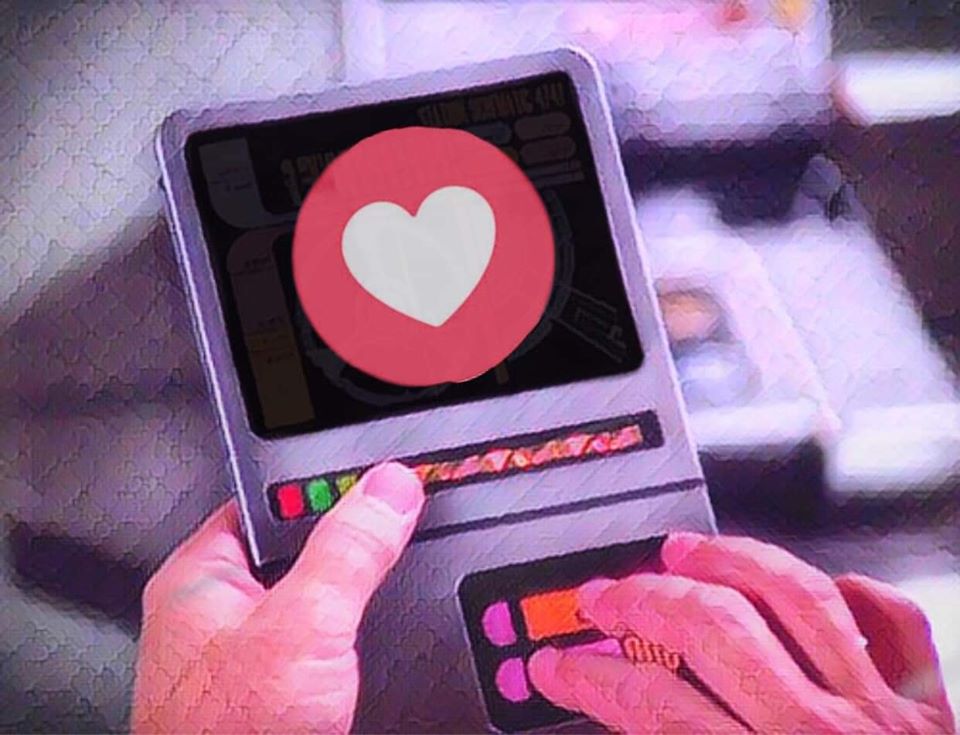
The meme is an image of a Facebook "Like" button, but it's been replaced with a heart icon, implying a "Like" has been turned into a romantic gesture. The text "I love you" is often overlaid on the image, suggesting a playful way to express affection on social media.
detailed-analysis (gemma3-27b-vision)
Okay, here's an analysis of the image, broken down into the sections you requested, only where relevant. Given the image, several of the sections aren't strongly applicable, so I've been selective.
Visual Description
The image depicts a pair of hands operating a futuristic, metallic device with a screen. The device appears to be a control panel of some kind, possibly from a science fiction setting. The screen prominently displays a simple, red heart icon, centered in a circle. The palette is heavily dominated by shades of purple, magenta and blacks. The overall aesthetic is slightly grainy and reminiscent of 1980s or 1990s visual effects. The screen is not clearly defined but has black background with other faint geometric patterns visible.
Foucauldian Genealogical Discourse Analysis
This image offers an interesting lens through which to apply Foucault's concept of power/knowledge. The device, coupled with the heart icon, suggests a system for quantifying or controlling affection. Tracing the genealogy of "liking" or "love" – how it has been categorized, measured, and disciplined – reveals how concepts of emotional connection aren’t simply natural, but are constructed through discourses.
- Panopticism: The device could be seen as a technological extension of panoptic control. The user is operating something that determines or acknowledges emotional exchange, and that "something" (the system represented by the device) holds power. It's possible the device creates a record, or a visible ranking or evaluation, further enforcing a kind of "emotional monitoring."
- Disciplinary Power: The act of ‘liking’ (symbolized by the heart) is potentially made a quantifiable data point. The user isn't freely expressing emotion, but performing a quantifiable action within a system. This performance reinforces the norms of that system.
- The Construction of “Affection”: By framing affection as something controllable and recordable via a device, the very meaning of love or like is altered. It suggests that authentic emotional connection can be reduced to a technical input.
Critical Theory
The image lends itself well to a critical theoretical analysis, particularly drawing from the Frankfurt School.
- Commodification of Emotion: The heart icon on the device signals the potential for the commodification of emotion. Love/liking/affection is reduced to a symbol that can be activated or deactivated. This is tied to the broader theme of the “culture industry,” where even intimate feelings are packaged and consumed.
- Instrumental Rationality: The device embodies instrumental rationality – the pursuit of efficiency and control. Instead of allowing emotions to flow freely, the device attempts to make them quantifiable and controllable, reducing them to tools for achieving a specific outcome (perhaps social validation, or power within a system).
- Alienation: The mediation of emotion through the device could be seen as a form of alienation. The user isn’t connecting directly with another person, but interacting with a technological interface. This interface creates a barrier to genuine emotional experience.
Postmodernism
The image resonates with several themes associated with postmodernism:
- Simulacra and Simulation: The heart icon itself is a simulacrum – a copy without an original. It’s a representation of affection, but it’s not the authentic emotion itself. The device and the icon together create a hyperreality, a simulation of connection.
- Fragmentation and Deconstruction: The grainy, fragmented aesthetic of the image could symbolize the breakdown of grand narratives and stable meanings. It suggests a world where emotion is deconstructed into fragmented symbols and signs.
- The Blurring of Boundaries: The image blurs the boundaries between human emotion and technology. It suggests a world where our feelings are increasingly mediated and influenced by machines.
Let me know if you'd like me to expand on any of these sections, or explore any specific theoretical frameworks in more detail.
simple-description (llama3.2-vision)
This meme is a screenshot of a character from the TV show "Star Trek: The Next Generation" using a device called a PADD (Personal Access Device) to express his emotions. The image shows the character's PADD displaying a heart symbol, indicating that he's feeling affection or love. The text that appears in the image is the character's name, "Beverly" (the ship's captain), and the phrase "I love you, Beverly".
tesseract-ocr
- 2a gh SON Ros: on S a - . 47 * f ere \ \ oe VAN \\ | , 4 | ¥ | er Bey ‘\ - ? ~ , A - os XQ ‘Ne y ae NX % KG eb: x! ee