First Seen
2023-05-10T21:03:36+00:00
simple-description (llama3.2-vision_11b)
This meme is a screenshot from the TV show "Avatar: The Last Airbender" featuring a character named Iroh, a wise and witty uncle, who is responding to a question about the meaning of a joke. The meme is a humorous take on the idea that some people's understanding of humor can be...off. The text "I'm not saying it's not funny, I'm saying it's not funny" is a clever play on words, poking fun at the idea that some people's sense of humor is just not...well, funny.
detailed-analysis (gemma3-27b-vision)
Okay, here's a breakdown of the image/meme, analyzed through the requested theoretical lenses. I'll skip sections that don't significantly apply.
Visual Description
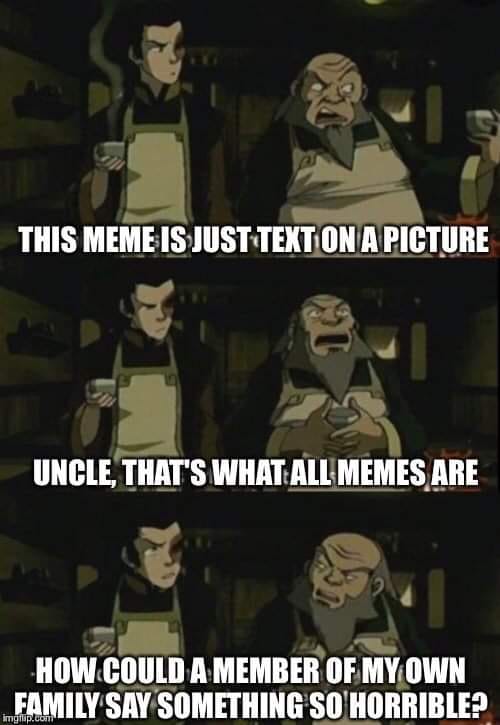
The image is a three-panel meme using screencaps from the animated television series Avatar: The Last Airbender. The characters featured are Zuko, a troubled prince, and his Uncle Iroh, a wise and compassionate elder. Each panel focuses on the character’s face with a speech bubble.
- Panel 1: Zuko looks neutral, and the text reads "THIS MEME IS JUST TEXT ON A PICTURE."
- Panel 2: Zuko looks mildly irritated. The text reads, “UNCLE, THAT’S WHAT ALL MEMES ARE.”
- Panel 3: Zuko is visibly angry and horrified, and the text reads, “HOW COULD A MEMBER OF MY OWN FAMILY SAY SOMETHING SO HORRIBLE?” Iroh looks equally upset and appears to be reacting to Zuko's statement.
The meme format relies on the dramatic irony of using characters known for their complex relationship to argue about the basic nature of memes. The humor derives from the disproportionate reaction and the absurdity of applying such intense emotional weight to a banal observation.
Foucauldian Genealogical Discourse Analysis
This meme is a fascinating example of how discourse about discourse emerges. Michel Foucault explored how knowledge and power are intertwined, and how discourses create systems of meaning. Here, the meme is not about any particular subject matter—it's about the very form of the meme itself.
- The Discourse of Memes: A discourse around memes has emerged, which includes discussions of their creation, consumption, and function. This meme interrogates that discourse, pointing out the fundamental simplicity of memes.
- Power/Knowledge: The meme attempts to disrupt the "expert" discourse about memes. It deconstructs the idea that there's something inherently complex or profound about them. In doing so, it challenges the power dynamics inherent in expertise. Anyone can recognize that a meme is "just text on a picture," leveling the playing field.
- Genealogy of the Meme: The meme is aware of its own history. It isn’t presenting a new idea; it is pointing out an obvious foundation of the form itself. The genealogical impulse here traces back to the original impulse behind meme creation—simple juxtaposition of image and text.
Postmodernism
This meme is deeply embedded in postmodern sensibilities.
- Meta-Commentary: The meme is inherently meta. It’s about the meme as a meme, rather than engaging with an external subject. It acknowledges its own constructed nature and its place within a larger system of online culture.
- Deconstruction: The statement "This meme is just text on a picture" is a kind of deconstruction of the meme. It strips away the layers of meaning and humor to reveal the basic building blocks. This aligns with postmodernist critique of grand narratives and the pursuit of underlying structures.
- Irony and Playfulness: The humor is rooted in irony and a playful acknowledgement of the absurdity of applying serious emotional weight to a trivial observation. Postmodernism often embraces playfulness and challenges traditional notions of seriousness.
- Intertextuality: The meme relies on knowledge of Avatar: The Last Airbender to create its effect. The use of the characters and their established dynamic adds layers of meaning and irony.
Critical Theory
While not a direct engagement with a specific critical theory framework (like the Frankfurt School), the meme subtly touches upon concepts related to mass culture and the construction of meaning.
- Commodification of Culture: Memes are part of the larger system of digital culture, often used for advertising and brand promotion. While this meme isn't about that, it acknowledges the ubiquity of memes as cultural artifacts. It implicitly asks what is the inherent value of a meme versus its commodification.
- Spectacle and Distraction: One could argue that memes contribute to a culture of spectacle and distraction, where superficiality often trumps substance. This meme, by drawing attention to the basic nature of memes, subtly critiques that trend.
Note: I didn't include Marxist Conflict Theory or Queer Feminist Intersectional Analysis because the meme doesn't lend itself to those frameworks. While you could stretch interpretations, those lenses don't provide particularly insightful readings of this specific image.
Let me know if you’d like me to elaborate on any of these points or explore a different theoretical lens!
simple-description (llama3.2-vision)
This meme is a screenshot from the animated TV series "Avatar: The Last Airbender". It features a character named Iroku, who is known for his grumpy and sarcastic personality. In the image, Iroku is saying "This meme is just text on a picture. What's so horrible about that?" which is a humorous commentary on the simplicity of modern memes.
tesseract-ocr
; a we THIS MEMEIS:JUST-TEXTON A’ Ha a ‘* 23 UT at any Oy a a by RS EU Ca FAMILY SAY SOMETHING SO'HORRIBLE?.