First Seen
2023-05-10T21:03:36+00:00
simple-description (llama3.2-vision_11b)
This meme is a humorous illustration of a cat trying to understand a complex concept, with the cat's expression of confusion and frustration. The image shows a cat standing in front of a whiteboard with a complex equation written on it, with the cat's paws on its head and a thought bubble above its head with a question mark.
detailed-analysis (gemma3-27b-vision)
Okay, let's break down this image through the lenses of various theoretical frameworks. Given the simplicity of the image, some frameworks will be more applicable than others. Here’s a breakdown, section by section.
Visual Description
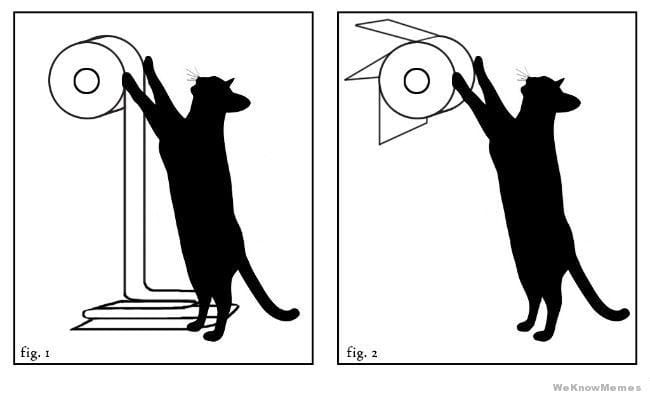
The image consists of two black-and-white silhouettes framed within rectangular panels labeled "fig. 1" and "fig. 2". Each figure depicts a black cat stretching upward towards a toilet paper roll on a stand.
- Fig. 1 shows the toilet paper roll in its standard, complete cylindrical shape. The cat is fully engaged in an act of reaching for it.
- Fig. 2 depicts the toilet paper roll in a partially unraveled state, suggesting it has been used/played with. The cat is in the same pose, engaged in the same act.
The contrast is simple and stark. The style is minimalist and evocative, relying on silhouette rather than detail. The image is captioned at the bottom with "WeKnowMemes" suggesting it is a meme, likely intended to be humorous or relatable.
Foucauldian Genealogical Discourse Analysis
This image can be examined through a Foucauldian lens focusing on power dynamics and the construction of norms.
- Discourse of "Cat-ness": The image plays into a pervasive discourse around cat behavior. Cats are often depicted as playful, mischievous, and drawn to things they "shouldn't" touch (like toilet paper). This image reinforces that constructed “cat-ness” through visual representation. The act of unraveling toilet paper isn't inherently problematic, but it becomes a ‘problem’ through this discourse.
- The Toilet Paper Stand as a Site of Power: The toilet paper stand isn’t just a functional object; it represents a structured element of the domestic sphere. The cat’s interaction with it can be seen as a disruption of this order. The transition from fig. 1 to fig. 2 demonstrates a shifting relationship between the cat and this structured space.
- Normalization & Discipline: The original “complete” roll (fig. 1) represents the idealized order. The unraveled roll (fig. 2) reveals a disruption of that order – a “deviation” from the norm. This isn’t a form of overt punishment, but a micro-level demonstration of how even seemingly innocuous acts can be interpreted as transgressions.
In a genealogical sense, we can trace the “history” of this visual trope: the playful cat, the destructiveness of pets, the human frustration with domestic disruption.
Critical Theory
We can engage with the image through a Critical Theory lens by looking at it as a commentary on societal structures.
- Domination of the Domestic Sphere: The image can be interpreted as representing the imposition of human order on the natural instincts of the cat. The toilet paper stand represents human attempts to organize and control the environment, while the cat’s action disrupts that order. This embodies the power dynamics in human-animal relationships.
- Reproduction of Control: The image can be read as a visual representation of the way power operates to reproduce itself. The cat’s ‘disruption’ (unraveling the paper) isn’t necessarily malicious, but the human response to that disruption reinforces the power imbalance.
- The Illusion of Order: The initial “complete” roll represents an illusion of control and order. The unraveling of the roll reveals the instability and fragility of that order. It challenges the notion of a perfectly controlled domestic environment.
Marxist Conflict Theory
Applying Marxist theory can seem a bit strained, given the lack of obvious class struggle. However, we can frame it in terms of resource control and the assertion of agency.
- Resource Control: The toilet paper, while seemingly trivial, can be seen as a symbolic representation of resources. The cat’s interaction with it can be interpreted as a disruption of the human claim to those resources (even if symbolic).
- Assertion of Agency: The cat’s action can be seen as a small act of resistance against the imposed order of the domestic sphere. It’s a demonstration of the cat asserting its own agency and desires, even in a limited way.
- The Illusion of Ownership: Humans consider the toilet paper ‘theirs’. The cat doesn’t recognize that division. It interacts with the object based on its own impulses, challenging the constructed notion of ownership and control.
Postmodernism
Postmodernism finds ample room for interpretation in this image.
- Deconstruction of Meaning: The image deconstructs the simple function of the toilet paper stand. It’s no longer just a holder of paper; it’s a site of play, disruption, and a symbol of the tension between order and chaos.
- Playfulness and Irony: The image is inherently playful and ironic. It mocks the human obsession with order and control. It suggests that even the most mundane objects and activities are subject to deconstruction and reinterpretation.
- Simulacra and Simulation: The image can be seen as a ‘simulacrum’ of domestic life. It’s a representation of a representation—a cartoonish depiction of a common situation. It highlights the artificiality and constructed nature of everyday experiences.
Queer Feminist Intersectional Analysis
This is the most challenging framework to apply, but we can find some points of intersection.
- Disruption of Normative Domesticity: The cat's action can be seen as a disruption of the normative expectations of domesticity—a rejection of the "proper" behavior expected in a home. This aligns with queer and feminist challenges to traditional societal norms.
- Rejection of Control: The cat's agency in unraveling the toilet paper can be interpreted as a rejection of the control that humans often seek to impose on both animals and marginalized groups.
- Subversion of Power Dynamics: The cat's playful act can be seen as a subtle form of resistance against the power imbalance inherent in the human-animal relationship—a reclaiming of agency within a constrained environment.
- The Interwoven Nature of Oppression: While stretched, the disruption can be symbolically linked to challenging the “neatness” and constructed order that often reinforces systemic power structures. A “messy” act can be a metaphor for disrupting the status quo.
Hopefully, this analysis provides a multifaceted interpretation of this simple yet intriguing image. The effectiveness of each framework is subjective and depends on the reader’s own interpretive lens.
simple-description (llama3.2-vision)
This meme features a cat attempting to use a toilet paper roll, but instead of unrolling it, the cat is trying to put it back on the holder. The text "fig. 1" appears in the top left corner of the image, indicating that it is the first image in a series. The image is likely meant to be humorous, poking fun at the cat's lack of understanding of how to use toilet paper.
tesseract-ocr
‘Y