First Seen
2023-05-10T21:03:36+00:00
simple-description (llama3.2-vision_11b)
This meme is a screenshot of a Reddit user's post, where they're sharing a humorous image of a character from the Star Wars universe, specifically Anakin Skywalker, with a caption that reads "I'm not arguing, I'm just explaining why I'm right". The meme pokes fun at the common internet phenomenon of people getting defensive and argumentative online, and the character's facial expression is a humorous exaggeration of that sentiment.
detailed-analysis (gemma3-27b-vision)
Okay, let's break down this image and its accompanying caption through the requested theoretical lenses. Please note that some sections will be minimal or non-existent depending on the applicability of the theory to the image.
Visual Description
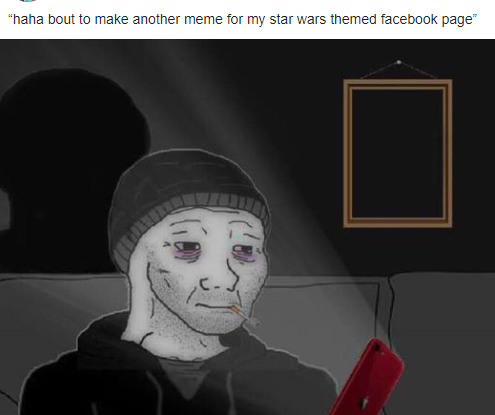
The image is a digitally drawn, stylized cartoon. It depicts a figure, presumably male, with exaggerated, distressed facial features. His eyes are visibly red and tearful, and his face shows signs of exhaustion and/or substance use (cigarette in mouth). He's wearing a beanie and appears to be slumped on a couch. The environment is dimly lit and stark. A phone with a glowing screen sits in the lower right corner and a blank frame is hanging on a wall behind the figure. The caption above reads, "haha bout to make another meme for my star wars themed facebook page". The aesthetic is distinctly internet-influenced, leaning towards a melancholic, "depressive meme" style.
Foucauldian Genealogical Discourse Analysis
This image, and its context (a Facebook post), is highly relevant to Foucauldian analysis. The "depressive meme" style is a discourse—a way of speaking, representing, and understanding experiences, particularly around mental health and/or dissatisfaction. This discourse functions to:
- Produce Knowledge: By constantly sharing and consuming images like this, a certain understanding of "being a fan" or "online life" is constructed. It normalizes and even glamorizes exhaustion, perhaps linking it to dedication or irony.
- Exercise Power: The creation and dissemination of this meme contribute to the power/knowledge nexus. The poster is exerting power through representation, defining the experience of fan culture and/or online life.
- Genealogical Trace: A genealogical analysis would trace the historical development of this meme style. It would explore the roots in earlier forms of internet humor, the rise of "ironic detachment," the increase in discussions of mental health online, and the specific tropes associated with this aesthetic. The style borrows from older traditions of showing sadness and/or being a loner, but updates it through internet signifiers.
The act of making the meme is a performance of this discourse. The Facebook page is a site where this discourse is enacted and reinforced.
Critical Theory
This image lends itself to a Critical Theory examination through the lens of commodification and alienation.
- Commodification: The figure is essentially producing content (the meme) for an online platform (Facebook) that operates on a model of attention economy. The "work" of creating the meme is likely unpaid, while Facebook profits from the engagement it generates. This highlights the commodification of creative labor and personal expression in the digital age.
- Alienation: The figure’s exhausted and despondent state could be interpreted as a symptom of alienation. The caption suggests a compulsive desire to continue producing content despite the apparent emotional toll. This can be linked to alienation from the creative process itself, from genuine connection, or from a sense of purpose beyond the creation of online content. The act of constant creation becomes a substitute for fulfilling needs.
Marxist Conflict Theory
From a Marxist perspective, this image illustrates the contradictions of late-stage capitalism. The figure is simultaneously a producer of content and a consumer of the platform, and is likely exploited by the platform’s economic structure. The individual labors to create content (even if seemingly trivial), contributing to the platform's profit, but receives little to no material reward. The depiction of exhaustion and despair can be seen as a symptom of the broader alienation and precarity experienced under capitalist conditions. The seemingly ironic "haha" in the caption could be interpreted as a coping mechanism for the anxiety and stress of maintaining an online presence within a capitalist system.
Postmodernism
This image embodies several key aspects of postmodernism:
- Irony and Pastiche: The juxtaposition of a despondent image with a lighthearted caption ("haha") is ironic. The style itself is a pastiche—a blend of internet aesthetics, emotional expression, and meme culture.
- Hyperreality: The image presents a simulation of emotion and experience, potentially blurring the line between genuine feeling and performative expression. The meme exists as a self-referential sign, detached from any "real" connection to the experience of being a fan or being online.
- Deconstruction of Meaning: The image resists a single, straightforward interpretation. The combination of visual and textual elements creates ambiguity and invites multiple readings.
Queer Feminist Intersectional Analysis
This section is the least directly applicable, but there are still potential points for consideration:
- Performativity of Emotion: The visual presentation of sadness can be linked to the idea of emotional labor, often disproportionately expected of marginalized groups. The performance of sadness on social media can be analyzed through the lens of how emotions are constructed and displayed, and how this impacts individual and social expectations.
- Online Spaces and Vulnerability: Online spaces can be sites of both community and harassment. The figure's vulnerability (expressed through the exhausted image) could be seen as a reflection of the risks and challenges faced by individuals who express themselves online.
- Subversion of Masculinity: The image presents a traditionally masculine figure in a vulnerable, exhausted, and emotionally open state. This subversion of stereotypical masculinity could be analyzed through a queer lens, as it challenges traditional notions of male strength and emotional expression. However, this depends heavily on interpretation and could be absent altogether.
Let me know if you'd like me to elaborate on any of these analyses or explore different theoretical perspectives.
simple-description (llama3.2-vision)
This meme features a character from the Star Wars franchise, specifically a young boy named Anakin Skywalker, but in a humorous and unexpected context. The text at the top of the image reads: "haha bout to make another meme for my star wars themed facebook page". The image itself is a humorous and satirical take on the character's personality, showcasing his signature "I'm not a good guy" phrase from the Star Wars prequels.
tesseract-ocr
2 & 5) ® Ag