First Seen
2023-05-10T21:03:36+00:00
simple-description (llama3.2-vision_11b)
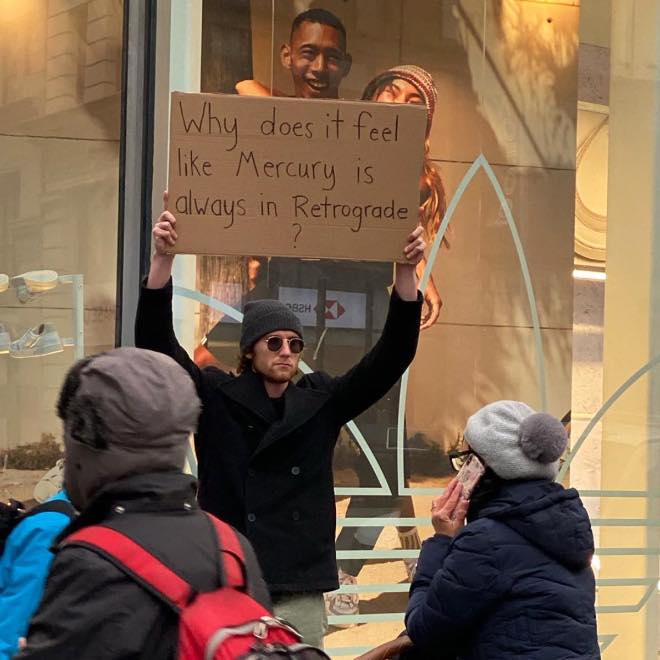
The meme is a humorous image of a person holding a sign that reads "Why is it always 'R' in every word?". The text is poking fun at the fact that the letter "R" is often found in words related to time, such as "recent", "regular", and "regularly", which can be confusing for those who are not familiar with the pattern.
detailed-analysis (gemma3-27b-vision)
Okay, here's an analysis of the image, broken down into the sections you requested, only including those that are relevant and appropriate to the content. It's a bit of a complex image, lending itself to multiple readings.
Visual Description
The image depicts a street scene, likely in a city. A young person, appearing to be male, is holding a cardboard sign up against a large glass storefront window. The sign asks: "Why does it feel like Mercury is always in retrograde?" The person is dressed in dark clothing, including a beanie and sunglasses, giving a somewhat anonymous and detached appearance.
Behind the person, the window displays a large advertisement or image featuring a smiling Black man. The reflection in the window shows pedestrians, including a person with a brightly colored backpack and another seated, seemingly taking a photo of the scene. The overall effect is layered – the physical person with the sign, the reflected image, and the visual connection/juxtaposition between the two. The scene seems to be set in front of a Bank of America location, suggested by the logo on the glass.
Postmodernism
This image is strongly indicative of postmodern themes. Several elements contribute to this:
- Irony and Playfulness: The sign referencing "Mercury in retrograde," a New Age astrological concept, appears humorous and ironic, contrasting with the potentially serious backdrop of a financial institution. It's a self-aware commentary on anxieties, perhaps anxieties around control or predictability in a chaotic world.
- Deconstruction of Meaning: The juxtaposition of the astrological question with the image of the Black man and the bank’s logo disrupts a straightforward narrative. It forces the viewer to question the connections and meaning of these disparate elements. There’s a deliberate ambiguity.
- Hyperreality: The glossy advertisement in the window, displaying a carefully constructed image of success or happiness, exists as a "simulacrum" – a copy without an original. This contributes to the postmodern condition where it's difficult to discern “real” from constructed realities. The reflection further complicates this, adding another layer of simulated “reality.”
- Fragmentation: The image is visually fragmented – the person with the sign, the reflection, the advertisement. This reflects a broader postmodern emphasis on fractured identities and experiences.
Critical Theory
The image can be analyzed through a Critical Theory lens, focusing on power structures and social critique.
- Subversion & Protest: The person holding the sign can be viewed as engaging in a subtle form of protest or resistance. The sign, while seemingly lighthearted, subtly critiques the societal pressures to conform to a rigid, linear, and predictable timeline—as opposed to embracing the cyclical nature of time and potentially acknowledging the unseen forces (astrology) that govern life.
- Commodification of Identity & Image: The use of the Black man’s image in the window advertisement immediately brings up questions of representation and commodification. Is this image being used to appeal to a specific demographic? Is it reinforcing stereotypes or merely serving as a marketing strategy? This ties into critical theory's examination of how capitalism exploits identity for profit.
- Critique of Rationality: The sign invoking astrology can be interpreted as a rejection of purely rational, scientific frameworks for understanding the world. It suggests a yearning for alternative systems of knowledge and meaning, and a questioning of the dominant, often oppressive, structures of power that prioritize rationality.
Queer Feminist Intersectional Analysis
While not immediately obvious, an intersectional queer feminist reading is possible, particularly in understanding the layers of power dynamics present:
- Disruption of Normative Time: Queer and feminist theory often challenge linear conceptions of time and progress. The invocation of Mercury retrograde—a period associated with disruption, delays, and reflection—could be seen as a rejection of the capitalist pressure to always be productive and moving forward. It's a reclaiming of a time for introspection and a refusal to adhere to rigid timelines.
- Representation and Visibility: The placement of the Black man’s image behind the protestor raises questions about whose voices are centered and amplified. Is this a deliberate act of obscuring, or a commentary on the invisibility of marginalized communities within the financial system?
- Emotional Labor & Validation: The vulnerability expressed in the sign ("Why does it feel...") hints at emotional labor. It acknowledges the emotional toll of navigating a system that often dismisses or invalidates subjective experiences. The question itself is a search for validation and shared understanding.
I’ve attempted to provide a thorough analysis based on the provided framework. The beauty of art (and even a snapshot like this) is its capacity for multiple interpretations. Let me know if you’d like me to elaborate on any specific point or explore a different theoretical lens.
simple-description (llama3.2-vision)
The meme is a humorous image of a person holding a sign that reads, "Why does it feel like Mercury is always in retrograde?" The phrase "Mercury in retrograde" is a common astrological term that refers to a period when the planet Mercury appears to be moving backwards in the sky, but the phrase has become a cultural phenomenon to describe any period of chaos or confusion.
tesseract-ocr
Pia q DS FS "7 | Why does it feel | eet B like Mercury — .oae 5 Lalways in Retonag y) ; | ee | ek ee a | 4 j a