First Seen
2023-05-10T21:03:36+00:00
simple-description (llama3.2-vision_11b)
The meme is an image of Mark Zuckerberg, the CEO of Meta, with a caption "Zuck, we're just trying to live" in a style reminiscent of a "help" or "please" sign. The meme is poking fun at Zuckerberg's announcement that Meta will be removing news content from its platforms, implying that the company is being insensitive to users' needs.
detailed-analysis (gemma3-27b-vision)
Okay, here's an analysis of the image broken down into sections based on the requested theoretical frameworks. I'll indicate when a framework doesn't really apply or is minimal.
Please note: This is interpretation and depends on how deeply we apply each theory. It's complex, and other interpretations are valid.
1. Visual Description
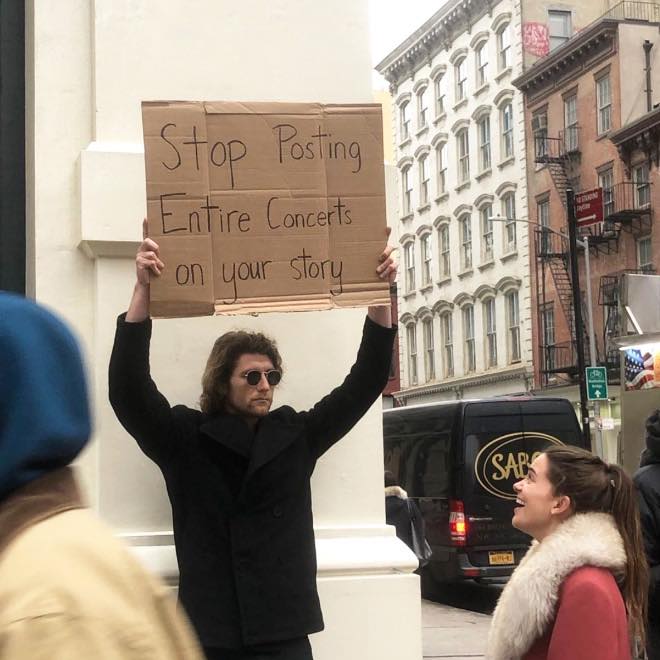
The image depicts a man holding a handmade sign that reads "Stop Posting Entire Concerts on your story." He's standing on a city street, presumably in a metropolitan area (based on the architectural style of the buildings). The man is dressed in a black coat, wearing sunglasses, and has long hair. He’s holding the sign above his head, clearly attempting to make a public statement.
The background features a brick building with arched windows, a black van with visible branding (“SAB” likely referencing the cafe/bar in the image), and other pedestrian activity (a woman with a red coat, the corner of another person in a blue hat). The overall tone is one of protest or disapproval, directed at a specific behavior—sharing full concert recordings on social media "stories." It seems to be an act done on impulse or out of frustration. The lighting is overcast and cool.
2. Foucauldian Genealogical Discourse Analysis
This image is ripe for a Foucaultian analysis. The protest isn't about the inherent wrongness of recording concerts. It's about the discourse surrounding acceptable modes of witnessing and documenting live performance.
- Power/Knowledge: The act of sharing entire concert recordings on "stories" (presumably Instagram, Snapchat etc.) reveals power dynamics at play. The sharer asserts control over the experience, re-distributing it for their own consumption and that of their audience. The protester implicitly challenges this power, seeking to reclaim a form of 'shared experience' that is not entirely mediated. The platforms themselves – Instagram, Snapchat – are sites of power that structure how we experience and share events.
- Genealogy: A genealogical inquiry would trace the historical shift in how concerts are experienced. Prior to accessible recording devices, concerts were ephemeral, unique, unrepeatable experiences. With the proliferation of smartphones and social media, this has changed radically. The concert has become a source of content, an opportunity for self-presentation, and a commodity for social media engagement.
- Discipline: The protest can be read as a form of "counter-conduct," a rejection of the normalizing pressures of this digital culture. The protester is trying to discipline behavior, to establish a new norm around respectful concert attendance.
- Subjectivation: The protestor is attempting to create/reinforce the subject position of “respectful concert attendee” as opposed to the “self-promoting documenter.”
3. Critical Theory
From a Critical Theory perspective (drawing on the Frankfurt School, Adorno & Horkheimer), the image speaks to the broader commodification of experience in late capitalist society.
- Culture Industry: The act of recording and sharing entire concerts on social media transforms a live, authentic experience into a consumable commodity—'content' to be liked, shared, and consumed. This fits into the culture industry’s logic of turning all aspects of life into products for profit and validation.
- Loss of Aura: Drawing on Walter Benjamin, the endless reproduction of concert experiences through recordings destroys the “aura” of the original event—its unique, unrepeatable quality. It turns it into something readily available and devalued.
- False Consciousness: Those who share entire concerts may be unaware of how their actions contribute to the commodification of culture and the erosion of authentic experience. They are acting under the illusion that they are "sharing" when they are actually contributing to a system that devalues the experience itself.
- Alienation: The constant documentation of experiences creates a distance between the individual and the actual event. Instead of fully immersing themselves, individuals become focused on capturing the moment for external validation, leading to a sense of alienation.
4. Marxist Conflict Theory
The image, viewed through a Marxist lens, highlights the tensions between labor, value, and consumption within the cultural sphere.
- Labor & Exploitation: The performers (musicians, sound engineers, venue staff) are engaging in labor that produces value. However, the value is being partially extracted by those who record and share the concert without compensation to the creators. It's a form of digital “free-riding” that undermines the economic basis of live performance.
- Commodification of Culture: The concert becomes a commodity, but the profit is not necessarily distributed equitably. The sharer gains social capital (likes, followers) without contributing to the economic sustainability of the performers.
- Class Conflict: (This is a bit of a stretch, but potentially present). It could be argued that there's a class dynamic here – those with access to technology and the desire for social validation (the sharers) are potentially exploiting the labor of the performers.
- Surplus Value: The sharer extracts "surplus value" from the concert in the form of social media engagement, while the performers don't benefit from it.
5. Postmodernism
A Postmodern perspective would focus on the breakdown of traditional hierarchies and the blurring of boundaries.
- Hyperreality: The shared concert experience on social media becomes a "hyperreality"—a simulation of the experience that is more real than the real thing. The curated, filtered, and edited recordings create a mediated version of the concert that eclipses the original.
- Loss of Authenticity: The emphasis on documentation and sharing challenges the notion of "authenticity." The concert becomes a performance for the camera as much as for the live audience.
- Deconstruction of Meaning: The act of sharing the entire concert decontextualizes the music and the experience, reducing it to a stream of fragmented content. It challenges the idea that there is a single, authoritative meaning to the performance.
- Fragmentation: The image embodies the fragmentation of contemporary experience, where attention is scattered and experiences are consumed in bite-sized pieces.
6. Queer Feminist Intersectional Analysis
This is the most challenging lens to apply directly, but intersectionality can reveal some interesting dynamics.
- Power & Visibility: The protester is taking up space and asserting their right to define what is acceptable behavior within a public setting. This act of claiming space can be understood as a form of resistance, particularly if the protester is a marginalized individual.
- Consumption & Performance: The act of sharing concerts can be tied to performative consumption, where individuals use experiences to construct and project their identity. This can be particularly relevant in online spaces, where identity is often fluid and constructed.
- Gaze & Voyeurism: The act of recording and sharing concerts can be seen as a form of voyeurism, where the sharer is positioning themselves as a spectator and extracting pleasure from the performance of others. This can be particularly relevant if the performers are marginalized or vulnerable.
- Intersectional Power Dynamics: The analysis could consider how race, class, gender, and sexuality might influence the dynamics of recording and sharing concerts. For example, the protester might be challenging the dominant norms of a particular subculture or online community.
I hope this detailed breakdown provides a comprehensive analysis of the image from various theoretical perspectives! Let me know if you'd like me to expand on any specific aspect.
simple-description (llama3.2-vision)
This meme features a man holding a cardboard sign that reads "Stop posting entire concerts on your story" in a sarcastic tone. The image is likely a humorous commentary on social media users who share lengthy, unedited recordings of live events on their social media stories. The sign is held by a man in a humorous, exaggerated pose, adding to the comedic effect.
tesseract-ocr
Sz.) pe aa me r 4 a Stop Fosting a1 he 1) ) i = F eke, Entire Cet 1 ae eS On \our Shoru_Z eee i a 1 Es ap ee - x = \\ a 4g i: t