First Seen
2023-05-10T21:03:36+00:00
simple-description (llama3.2-vision_11b)
The meme is a screenshot of a Facebook post from a user who is upset that they can no longer delete their old Facebook posts, even if they're from before Meta's acquisition of Instagram. The user is asking why they can't delete their old posts, and the response from Meta is a screenshot of the user's original post with the caption "You can't delete this post because it's too old. This post is preserved and can't be deleted."
detailed-analysis (gemma3-27b-vision)
Okay, here's an analysis of the image, broken down into the requested theoretical lenses. I'll omit sections where the theory doesn't meaningfully apply, or where it would feel overly stretched.
Visual Description
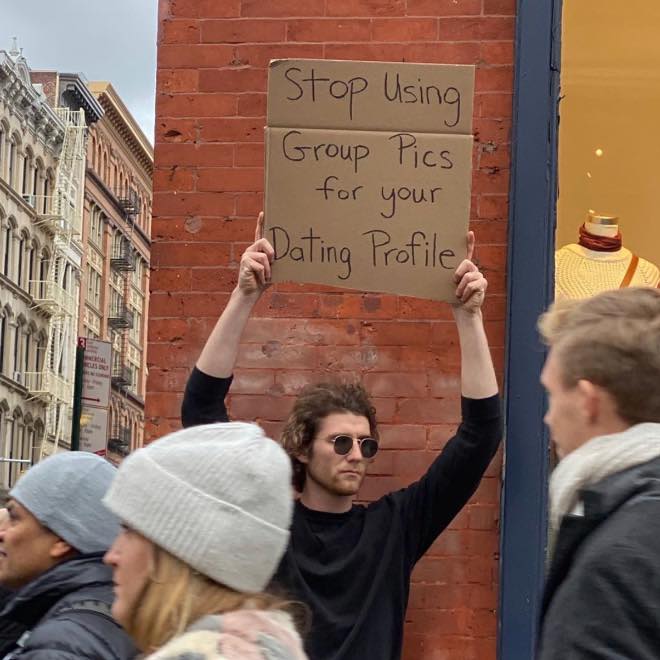
The image depicts a man standing on a city sidewalk holding a cardboard sign above his head. The sign reads, "Stop Using Group Pics for your Dating Profile." He is wearing sunglasses and a black long-sleeved shirt. He has dark hair and appears to be in his late 20s or early 30s. The background consists of a brick building and storefronts with reflections in the glass. Other pedestrians are partially visible around him, one wearing a grey knit hat and another with a tan scarf. The scene seems to be in an urban, possibly commercial, area. The lighting suggests a cloudy or overcast day. He is positioned to appear as if protesting, and the sign suggests a specific complaint related to online dating.
Foucauldian Genealogical Discourse Analysis
This image is fertile ground for Foucauldian analysis. The protest sign isn’t just about a preference; it's about power and the construction of the ‘self’ within the discourse of online dating.
- Discourse of Dating: Online dating apps create a specific discourse. They demand presentation of the self, standardization through photos and profiles, and a logic of 'matchability.' The man’s sign disrupts this discourse. He is attempting to regulate how others present themselves within it.
- Power/Knowledge: The “problem” of group photos isn’t inherent. It is constructed through the practices of dating apps and the subsequent frustrations of users. He’s asserting a particular kind of "knowledge" – that group photos are deceptive or create ambiguity – and attempting to exercise power over others to adhere to that perceived truth.
- Genealogy: A genealogical approach would trace the historical development of these dating norms. Why did photos become so central? What were the early forms of courtship, and how have they been transformed by technology? Examining these shifts would reveal how seemingly natural conventions (like needing to see a clear, individual photo) are actually historically contingent.
- Subjectification: The sign implicitly suggests that individuals who use group photos are being dishonest or trying to mislead. This is an act of subjectification - imposing a categorization and assessment upon others based on this practice. The man is attempting to define and constrain the ways individuals can position themselves within the dating landscape.
Critical Theory
The image can be interpreted through the lens of Critical Theory, particularly related to the commodification of self and the alienation of genuine connection.
- Commodification of Self: Dating apps encourage treating people as commodities - objects to be selected, sorted, and "matched" based on surface-level characteristics. The protest sign, while seemingly trivial, exposes a frustration with the difficulty of discerning the individual behind the curated profile. Group photos contribute to this difficulty, blurring the lines between the self and the collective.
- Alienation: Modern life, as Marxists and other critical theorists would argue, leads to alienation from oneself, from others, and from meaningful labor. Dating apps can exacerbate this. The superficiality of profile-based selection, combined with the fear of deception (highlighted by the sign), hinders the formation of authentic connections. The man's protest is a reaction to feeling disconnected or distrustful within this system.
- Ideology: The normalization of curated profiles, filters, and selective self-presentation represents an ideological operation. The man is pushing back against the expectation that individuals must present an idealized version of themselves.
Postmodernism
The image can be read as a commentary on the fragmented and constructed nature of identity in the postmodern era.
- Simulation and Hyperreality: The world of online dating is a form of simulation. Profiles are curated performances designed to create a desired impression. Group photos add another layer of abstraction, making it harder to discern the "real" person.
- Deconstruction of Meaning: The man's protest can be seen as a deconstruction of the meaning traditionally attached to photos as representations of identity. He is challenging the assumption that a photo should unequivocally identify an individual.
- Loss of the Authentic Self: Postmodern thought emphasizes the idea that there is no essential, stable self, only a series of performances and representations. The frustration with group photos could be seen as a symptom of this broader anxiety about the loss of the authentic self.
I hope this detailed analysis, broken down by theoretical lenses, is helpful! Let me know if you'd like me to expand on any of these points or explore other perspectives.
simple-description (llama3.2-vision)
This meme features a photo of a person holding a protest-style sign in a crowded area. The sign reads "Stop using group pics for your dating profiles" and is likely being held by someone who is frustrated with others using group photos as their primary profile picture on dating apps. The image is meant to be humorous and relatable, poking fun at the common practice of using group photos on dating profiles.
tesseract-ocr
ie eS I" : | Se J ey