First Seen
2023-05-10T21:03:36+00:00
simple-description (llama3.2-vision_11b)
The meme is a humorous take on the concept of Millenihilism, a philosophical idea that suggests the younger generation is more nihilistic and pessimistic about the future. The meme features an image of a group of people dancing, with the caption "when you realize you're going to die soon" and the text "I'm not arguing I'm just explaining why I won't be around to see the apocalypse". The meme is a lighthearted way to poke fun at the idea that younger generations are more pessimistic about the future, and that they may not be around to see the apocalypse.
detailed-analysis (gemma3-27b-vision)
Okay, here's an analysis of the meme, broken down into sections as requested. I will only include sections where the concepts demonstrably apply.
Visual Description
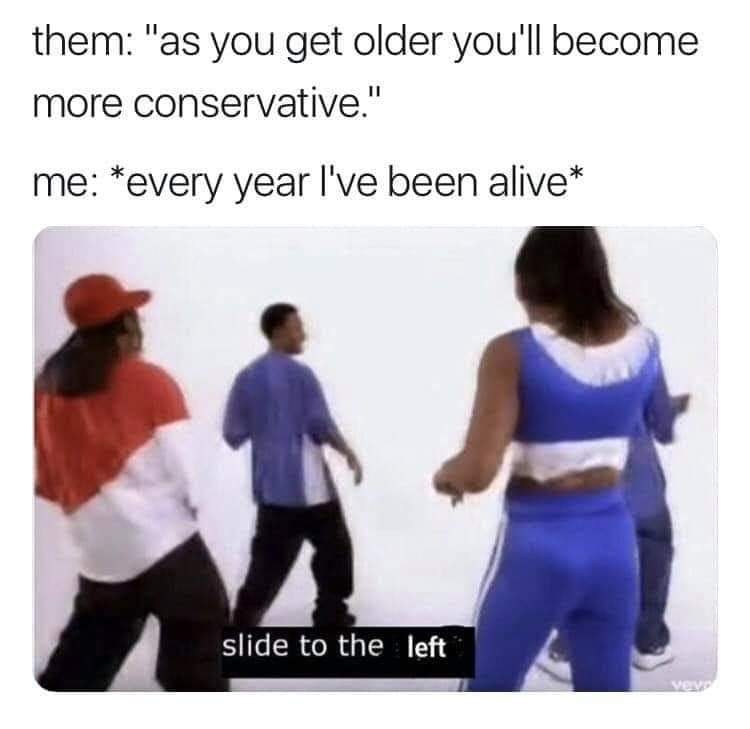
The meme consists of text overlaid on a still image taken from a viral video of Kel Mitchell (from the show All That and Kenan & Kel) performing a physical gag. Mitchell starts with a man (Kenan Thompson) standing between him and another man, and he slides across the floor, passing under Kenan Thompson’s arms, and ending up on the other side. The text overlay is a conversational exchange: “them: ‘as you get older you’ll become more conservative.’” and “me: every year I’ve been been alive” with the words “slide to the left” added to the bottom of the image. The use of the video is meant to visually represent someone shifting away from the perceived trajectory of becoming more conservative with age.
Foucauldian Genealogical Discourse Analysis
This meme engages with the discourse surrounding aging and political belief. Michel Foucault would be interested in how the idea that people "naturally" become more conservative with age is constructed as a truth through historical and social power dynamics. This isn't simply an organic process, but a way of normalizing a particular political trajectory.
- Genealogy: We can trace a genealogy of this claim. It's linked to ideas about maturity, responsibility, and accumulating wealth (which is often associated with conservative politics). Historically, the idea of "settling down" and embracing tradition has been used to encourage conformity and maintain the status quo.
- Power/Knowledge: The statement "you'll become more conservative" is a power/knowledge claim. It asserts a particular "truth" that can exert power by influencing how individuals perceive their own aging and political development. It subtly pressures people to conform to this expected trajectory.
- Disciplinary Power: The expectation of becoming more conservative can function as a form of disciplinary power. Individuals may internalize this expectation and self-regulate their beliefs to align with it, even if it doesn't reflect their true values.
- The Meme as Resistance: The meme’s visual and textual juxtaposition is a counter-discourse. By playfully illustrating a rejection of this expectation (“sliding to the left”), it challenges the normalizing effect of the original statement. It illustrates an active effort to resist being categorized within an expected political evolution.
Critical Theory
The meme can be analyzed through the lens of Critical Theory, particularly as it relates to the critique of ideology.
- Ideology: The statement "you'll become more conservative" can be seen as an expression of dominant ideology – a set of beliefs and values that serve to maintain the existing social order. This ideology presents conservatism as a natural, inevitable outcome of aging, masking the social, economic, and political forces that contribute to conservative viewpoints.
- False Consciousness: Critical Theory might argue that those who believe they are "naturally" becoming more conservative are experiencing a form of "false consciousness." They haven’t critically examined the factors shaping their beliefs and have internalized the values of the dominant culture.
- Emancipation: The meme, in its rejection of this supposed inevitability, can be seen as an attempt to disrupt this false consciousness and encourage individuals to critically examine their own beliefs, thus promoting a form of emancipation from ideological control. The act of “sliding” to the left is a visually expressive assertion of agency and resistance against a pre-defined trajectory.
Postmodernism
Postmodernism relates to this meme through the following:
- Rejection of Grand Narratives: The meme rejects the grand narrative that aging automatically leads to conservatism. It challenges the idea that there is a single, linear path of political development.
- Playfulness & Irony: The use of a silly, viral video clip demonstrates postmodern playfulness and irony. It rejects the seriousness with which the statement about aging and conservatism is often presented.
- Deconstruction of Meaning: The meme deconstructs the assumed link between age and political belief. It shows that this connection is not natural or inevitable, but a social construct.
- Subjectivity: The “me” in the meme asserts a subjective experience that deviates from the expected norm, emphasizing individual agency and the rejection of universal truths.
Queer Feminist Intersectional Analysis
While not the central theme, there are nuances that allow for a Queer Feminist Intersectional reading.
- Challenging Normative Aging: Feminists and queer theorists often critique normative expectations about life stages (including aging). The meme subverts the expectation of settling down and adopting traditional values (often associated with conservatism).
- Intersection of Age & Political Identity: This meme touches upon how age intersects with other identity categories, and how the expectation of political change with age can be particularly oppressive for those already marginalized.
- Resistance & Agency: The meme is a form of resistance against the pressure to conform to dominant ideologies. It affirms the agency of individuals to define their own political beliefs, regardless of their age. The image of “sliding” can be metaphorically interpreted as resisting being pinned down or boxed into pre-defined categories.
Let me know if you'd like me to elaborate on any of these points, or focus on a particular theoretical framework!
simple-description (llama3.2-vision)
This meme is a humorous take on the idea that as people age, they become more conservative. The image is a screenshot from a music video featuring a group of people dancing, but the caption "I'll be 40" is replaced with "I'll be dead". The text "I'll be dead" is written in a font that looks like it's coming from a video game, implying that the person is aware of their own mortality.
tesseract-ocr
them: "as you get older you'll become more conservative." me: *every year I've been alive* - . an yy y slide to the left ‘ i