First Seen
2023-05-10T21:03:36+00:00
simple-description (llama3.2-vision_11b)
The meme is a humorous take on the concept of Millenihilism, which is a philosophical idea that the current generation (Millennials) are apathetic and disconnected from the world. The meme features a screenshot of a conversation between a 13-year-old and a 30-year-old, where the 13-year-old is complaining about being forced to eat a "bland" and "boring" pizza, while the 30-year-old is sarcastically responding with a phrase that is often associated with nihilism.
detailed-analysis (gemma3-27b-vision)
Okay, here's an analysis of the image, broken down into the requested sections, considering which theoretical frameworks apply. It's important to note that applying these theories to a meme is often interpretative and playful, highlighting how theoretical frameworks can illuminate everyday cultural artifacts.
Visual Description
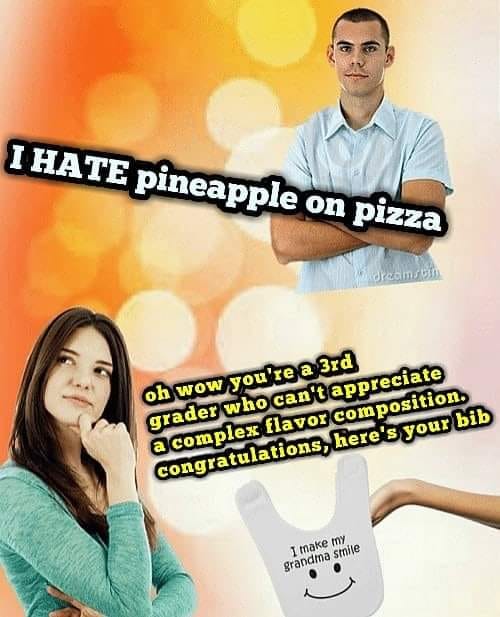
The image is a stock photo-based meme. It depicts two individuals, seemingly in a kitchen. On the left is a woman with dark hair, looking slightly downward with a pensive or irritated expression. She’s wearing a blue, short-sleeved top. On the right is a man with short dark hair, arms crossed in a judgmental pose, looking down on the woman. Overlaid on the image are text bubbles and text. At the top is a large text bubble declaring “I HATE pineapple on pizza”. Below the man is a text bubble reading “oh wow you're a 3rd grader who can't appreciate a complex flavor composition, congratulations, here's your bib”. Beneath the woman is an image of a baby's bib with the phrase "I make my grandma smile". The overall impression is one of condescension and a perceived conflict about taste. The setting seems domestic, with the kitchen adding to the sense of personal preference being debated.
Foucauldian Genealogical Discourse Analysis
This meme illustrates a power dynamic within the discourse of food preference. Michel Foucault’s genealogical approach would analyze how the "rules" for what constitutes "good" taste are constructed and enforced.
- Power/Knowledge: The man's response ("you’re a 3rd grader…") isn't simply about pineapple on pizza, it’s about asserting knowledge and therefore power through a claim of refined palate. He defines a certain kind of taste as “sophisticated” and implicitly positions those who disagree as less intelligent or less cultured. This is a power/knowledge structure – claiming a certain knowledge (of flavor) to establish authority.
- Discursive Formation: The debate over pineapple on pizza is a specific discursive formation – a set of rules, practices, and categories that constitute a particular way of talking and thinking about food. The meme highlights how this discourse is often driven by hierarchies of taste.
- Genealogy of Taste: A genealogical investigation might trace how notions of “good” food have developed historically, tied to class, colonialism, and cultural values. Why is certain food considered "sophisticated" while others are considered “childish?” The meme hints at this historical construction.
Critical Theory
The meme can be examined through the lens of Critical Theory, specifically focusing on ideology and the reproduction of social norms.
- Ideology: The man's response acts as a subtle expression of cultural capital. He suggests that liking pineapple on pizza indicates a lack of sophistication—a marker of cultural inferiority. This reinforces the idea that certain tastes are “better” than others, serving a function in maintaining social hierarchies.
- Domination and Resistance: The woman’s “I make my grandma smile” is a micro-act of resistance to this perceived cultural dominance. It suggests a valuing of personal, familial joy over adherence to arbitrary standards of taste. It's a reclaiming of agency and a rejection of being judged.
- Culture Industry: The use of a stock photo for a meme and its distribution through social media highlights the ways in which even seemingly trivial preferences are circulated and reproduced within the “culture industry.”
Marxist Conflict Theory
While a bit of a stretch, there’s a faint connection to Marxist conflict theory.
- Cultural Capital as a Form of Capital: The man's assertion of a "refined palate" can be seen as a display of cultural capital—a form of non-economic capital that can confer status and advantage.
- Class Distinction (Subtle): The implied hierarchy of taste hints at class distinctions. There's an unstated suggestion that "sophisticated" tastes are associated with higher social classes, while simpler preferences are associated with lower classes.
- False Consciousness: (Again, a bit of a stretch) One could argue that people who rigidly adhere to these arbitrary taste standards are demonstrating a form of false consciousness—being unaware of the social construction of these preferences and their role in reinforcing inequality.
Postmodernism
This meme exemplifies several postmodern characteristics:
- Deconstruction of Grand Narratives: The meme playfully challenges the idea of objective "good" taste. It implies that taste is subjective and socially constructed—rejecting the idea of universal culinary standards.
- Pastiche and Irony: The use of a stock photo combined with the exaggerated text bubbles creates a sense of irony and self-awareness. The meme doesn't take its own debate seriously, recognizing its absurdity.
- Subjectivity and Fragmentation: The meme underscores the idea that individual preferences are valid, even if they clash with others. It embraces the fragmentation of taste and the lack of a unified cultural standard.
- Hyperreality: The meme exists as a digitally shared image, divorced from the "real" experience of eating pizza. This contributes to the hyperreality – a simulation of reality that becomes more real than reality itself.
Queer Feminist Intersectional Analysis
This application is the most tenuous. However, you could interpret it through an intersectional lens, if you stretch the interpretation:
- Challenging Norms: The woman's defiant stance ("I make my grandma smile") could be seen as a rejection of societal pressure to conform to dominant tastes (a parallel to rejecting normative expectations in other areas of life).
- Valuing Personal Experience: The emphasis on personal enjoyment ("making grandma smile") emphasizes the validity of subjective experiences and resisting external judgment.
- Dismissal of “Expert” Opinion: The man's condescending tone and assertion of superiority aligns with broader patterns of men dismissing women's opinions or preferences. The meme could be read as subtly satirizing this dynamic.
Important Note: It’s important to recognize that these analyses are interpretations. Applying complex theoretical frameworks to a lighthearted meme is a way of demonstrating how these frameworks can be used to understand everyday culture, but it’s also important to avoid overstretching the analysis. The meme is ultimately a humorous commentary on taste, but it offers a surprisingly rich ground for theoretical exploration.
simple-description (llama3.2-vision)
This meme features a person expressing their dislike for pineapple on pizza, which is a common topic of debate. The text "I HATE pineapple on pizza" is prominently displayed. The meme also includes a humorous response from a 3rd grader, who expresses a sarcastic and unimpressed opinion about the person's dislike.
tesseract-ocr
(ze ) we ATE Pest \f ws) f nea \ WZ hy I) by SP ll C a Jane i. Oy ppsasee gyi) Ay ™ } qo CL co eee \ ae Co ee Cia y ( STO Roe coe ri) 7 ~~ \ we) —- ~<_ r K ee