First Seen
2023-05-10T21:03:36+00:00
simple-description (llama3.2-vision_11b)
The meme is a play on the concept of "millenialism," which refers to the idea that the younger generation is more focused on the present and less concerned with the long-term consequences of their actions. The image is likely a humorous illustration of a young person (perhaps a "millenial") who is more concerned with taking a selfie and getting a good angle for Instagram than with preserving the environment for future generations. The text "I'm not a millenial, I'm a millenialism" is likely a humorous way of saying that the person is more concerned with their own self-image and social media presence than with making a positive impact on the environment.
detailed-analysis (gemma3-27b-vision)
Okay, here's an analysis of the image, broken down into sections based on the requested theoretical frameworks. It's a complex image, intentionally layered with generational meta-commentary. Because some of the frameworks don't neatly apply, I'll note where that is the case.
Visual Description
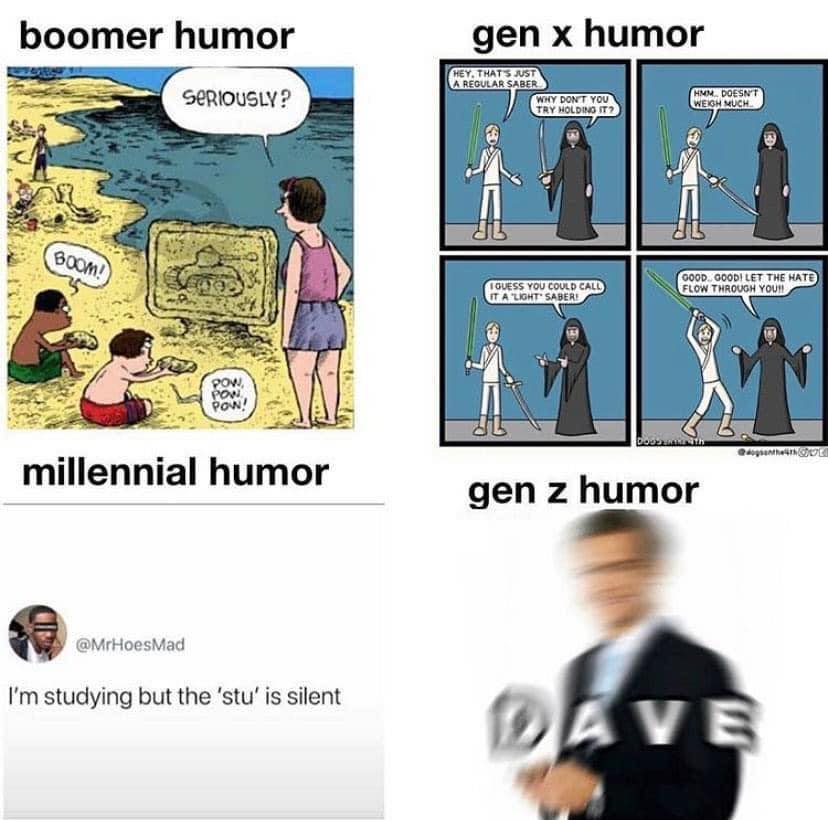
The image is a four-panel meme compilation showcasing humorous representations associated with four different generations: Boomers, Gen X, Millennials, and Gen Z.
- Boomer Humor: Depicts a cartoonish scene of a man standing in a field, seemingly bewildered, while children are aggressively hitting him with sticks. A speech bubble reads "Seriously?"
- Gen X Humor: A four-panel comic strip using minimalistic black and white drawing. A character in a black robe (a Darth Vader-esque figure) is questioned about his lightsaber. The responses are deadpan and understated, culminating in a sinister affirmation of the “Dark Side.”
- Millennial Humor: Shows a Twitter screenshot from the account @MrHoesMad stating: “I’m studying but the ‘stu’ is silent”. This refers to a running internet meme where millennials have reclaimed the pronunciation of the word “study” to be only “stu”.
- Gen Z Humor: Features a black and white photograph of a person wearing a suit with "DAVE" printed across the front. The person's face is contorted in an exaggerated, almost anguished expression. It's a reference to a viral trend of taking dramatic photos with the name "Dave" on clothing.
Foucauldian Genealogical Discourse Analysis
This meme offers fertile ground for a Foucauldian analysis. The representations of each generation construct specific discourses about identity and behavior.
- Power/Knowledge: Each meme functions as a power/knowledge operation. The “humor” isn’t inherent; it’s produced by the association of certain traits with each generation. The “Boomer” image constructs a discourse of oblivious entitlement and victimization. The Gen X image constructs an aloof, sardonic intellectualism. Millennial discourse is about internal, self-aware irony. Gen Z embodies a performative, exaggerated emotionality.
- Genealogy: We can trace the genealogy of these representations: the Boomer image draws on stereotypes of aging, conservative figures; Gen X on 90s counterculture; Millennials on internet culture and the rise of self-deprecating humor, and Gen Z on the increased visibility of irony, cynicism, and emotional display through social media. These aren't fixed, essential qualities, but historical constructions.
- Disciplinary Power: The meme can be seen as an instance of disciplinary power: by labeling and categorizing generations, it enforces norms and expectations. The 'humor' arises from the perceived deviation from these norms, or the affirmation of them.
Critical Theory (Frankfurt School)
The image can be analyzed through the lens of Critical Theory, particularly the Frankfurt School's critique of mass culture.
- Culture Industry: The meme itself is a product of the “culture industry,” a commodified form of entertainment and social commentary. Its purpose is not necessarily to critique society, but to perpetuate its existing structures through the guise of humor.
- False Consciousness: The meme reinforces a kind of “generational consciousness,” creating artificial divisions and obscuring underlying social and economic inequalities. It focuses on superficial differences in attitude and behavior while ignoring the structural forces that shape these characteristics.
- Commodification of Authenticity: The meme's humor relies on the commodification of "authenticity." Each generation is reduced to a set of easily digestible stereotypes, packaged and consumed as entertainment.
Marxist Conflict Theory
While not a primary focus, a Marxist reading can identify underlying tensions.
- Class and Generational Conflict: The meme subtly highlights conflicts between generations, potentially reflecting anxieties about shifting power dynamics, economic conditions, and social values. Each generation has experienced different economic and political conditions, leading to divergent perspectives and interests.
- Ideology: The meme can be seen as a form of ideological reinforcement, perpetuating certain beliefs and values about each generation. The perceived characteristics of each generation may serve to justify existing social hierarchies or inequalities.
Postmodernism
Postmodern themes are heavily present.
- Irony & Parody: The meme relies heavily on irony and parody. It doesn't take itself seriously and actively mocks the very idea of categorizing and defining generations.
- Meta-Commentary: The meme is a form of meta-commentary, commenting on itself and on the ways in which we create and consume humor. It acknowledges the artificiality of the categories it presents.
- Deconstruction of Meaning: The meme deconstructs the idea of a coherent generational identity. It suggests that there is no essential “Boomer,” “Gen X,” “Millennial,” or “Gen Z,” only a collection of fragmented and contradictory representations.
- Simulacra and Simulation: The meme presents simulacra of generational identities—copies without originals. The representations are more real than the realities they supposedly reflect.
Queer Feminist Intersectional Analysis
This framework is the least directly applicable, but we can still find points of connection.
- Performance and Identity: The Gen Z image, with its exaggerated expression and performative display, can be analyzed through a queer lens, as a deliberate disruption of traditional norms and expectations.
- Challenging Categorization: The meme's overall critique of categorization aligns with queer and feminist critiques of essentialism and fixed identities.
- Intersectionality: (More subtly) Generational identity intersects with other identities (race, class, gender, sexuality). The meme may reinforce certain stereotypes about these intersections. For example, the “Boomer” image often evokes assumptions about white, middle-class privilege.
In conclusion:
This meme is a sophisticated piece of meta-commentary that draws on multiple theoretical frameworks. It’s not simply a humorous observation about generational differences; it’s a commentary on the ways in which we construct, categorize, and consume identities in the digital age. Its strength lies in its layering of meanings and its ability to provoke critical reflection on the very systems that shape our perceptions of the world.
Let me know if you'd like me to expand on any of these points or analyze a specific aspect of the image in more detail.
simple-description (llama3.2-vision)
The meme is a humorous illustration of a family playing with a sandcastle on the beach. A child is excitedly saying "I'm building a castle!" while another child is destroying it with a shovel. The text "I'm building a castle!" is written in a speech bubble above the child's head. The image is captioned "I'm building a castle!" with a series of subsequent captions, each showing the child's castle being destroyed in a different way, with the final caption reading "I'm building a castle!" again.
tesseract-ocr
boomer humor gen x humor a SeRiousiy? 4 SB Wie ¢ BK H ‘ts 4 D ye Ga E S04”) Sess | » Fo00D.. GOOD! LET THE HATE 2) | / Ge Fae ae RoW Re millennial humor gen z humor 2 & aMrHoesMad I'm studying but the ‘stu’ is silent f Z ww ww