First Seen
2023-05-10T21:03:36+00:00
simple-description (llama3.2-vision_11b)
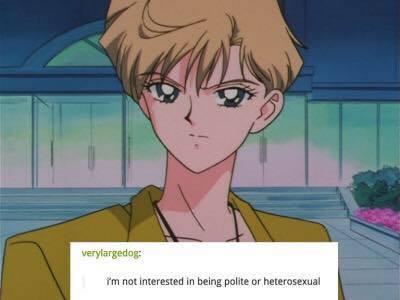
This meme is a screenshot from a 2000s anime-style video game, likely a visual novel or dating sim, where a character has a straightforward and slightly awkward confession. The text in the image reads "I'm not into girls" and "I'm not into boys", implying a lack of interest in romantic or sexual relationships, often referred to as "a-sexuality" or "abstention". The meme is likely used to humorously express disinterest in romantic or social interactions.
detailed-analysis (gemma3-27b-vision)
Okay, let's break down this image and the text overlay through several theoretical lenses.
Visual Description
The image is a screencap from an anime, specifically Sailor Moon. It depicts a young man, identified as Mamoru Chiba (also known as Tuxedo Mask), gazing with a slightly melancholic or defiant expression. He has short, blonde hair, large expressive eyes, and is wearing a yellow/gold suit or jacket. The background is a brightly coloured, stylized depiction of an interior space, potentially a school or castle. The image has a distinct 90s anime aesthetic, characterized by bold lines and vibrant colours. There is a text overlay in a yellow box: "verylargedog: I'm not interested in being polite or heterosexual".
Foucauldian Genealogical Discourse Analysis
This image, when paired with the text, becomes a site for examining power dynamics through a Foucauldian lens. The statement, "I'm not interested in being polite or heterosexual", challenges the discourses that have historically defined both "politeness" and "heterosexuality".
- Politeness as Discourse: Foucault argues that power isn't just repressive but productive. "Politeness" isn't a natural behavior but a set of social rules and expectations that have been historically constructed and enforced to maintain social order and hierarchy. By explicitly rejecting politeness, the statement disrupts these established power dynamics.
- Heteronormativity as Discourse: The rejection of heterosexuality goes further, destabilizing the dominant discourse that positions heterosexuality as the natural, normal, and desirable sexual orientation. Foucault would see this as a challenge to the "regime of truth" that has constructed heterosexuality as the standard. The statement implicitly questions the power structures that enforce this norm.
- Genealogy & Power: A genealogical analysis might investigate how these discourses (politeness, heteronormativity) came to be. It would trace the historical development of these concepts, revealing the institutions, practices, and social forces that have shaped them. The statement itself can be seen as an act of resistance, a "counter-discourse" challenging the established order.
Queer Feminist Intersectional Analysis
This image and text is ripe for a Queer Feminist Intersectional reading. The rejection of both politeness and heterosexuality simultaneously challenges traditional power structures.
- Intersectionality: The statement isn't just about sexual orientation, but also about resisting social expectations generally. "Politeness," especially as it's often enforced upon women and marginalized groups, can function as a tool of control. The refusal to be polite can be seen as an assertion of agency and a rejection of patriarchal expectations.
- Queer Resistance: The explicit rejection of heterosexuality aligns with queer theory's challenge to the binary categorization of sexual orientation and the dominant norms of heteronormativity. This could be read as an embrace of non-normative desires and identities, and a challenge to the systems that marginalize LGBTQ+ individuals.
- Feminist Dimensions: Often, politeness is associated with a "gendered script" where women are expected to be accommodating, agreeable, and prioritize the comfort of others over their own needs. Rejecting politeness can therefore be a feminist act of reclaiming agency and self-expression. The combination with challenging heterosexuality suggests a broader rejection of restrictive societal roles and expectations.
- Mamoru Chiba as a Character: Interestingly, the character himself has a complex role in the Sailor Moon universe, often blurring gender roles and challenging traditional masculine expectations. This makes the overlay particularly resonant.
Postmodernism
A postmodern reading of this image focuses on the disruption of grand narratives and the celebration of subjectivity.
- Deconstruction of Norms: The statement is a deliberate act of deconstruction. It challenges the presumed stability of categories like “politeness” and “heterosexuality” by refusing to adhere to them. Postmodernism rejects the idea of universal truths and stable meanings, embracing ambiguity and multiple interpretations.
- Subjectivity & Agency: The statement is a powerful expression of individual subjectivity. It asserts the speaker's right to define themselves on their own terms, rather than conforming to external expectations.
- Rejection of Meta-Narratives: The rejection of both politeness and heterosexuality dismantles the grand narrative of societal norms. It signals a move away from a top-down understanding of social order and toward a more fragmented, pluralistic perspective.
Critical Theory
This image and text can be viewed through a Critical Theory lens as a statement of resistance against systems of domination.
- Dominant Ideology: The rejection of politeness and heterosexuality challenges the dominant ideology that maintains social control. The quote acts as a pushback against the normalization of these concepts.
- Emancipation: The speaker is asserting their autonomy and resisting the forces that seek to constrain them. This can be seen as a step toward emancipation from oppressive systems.
- Power Dynamics: Critical Theory examines how power operates within society. This image highlights the ways in which power is exercised through social norms and expectations, and how individuals can resist these forces.
Marxist Conflict Theory
While less direct, a Marxist analysis could consider the ways in which "politeness" and "heteronormativity" serve to reinforce class structures and capitalist exploitation.
- Social Control & Labor: Politeness can be seen as a mechanism of social control, ensuring a smooth-running workforce and minimizing disruption to the capitalist system. Rejecting politeness can be seen as a form of resistance against this control.
- Reproduction of Ideology: Heteronormativity reinforces traditional family structures, which are seen as essential for the reproduction of labor power. By rejecting heterosexuality, the statement challenges this system.
- Class and Identity: The interplay between class, gender and sexuality creates distinct power dynamics. Challenging heteronormative expectations is potentially linked to a broader resistance against the capitalist system.
I hope this breakdown of the image and text through various theoretical lenses is comprehensive and insightful. Let me know if you would like me to elaborate on any specific aspect!
simple-description (llama3.2-vision)
This meme is an image of a character from a Japanese anime series, specifically Ran Shibasaki from the anime "Sailor Moon". The text overlay on the image reads "I'm not interested in being polite or heterosexual" in a bold, black font. The image is likely a humorous or sarcastic take on the character's personality, poking fun at her strict and uptight nature.
tesseract-ocr
verylargedog: ‘Fm not interested in being polite or heterosexual