First Seen
2023-05-10T21:03:36+00:00
simple-description (llama3.2-vision_11b)
The meme is a play on the concept of Millenihilism, a term coined to describe the idea that younger generations are more nihilistic and pessimistic about the future. The image shows a person holding a sign that says "I'd rather be unemployed and have a 401(k) than work for a company that doesn't provide one" with a caption that reads "The economy is fine, we just need to get rid of the people who are holding us back". The meme is poking fun at the idea that the economy is doing well, but that's only because of the lack of jobs and the struggle of many people to make ends meet.
detailed-analysis (gemma3-27b-vision)
Okay, here's an analysis of the image using the frameworks you've requested. I'll include sections only where the frameworks are relevant. Given the nature of the image, Marxist Conflict Theory and Critical Theory are central, while Postmodernism and Queer Feminist Intersectional Analysis are less directly applicable but still offer potential points of engagement.
Visual Description
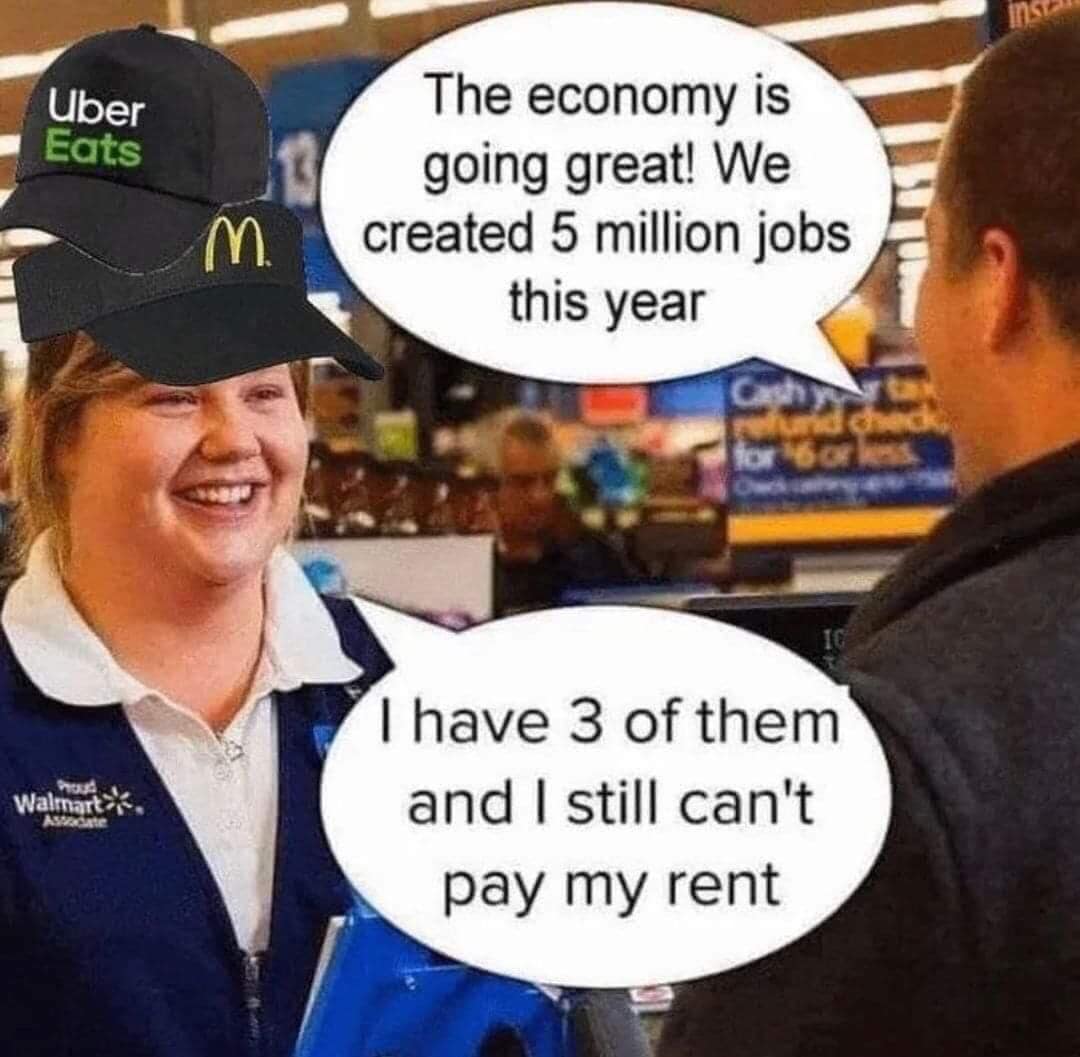
The image is a meme-style graphic depicting a conversation between two people at a Walmart checkout.
- Person 1: A Walmart employee, wearing a blue uniform vest and a visible name tag, is smiling brightly. They are also wearing hats for Uber Eats and McDonald's, indicating they are working multiple "gig economy" jobs.
- Person 2: A person (only their shoulder and head are visible) standing in line at the checkout. They appear to be somewhat somber and less enthusiastic than the employee.
- Text Bubbles:
- Employee: "The economy is going great! We created 5 million jobs this year."
- Customer: "I have 3 of them and still can't pay my rent."
- Setting: The Walmart checkout lane. Visible on the counter is a sign advertising cashback.
- Overall Impression: The meme is designed to be ironic and highlights the disconnect between official economic narratives and the lived experiences of many workers. The bright, almost manic, smile of the employee contrasts with the customer's frustration.
Marxist Conflict Theory
This image is highly resonant with Marxist Conflict Theory. It explicitly illustrates the core tenet of this theory: the inherent tension between the bourgeoisie (the owners of the means of production) and the proletariat (the working class).
- Exploitation of Labor: The employee's statement about "5 million jobs created" is presented as a metric of economic success, but the customer’s response reveals the reality for many who fill those jobs: even multiple jobs are insufficient to afford basic needs like rent. This demonstrates the exploitation of labor – workers are creating value (profit for Walmart, Uber Eats, and McDonald's) but are not receiving a proportionate share in the resulting wealth.
- Alienation: The customer experiences alienation, a core Marxist concept. They are separated from the fruits of their labor and are reduced to a means of production, unable to achieve meaningful economic security despite working. The multiple jobs themselves suggest a fragmented and precarious existence, furthering alienation.
- False Consciousness: The employee’s enthusiastic proclamation can be read as an example of "false consciousness". They are seemingly convinced of the economic prosperity, despite their own precarious working conditions. This can be attributed to indoctrination through dominant ideologies which prioritize profits over worker wellbeing.
- Class Struggle: The conversation is a micro-level illustration of class struggle – the inherent antagonism between those who control capital and those who sell their labor. The customer’s frustration implicitly challenges the narrative of economic success that benefits the owning class.
Critical Theory
The image lends itself well to analysis through the lens of Critical Theory, specifically its focus on power structures and ideology.
- Ideology and Hegemony: The employee’s statement represents a dominant ideology – the belief that economic growth (measured by job creation) automatically translates to overall well-being. This ideology is promoted by those in power (corporations, governments) and achieves hegemony – it becomes normalized and accepted as common sense, obscuring the underlying inequalities. The customer's response punctures this hegemonic narrative.
- Power Dynamics: The conversation reveals a clear power dynamic. The employee, as a representative of the corporations, is positioned as the voice of economic optimism, while the customer, as a worker struggling to make ends meet, represents a marginalized perspective.
- Deconstruction of Metanarratives: The meme deconstructs the metanarrative of unending economic growth. It suggests that simplistic measures of success (like job creation numbers) are inadequate and fail to capture the lived experiences of many.
- Social Critique: The image offers a sharp social critique of the contemporary economic system. It challenges the assumption that economic growth automatically benefits all members of society, highlighting the inequalities and precarity faced by a growing segment of the workforce.
Postmodernism
While less central than the previous analyses, a postmodern reading is possible.
- Fragmentation and Simulacra: The employee working for multiple gig economy companies (Uber Eats, McDonald’s, Walmart) exemplifies the fragmented nature of modern work and identity. Their job titles are almost performative – simulacra representing labor without necessarily guaranteeing stability or benefits.
- Deconstruction of Meaning: The meme deconstructs the traditional meaning of "success." It questions the idea that economic indicators accurately reflect individual well-being.
- Ironic Discourse: The use of irony (the employee's overly enthusiastic statement contrasted with the customer's reality) is a hallmark of postmodern discourse. It invites viewers to question the sincerity of official narratives.
Queer Feminist Intersectional Analysis
This framework is the least directly applicable, but offers some potential angles.
- Precarity and Marginalization: The customer’s inability to afford rent despite multiple jobs points to the increased economic precarity faced by marginalized groups, including women, people of color, and LGBTQ+ individuals, who are disproportionately represented in low-wage jobs.
- Intersection of Labor and Identity: The image implicitly acknowledges that labor isn’t experienced in a vacuum. The customer's struggle is likely compounded by other forms of oppression based on their gender, race, sexual orientation, or other aspects of their identity.
- Exploitation of Care Work: If the customer is a caregiver (e.g., for children or elderly relatives), their economic struggle is further complicated by the devaluation of unpaid care work.
In conclusion, this meme is a powerful commentary on the inequalities of the modern economy. It is particularly well-suited to analysis through Marxist Conflict Theory and Critical Theory, which highlight the inherent tensions between capital and labor, the role of ideology in perpetuating inequality, and the need for social critique. While Postmodernism and Queer Feminist Intersectional Analysis offer less direct connections, they can provide additional layers of interpretation, emphasizing the fragmentation of modern life and the intersectional nature of economic precarity.
simple-description (llama3.2-vision)
The meme is a humorous conversation between a Walmart employee and a customer. The customer says "The economy is going great" and the employee responds with "I have 3 of them and I still can't pay my rent". The meme is a satirical commentary on the state of the economy and the struggles of low-wage workers.
tesseract-ocr
_ a ° Wa The economy is ee §— going great! We ys _ Aiwa created 5 million jobs | 3 this year ' i = ~\m Pike r ’ E ‘ak SP o 4 - — 4 be ). —— e / ’| have 3 of them Cae and | still can't P pay my rent