First Seen
2023-05-10T21:03:36+00:00
simple-description (llama3.2-vision_11b)
The meme is a photo of a vintage cash register with a handwritten note that says "I'm sorry" and a price tag that says "$1.00". This is a humorous example of a "Millenial" (person born in the 90s) taking a nostalgic approach to shopping, with the cash register being a relic of the past and the price being a ridiculously low amount.
detailed-analysis (gemma3-27b-vision)
Okay, here's an analysis of the image, broken down into sections based on the requested theoretical frameworks. I'll only include sections where the framework seems applicable to the image's content and context. I'll try to be as thorough as possible within the scope of a single image.
Visual Description
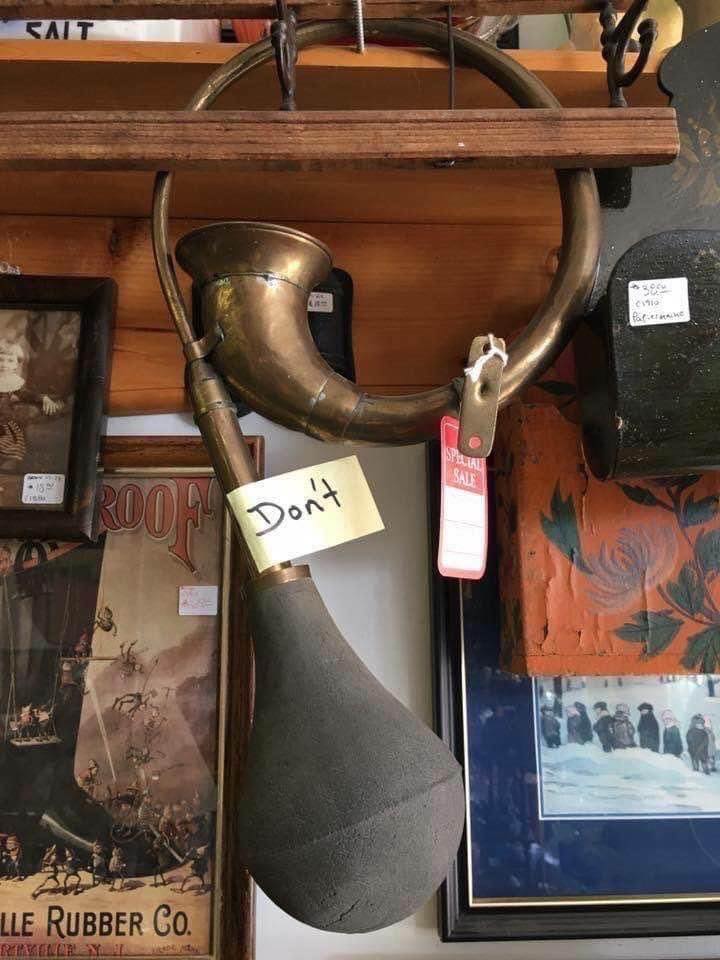
The photograph captures a vignette within what appears to be an antique or second-hand shop. The central focus is a large, vintage brass horn or speaking trumpet. It's dramatically curved and appears to be mounted or suspended as a display item. Attached to the horn is a small, handwritten yellow sign with the word "Don't" on it. The horn is surrounded by framed prints and posters.
To the left is a framed image featuring a person in historical dress. The bottom portion of a colorful, vintage poster advertising "ALLE RUBBER CO." is partially visible below the horn. To the right, there's a framed print of an autumnal landscape with a floral design and people in period clothing. Price tags (with handwritten price information) are visible on the surrounding items, indicating a commercial setting. The background features wooden paneling or shelves, suggesting an older establishment. The image is a little cluttered, reinforcing the sense of a crammed antique store. The lighting appears to be ambient and somewhat dim.
Foucauldian Genealogical Discourse Analysis
This image offers a compelling entry point for a Foucauldian analysis. The antique horn is not simply an object; it is a site where discourses of power, knowledge, and control are materialized.
- Discourse of Communication & Authority: The horn, historically, was a device used to amplify a voice, projecting authority over distance. It represents a specific historical mode of communication where one voice dominated. The "Don't" sign disrupts this function. The sign is an assertion of prohibition, a form of control. It tells us what is not allowed, which implies an underlying power structure attempting to manage access or behavior.
- The Archive & Memory: Antique stores, like the setting here, act as archives – collections of objects that embody particular historical moments and ways of life. The horn is a material trace of a time when public speaking relied on different technologies, different social norms, and likely, different power dynamics. The preservation of these objects is a selective process, constructing a particular version of the past.
- Discipline & Surveillance: The "Don't" sign can be viewed as a micro-exercise of discipline. It is a localized attempt to regulate behavior within the space of the shop. While seemingly minor, it points to a broader network of rules and expectations governing our interactions with objects and spaces.
- Genealogy of Prohibition: Tracing the genealogy of the "Don't" reveals not just the immediate prohibition (don't touch, don't use), but the broader history of restrictions, ownership, and control over material culture. Why is this horn deemed "fragile" or "valuable" enough to require a warning? The answer lies in a web of economic, aesthetic, and social values.
Critical Theory
From a Critical Theory perspective (drawing on the Frankfurt School, Adorno, Horkheimer), this image reveals aspects of commodity fetishism and the reification of the past.
- Commodity Fetishism: The antique horn, divorced from its original use and context, has been transformed into a commodity, an object of aesthetic value and economic exchange. Its "aura" (Walter Benjamin) has been altered, focusing less on its functionality and more on its historical novelty or perceived beauty. The price tag reinforces this commodification.
- Reification of History: The antique store itself presents a reified version of the past. History is reduced to a collection of objects, stripped of its complexity and presented as a curated spectacle. This can create a distorted understanding of the past, emphasizing aesthetics over social realities.
- Culture Industry: The shop functions as a small-scale element of the "culture industry." It packages and sells fragments of the past as consumer goods, potentially contributing to a superficial engagement with history and culture.
- Alienation: The "Don't" sign contributes to a sense of alienation. We are distanced from the object, prohibited from fully engaging with it. This reinforces a passive consumer role rather than active participation in cultural heritage.
Marxist Conflict Theory
Through a Marxist lens, the image highlights class dynamics and the commodification of history for profit.
- Ownership and Control: The antique shop, as a commercial enterprise, represents a system of ownership and control over material culture. The shop owner exercises control over these objects, determining their value and accessibility.
- The Exploitation of History: The vintage objects, including the horn, are presented as commodities for sale. This can be seen as a form of exploitation of the past, turning historical artifacts into sources of profit.
- Class and Access: The prices of the items (implied by the price tags) limit access to these historical objects to those with sufficient economic resources. This reinforces class divisions and creates a hierarchy of cultural consumption.
- Labor & Production: While the horn is vintage, the labor of the shop owner (curation, cleaning, pricing, display) and potentially restoration work contribute to its value. This highlights the ongoing labor embedded in the commodity.
I hope this provides a reasonably comprehensive analysis based on your requested theoretical frameworks. Let me know if you'd like me to expand on any particular aspect or explore additional perspectives.
simple-description (llama3.2-vision)
This meme is a picture of a old-fashioned, brass horn with a sign that says "Don't" attached to it. The horn is likely being used as a humorous warning sign, implying that someone should not use it or make a loud noise with it. The text "Don't" is a clear and direct warning, implying that the horn is not to be used or is not in working condition.
tesseract-ocr
a, =. | ie | ia ae ee , Se SS | 4 } . Ss iy — \ a if =f 7 | ew“. % — | hi ——— * ums a de ee | eee \ ee a i ine lo a