First Seen
2023-05-10T21:03:36+00:00
simple-description (llama3.2-vision_11b)
I couldn't find any information on the meme "Millenihilism" or a meme with the text "I don't own a home, I just rent one and my landlord is my dad". It's possible that this is a user-generated meme or a joke that hasn't gained widespread popularity. If you could provide more context or information about the meme, I'd be happy to help you understand it.
detailed-analysis (gemma3-27b-vision)
Okay, here's an analysis of the image and headline provided, broken down into the requested sections, acknowledging that some sections will be more relevant/applicable than others. I’ll focus on analytical angles, interpreting what the image and headline suggest rather than simply describing it.
1. Visual Description
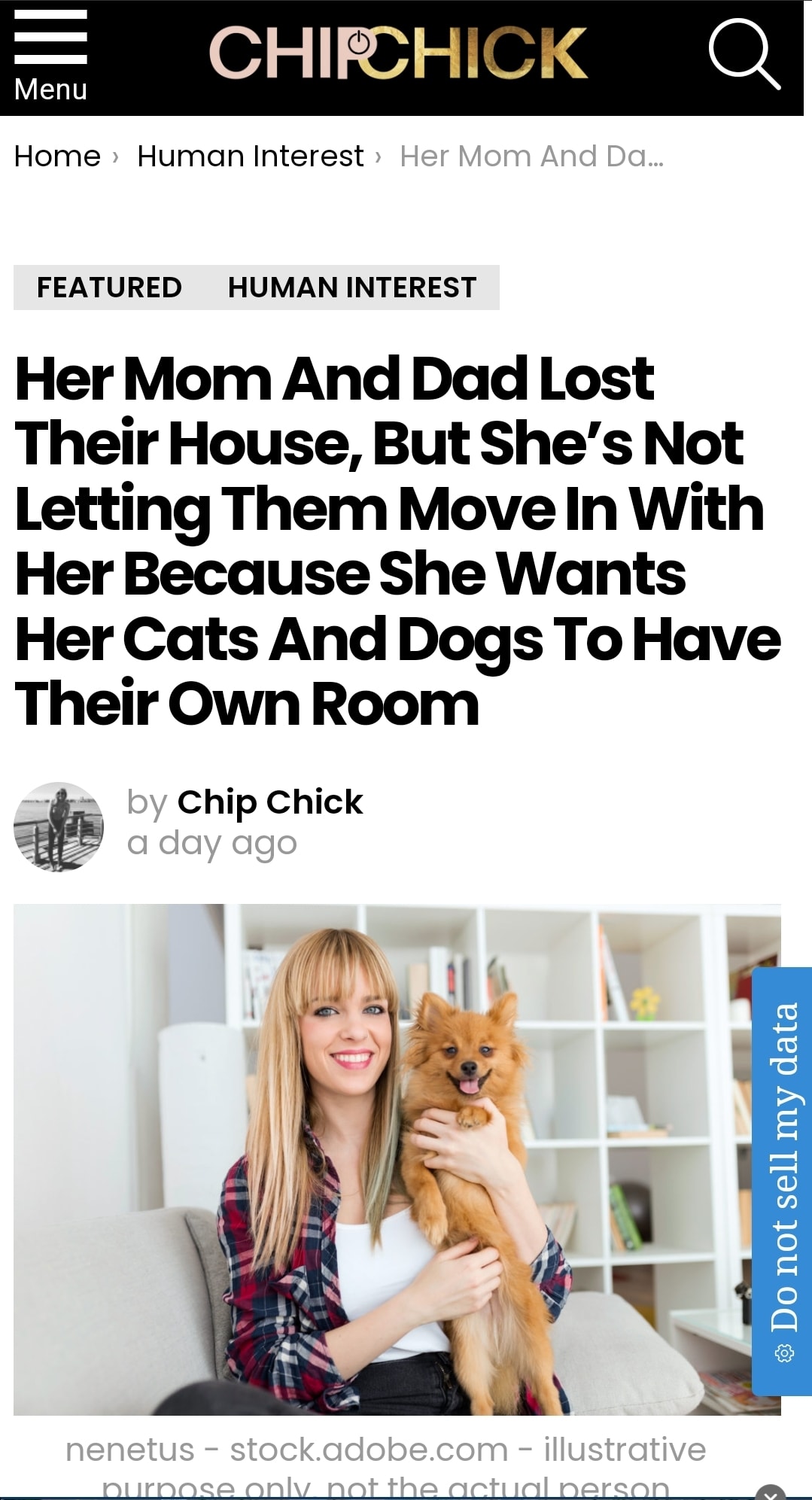
The image features a blonde woman smiling and looking down at a small, light-colored dog she's holding. She is indoors, seemingly in a living room setting. The background includes bookshelves filled with books and colorful items (suggesting a bright, visually stimulating environment). The woman is wearing a checkered button-down shirt, and her overall presentation is fairly polished and conventional. The composition of the photo feels intentionally curated, like stock photography aimed at conveying a sense of comfort and domesticity. The overall lighting is bright and cheerful.
2. Foucauldian Genealogical Discourse Analysis
The headline and image create a discourse around domesticity, family obligation, and animal companionship. Foucauldian analysis would explore the historical power/knowledge systems that have shaped these concepts.
- Discipline and Normalization: The expectation that adult children should take in their parents when they lose their home is rooted in a historically-constructed norm of familial responsibility. The "problem" is not the parents losing their home, but the daughter's refusal to conform to this expectation, potentially disrupting the established order.
- Power Relations: The daughter wields power in this situation by asserting her boundaries and defining her own priorities (the comfort of her pets). This challenges the assumed power dynamic where parents typically have authority over children. It also hints at a power dynamic within the family, where the daughter is perhaps asserting agency after a lifetime of potentially navigating a traditional family structure.
- Genealogy of "Home": The idea of "home" itself is not a natural given. It’s a historically constructed concept tied to ideas of family, property, and comfort. This headline subtly reveals how a person's definition of "home" can diverge from traditional understandings. Is "home" about blood relations, or about creating a specific environment of comfort for oneself and one's chosen companions?
3. Critical Theory
- Commodification of Affection: The image feels deliberately "lifestyle-branded" – suggesting a focus on curated self-expression and a consumption-driven culture. The prioritization of pet comfort could be seen as an extension of this, where pets become objects of affection that require specialized care and commodities.
- Critique of Traditional Family Structures: The headline challenges the assumption that family ties are inherently unconditional. The daughter is prioritizing her own needs and desires (and those of her pets) over the assumed obligation to care for her parents. This can be seen as a critique of traditional, patriarchal family structures that often prioritize familial duty over individual autonomy.
- Ideology of Pet Ownership: The headline subtly reinforces the idea that pets are family members deserving of dedicated space and care. While seemingly benign, this can be analyzed as part of a larger cultural shift in how we view animals – from utilitarian objects to emotionally valued companions.
4. Marxist Conflict Theory
This area is less directly applicable, but a brief connection can be made.
- Resource Control: The conflict (parents needing a place to live vs. daughter’s desire for pet space) can be seen as a struggle over limited resources – space, comfort, and control over the domestic environment. The daughter is defending her "territory" and her chosen way of life.
- Bourgeois Lifestyle: The curated, bright, visually-stimulating environment suggests a level of comfort and disposable income. The daughter prioritizes her "lifestyle" and comfort, which can be seen as indicative of a particular class position.
5. Postmodernism
- Rejection of Grand Narratives: The headline subverts the "grand narrative" of unconditional filial piety. It suggests that family relationships are complex, contingent, and subject to individual interpretation.
- Emphasis on Subjectivity: The daughter's decision is presented as a matter of personal preference and boundary setting. The headline highlights the subjective experience of creating a “home” and defining one’s own values.
- Fragmentation of Meaning: The seemingly “absurd” juxtaposition of parents losing their home and the daughter prioritizing her pets’ space challenges traditional notions of morality and duty. It embraces the idea that meaning is constructed, not inherent.
6. Queer Feminist Intersectional Analysis
- Challenging Domestic Norms: A queer feminist perspective would analyze how this story subverts conventional expectations of women's roles within the family. Traditionally, women are often positioned as caregivers and expected to prioritize the needs of others, especially family members. The daughter’s refusal to conform to this expectation can be read as a form of resistance.
- Boundary Setting as Self-Care: The daughter's decision to prioritize her and her pets' comfort can be framed as an act of self-care and boundary setting, a concept central to feminist thought.
- Intersectional Considerations: The story doesn't offer enough detail for a full intersectional analysis. It would be important to consider the daughter's race, class, sexuality, and any other relevant social identities to understand the complexities of her situation and her decision-making process. For example, is there a difference in how a white daughter and a daughter of color might navigate these familial obligations?
Disclaimer: This analysis is based solely on the provided image and headline. A more comprehensive analysis would require further context and information. I have attempted to demonstrate how different theoretical frameworks can be applied to interpret this seemingly simple piece of media.
simple-description (llama3.2-vision)
The meme is a screenshot of an article on the website "Chick" (formerly "Chick" and "Chick") with a provocative headline: "Her Mom And Dad Lost Their House, But She's Not Letting Them Move In With Her Because She Wants Her Cats And Dogs To Have Their Own Room." The article is a satirical take on a common situation where a child is prioritizing her pets' needs over her parents' financial struggles.
tesseract-ocr
ver CHIRBCI awe aN Q Home » Human Interest FEATURED HUMAN INTEREST Her Mom And Dad Lost Their House, But She’s Not Letting Them Move In With Her Because She Wants Her Cats And Dogs To Have Their Own Room -o- Chip Chick 1 (iy Mold \E ae Need Ae > 4 ES i | i — i i Cc N ) ! aif Mé q 8 eo | S 5 \ =