First Seen
2023-05-10T21:03:36+00:00
simple-description (llama3.2-vision_11b)
The meme is a screenshot from a Star Trek: The Next Generation episode where Captain Jean-Luc Picard is explaining a complex concept to his crew. The meme is captioned "Millenihilism" and features the character Data saying "I am experiencing an overwhelming desire to destroy all of humanity". The text is likely referencing the concept of "millenihilism" which is a hypothetical scenario where humanity is wiped out by a technological singularity. The meme is likely poking fun at the idea that humans are so self-absorbed that they would be the ones to destroy themselves.
detailed-analysis (gemma3-27b-vision)
Okay, here's a breakdown of the provided image meme using the requested theoretical frameworks. It's a quirky example, and the application of these theories will be accordingly layered and, at times, slightly satirical to reflect the meme's spirit.
Visual Description
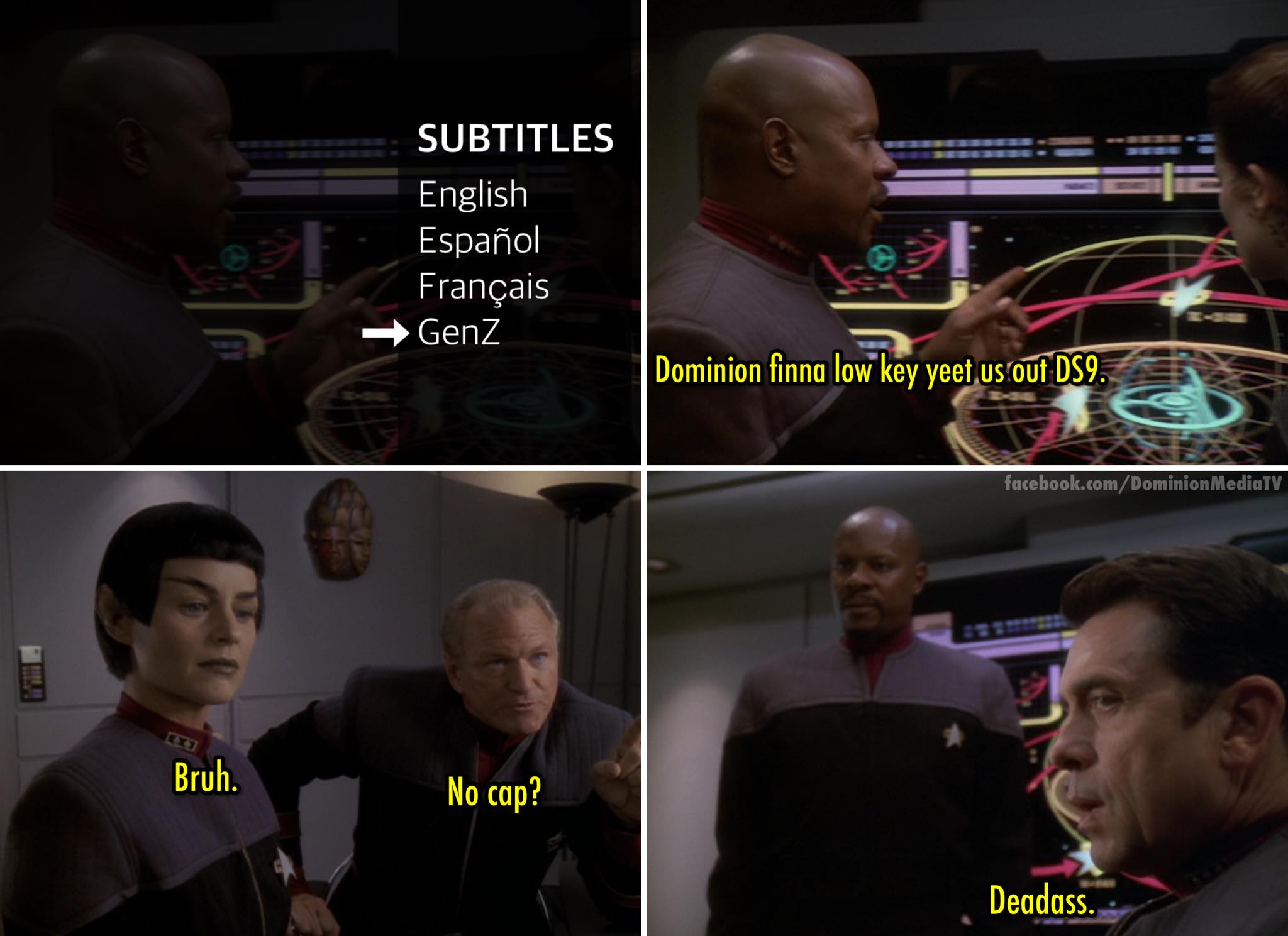
The image is a four-panel meme constructed from screenshots of Star Trek: Deep Space Nine. The screenshots are edited with contemporary internet slang overlaid as dialogue replacements.
- Panel 1: A menu screen presenting subtitle options: English, Español, Français, and GenZ, with an arrow pointing to the GenZ option.
- Panel 2: Gul Dukat is speaking, but his dialogue is replaced with the phrase "Dominion finna low key yeet us out DS9." (Meaning the Dominion is secretly planning to eject them from Deep Space Nine.)
- Panel 3: Captain Sisko and Odo are in conversation. Sisko says "Bruh," and Odo responds with "No cap?" (“No lie?”)
- Panel 4: A close-up of Sisko, responding to Odo with "Deadass." ("Seriously.")
The entire image relies on the juxtaposition of the formal, science-fiction setting of Deep Space Nine with the informal, rapidly-evolving vernacular of Gen Z internet slang. This contrast is the primary source of the humor.
Foucauldian Genealogical Discourse Analysis
The meme can be read as a playful disruption of established discursive practices. Michel Foucault's work emphasizes how power operates through discourse—the ways we talk and think about things. Deep Space Nine establishes a specific discourse of galactic politics, military strategy, and interstellar diplomacy. This is a formal, structured, and codified way of talking about power.
The meme violates this established discourse. It superimposes the slang of Gen Z, which operates as a counter-discourse. The slang functions as an alternative vocabulary, shifting the conversation away from geopolitical strategy to a mode of communication based on personal affect and in-group signaling. This isn’t necessarily about overthrowing the Star Trek discourse, but demonstrating its constructed nature and the possibility of alternative ways of talking about the same power dynamics.
The "subtitle menu" framing in the first panel subtly reinforces this idea, presenting “GenZ” as a valid linguistic option alongside established languages, placing it on a level playing field. It's a “genealogy” of dialogue – showing how ways of speaking evolve and transform over time.
Postmodernism
This meme epitomizes several key characteristics of postmodernism.
- Pastiche & Intertextuality: It’s a blending of two distinct cultural texts—Deep Space Nine and Gen Z internet culture—creating a new, hybrid text.
- Irony & Playfulness: The humor is derived from the absurd juxtaposition, intentionally undermining the seriousness of the Star Trek universe.
- Deconstruction of Grand Narratives: The meme subtly challenges the "grand narrative" of Star Trek’s utopian vision. By injecting the banality of internet slang, it reminds the viewer that even in a space opera, human communication remains grounded in everyday, often trivial, interactions.
- Simulation & Hyperreality: The meme is a "simulation" of a conversation, but it doesn't aim for authenticity; it's a playful exaggeration. It’s a hyperreal representation of dialogue, as it’s more focused on the performance of communication (using slang) than actual meaning.
Critical Theory
From a Critical Theory perspective, the meme can be analyzed as a subversive act of reappropriation. Deep Space Nine presents a complex universe with political tensions and power struggles, often mirroring real-world conflicts. By overlaying Gen Z slang, the meme highlights the absurdity of these power dynamics.
The slang used isn't simply random. Phrases like “deadass” and “no cap?” are often used to demand authenticity and truth. In the context of the show, where deception and political maneuvering are rife, the demand for "realness" becomes a subtle critique of the power structures at play. The meme doesn’t necessarily offer a solution, but it calls attention to the problem.
The meme also speaks to the contemporary moment where digital language is central to the formation of identity and social connection. It acknowledges that Gen Z’s unique linguistic habits, once relegated to online spaces, are now permeating mainstream culture.
Marxist Conflict Theory
While not a strong fit, a Marxist reading could be applied in a limited way. The original Star Trek series (and Deep Space Nine to a degree) can be seen as offering a utopian vision of a post-scarcity society. However, power imbalances still exist.
The meme disrupts this idealized vision by grounding the conversation in the language of everyday life, a language potentially linked to class and social standing. Gen Z slang can be seen as a form of cultural capital – a marker of in-group membership and shared identity. The "Dominion finna" phrasing suggests the power structures of the show will be overthrown by Gen Z's influence.
This is, admittedly, a rather stretched interpretation. The meme doesn't directly address economic inequality or class struggle. However, it does hint at a shift in cultural power, with Gen Z asserting its linguistic dominance over established narratives.
Queer Feminist Intersectional Analysis
A queer feminist reading is somewhat present as well. The act of "re-voicing" characters like Sisko and Odo with Gen Z slang can be viewed as a disruptive act, challenging the traditionally masculine and authoritative roles they embody. It also introduces the perspective of a contemporary subculture (Gen Z) into a historically male-dominated narrative.
The slang itself has origins in Black and LGBTQ+ communities. Using this language within the Star Trek setting appropriates these language patterns into the Star Trek context, challenging the dominant culture’s framing.
Intersectionality would acknowledge the multiple layers of identity at play: the original characters, the creators of the meme, and the audience engaging with it. The meme could be seen as a playful expression of resistance against dominant cultural norms, reclaiming a space for marginalized voices within a traditionally mainstream narrative.
Disclaimer: These interpretations are subjective and based on the theoretical frameworks provided. The meme itself is primarily intended as humor, and a rigid application of these theories might feel overly academic or forced.
simple-description (llama3.2-vision)
The meme is a screenshot from the TV show Star Trek: The Next Generation, featuring the character Captain Jean-Luc Picard. The image is captioned with a quote from the show, but the quote has been replaced with a humorous and nonsensical phrase. The text reads: "Dominion finna low key yeet us out DS9."
tesseract-ocr
SUBTITLES = = ro aaa oe » Espafiol Si - ._S= => GenZ te rag Dominion finna low key yeet,us‘out DS9= = <—_ = =— 3 Sas Si Ses , , UCT CE Ae CLA 5; : ¥ T i 23 tee Tae TAT ae a ed , ‘> a ce