First Seen
2023-05-10T21:03:36+00:00
simple-description (llama3.2-vision_11b)
The meme is a humorous take on the concept of "milenial nihilism," a term coined to describe the anxiety and disillusionment of younger generations. The image shows a screenshot of a conversation where a person is being sarcastically asked if they're dead, and they respond with a humorous and relatable comment about being stuck in a never-ending loop of mundane tasks.
detailed-analysis (gemma3-27b-vision)
Okay, here's a breakdown of the image and text presented, analyzed through the lenses you requested. I’ll indicate if a particular theoretical framework doesn't apply, to avoid forced interpretations.
Visual Description
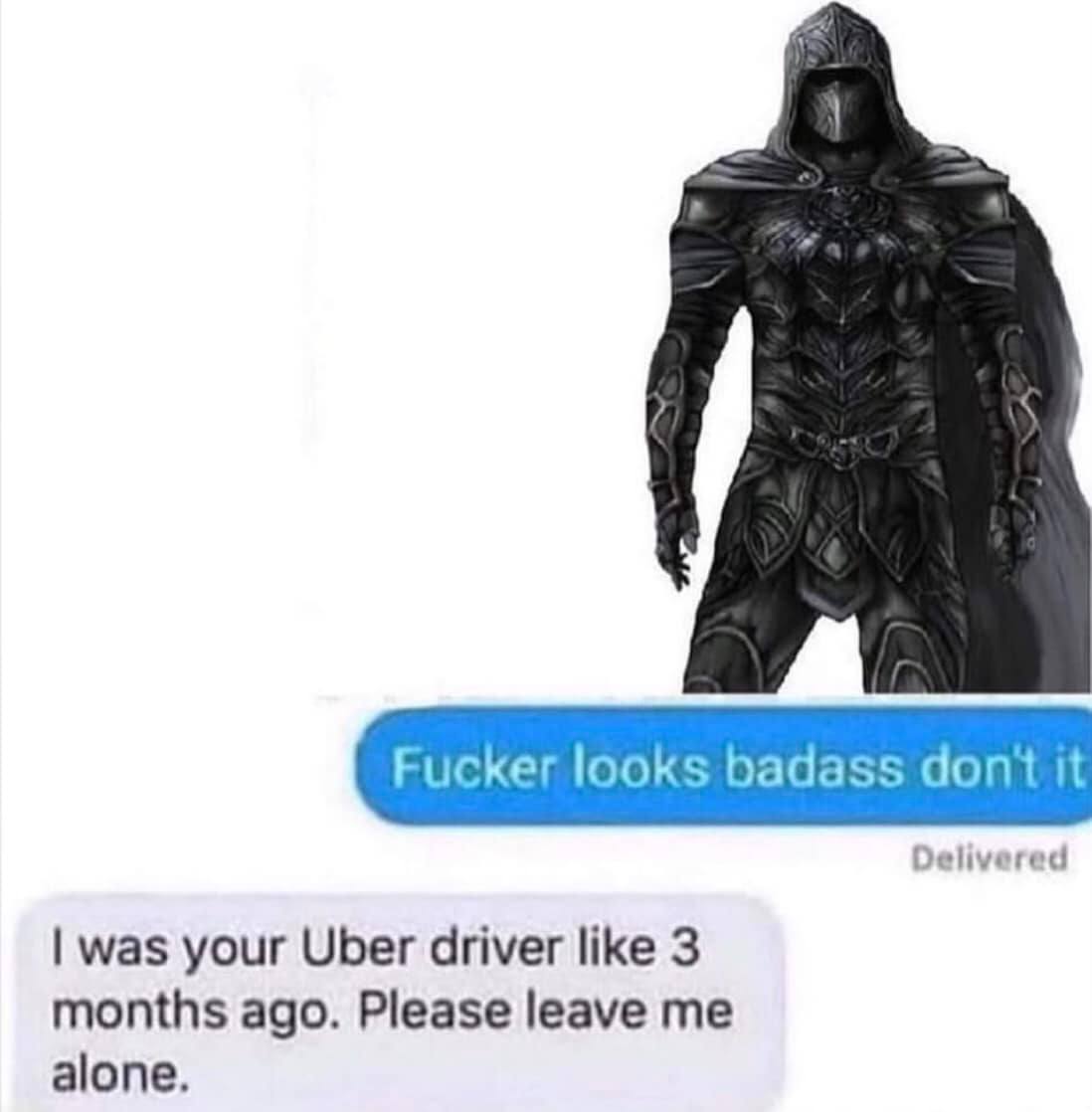
The image depicts a figure wearing a highly ornate, dark, almost robotic-looking suit of armor. The armor features intricate designs, reminiscent of insect wings or fractal patterns. The figure is posed somewhat dramatically, suggesting power or intimidation. The overall aesthetic is high fantasy/sci-fi, evoking characters from games like Destiny or a dark medieval fantasy. The lighting accentuates the detail of the armor, highlighting the contrast between dark and shadowed areas. The image is digitally rendered. The background is minimal, further focusing attention on the armored figure. A text message thread is overlaid on the image.
Foucauldian Genealogical Discourse Analysis
This scenario, as presented in the text message, opens an interesting space for Foucauldian analysis. The "badass" image and accompanying enthusiastic text ("Fucker looks badass don’t it") represent a discourse of power and aesthetics. The sender is projecting onto the former Uber driver an identity framed by visual signifiers—the elaborate armor—that are culturally coded with notions of strength, dominance, and perhaps even threat.
- Power/Knowledge: The initial text reveals a power dynamic. The sender asserts an evaluation of the driver ("Fucker looks badass"). This is not simply an aesthetic judgment; it is a constitutive act, meaning it attempts to define the driver through their visual presentation. It's about establishing a relationship where the sender is the observer and evaluator.
- Genealogy: Tracing the genealogy of the image itself—the history of armored figures in visual culture—reveals a lineage of representations linked to authority, protection, and often, violence. This historical context informs how the sender interprets the driver’s image. The driver's attempt to reclaim agency ("I was your Uber driver...Please leave me alone.") reveals the imposition of this power dynamic, and a desire to disentangle themselves from the constructed image.
- Disciplinary Power: The initial enthusiastic response can be read as a subtle form of disciplinary power. It attempts to normalize the driver into a category defined by the image—something to be admired and consumed visually. The driver's request to be left alone is a resistance to this normalization.
Critical Theory
This scenario lends itself well to a Critical Theory interpretation, particularly concerning alienation and the commodification of the self.
- Alienation: The driver’s distress (“Please leave me alone”) points to a sense of alienation. They are being treated not as a person with a past experience (being an Uber driver), but as an object of spectacle defined by an image. The enthusiasm for the “badass” appearance completely overlooks the driver's subjectivity.
- Commodification of Identity: The enthusiastic comment can be seen as a form of commodification—reducing the driver to a visually stimulating object for the sender’s entertainment. Their former role as a service provider (Uber driver) is irrelevant; only the image matters. The sender is "consuming" the driver’s aesthetic as entertainment.
- Spectacle: Relatedly, this interaction is arguably a manifestation of the "spectacle" as theorized by Guy Debord. The image has become more real than the person it represents, and the driver is reduced to a superficial representation consumed by the sender.
Marxist Conflict Theory
While the image itself doesn’t immediately scream "class struggle", we can interpret this through a Marxist lens by focusing on the relationship between service labor, social expectations, and the dehumanization of work.
- Exploitation of Labor: The Uber driver represents a worker performing a service. The sender’s reaction focuses entirely on their appearance as an aesthetic object, ignoring the labor and potential vulnerability of the driver. It’s a reminder of how even brief encounters in the gig economy can be characterized by a lack of genuine human connection.
- Commodification of the Person: The driver is reduced to a visual object, erasing their agency and individuality. This can be seen as a micro-level manifestation of the broader capitalist tendency to commodify everything, including human beings.
- Alienation from Production: The focus on the image completely disconnects the driver from the actual “product” of their labor – providing transportation. The sender isn’t interested in the service they received, only in the aesthetic appeal of the driver’s online presence.
Postmodernism
Postmodern interpretation would focus on the constructed nature of identity, the blurring of reality and simulation, and the fragmentation of experience.
- Simulacra and Simulation: The image itself is a simulation—a constructed representation. The sender’s enthusiastic reaction is directed at this simulation, not at the “real” person behind it. This interaction highlights the postmodern condition where signs often precede and define reality.
- Deconstruction of Identity: The driver’s attempt to separate themselves from the image is a resistance to the imposition of a fixed identity. They are trying to reclaim their agency and assert their subjectivity in a world where identities are fluid and constructed.
- Fragmentation: The connection is brief, limited to a digital exchange, and based on a superficial impression. This fragmentation is characteristic of postmodern experience.
Queer Feminist Intersectional Analysis
This framework is the least directly applicable, but still offers potential insights.
- Objectification & Surveillance: The enthusiastic comment can be read as a form of objectification, reducing the driver to a visual object for the sender’s consumption. In a feminist context, this echoes the broader pattern of women (and increasingly, all gender expressions) being viewed as objects of visual pleasure.
- Power Dynamics & Harassment: The unwanted attention and disregard for the driver's boundaries could be considered a form of micro-aggression or even a precursor to harassment. The sender’s enthusiasm disregards the driver’s clear request for space.
- Intersectionality: Considering the driver’s potential race, gender, or other marginalized identities, the situation could be further complicated. The sender’s enthusiasm might be imbued with biases or stereotypes. (Without further information, this remains speculative.)
I hope this detailed breakdown is helpful! Let me know if you'd like me to elaborate on any of these points or explore different theoretical lenses.
simple-description (llama3.2-vision)
This meme is a screenshot of a conversation where someone is responding to a friend's claim that they are "faster" than the video game character, Master Chief. The friend's response is a sarcastic and humorous comparison, saying that they are "faster" than Master Chief, who is known for his speed and agility in the Halo video game series.
tesseract-ocr
| was your Uber driver like 3 months ago. Please leave me alone.