First Seen
2023-05-10T21:03:36+00:00
simple-description (llama3.2-vision_11b)
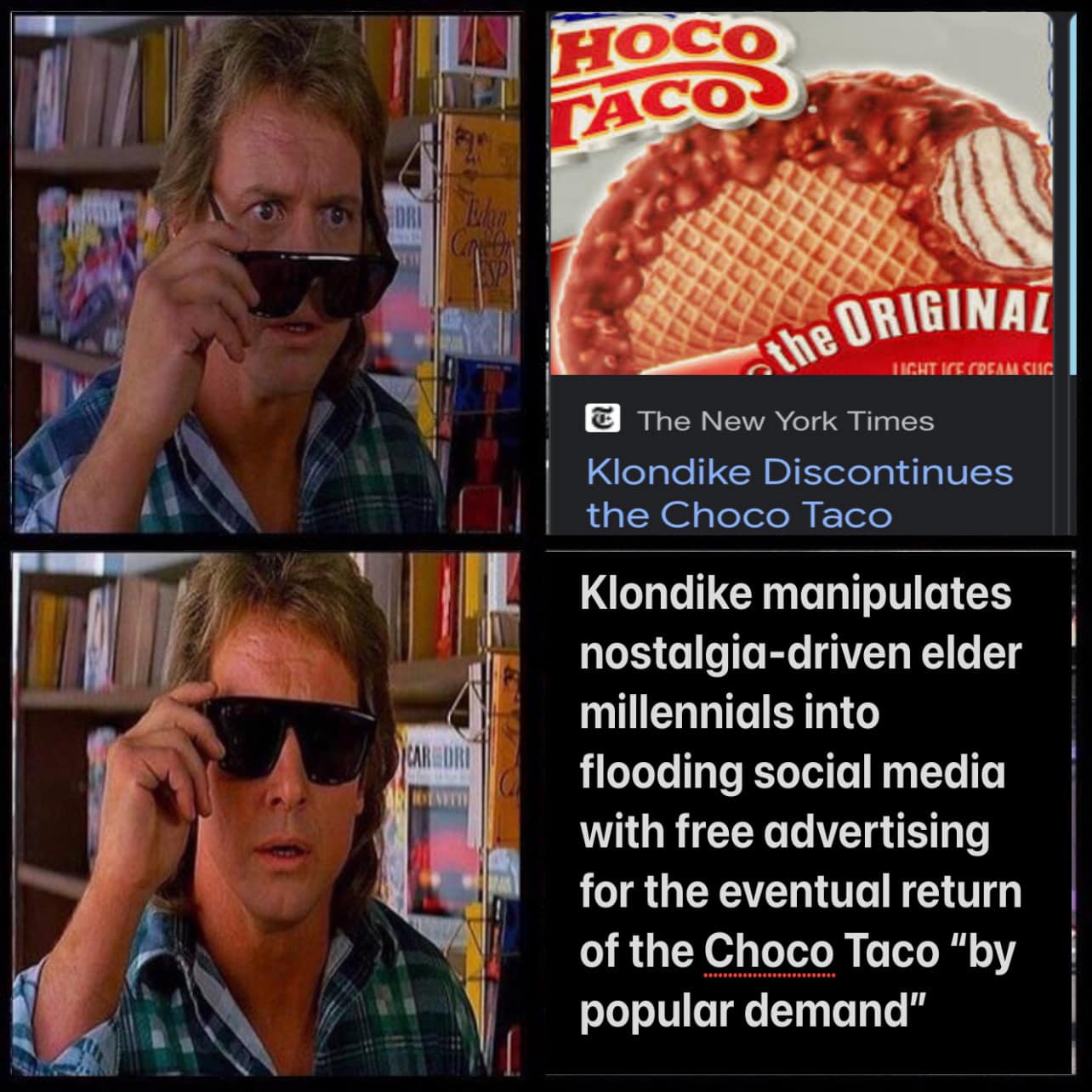
The meme is a humorous commentary on the changing nature of social media and the nostalgia for a bygone era. It features a screenshot of a news article from The New York Times with the title "Millennials Abandon Instagram and TikTok for Old-School Internet" and a photo of a person holding a vintage computer. The meme is captioned "Millennials are abandoning social media to return to the internet of the 90s and 2000s, where they can actually think and communicate without being constantly surveilled and manipulated by algorithms."
detailed-analysis (gemma3-27b-vision)
Okay, let's break down this image meme, applying the requested theoretical lenses. It's a very rich image for analysis, given its layers of cultural reference and internet-fueled irony.
Visual Description
The image is a diptych (two images combined) formatted as a meme. On the left, we have two panels of a screen capture from the film Superbad (2007) featuring actor Jonah Hill with increasingly distressed facial expressions. The setting appears to be a suburban home interior, with bookshelves visible in the background. On the right is a product shot of a Klondike Choco Taco, with branding prominently displayed. A text overlay reads: "Klondike Discontinues the Choco Taco" followed by "Klondike manipulates nostalgia-driven elder millennials into flooding social media with free advertising for the eventual return of the Choco Taco 'by popular demand'." The font is a standard sans-serif, appropriate for internet meme formatting. The color scheme is predominantly browns, reds, and off-whites, with Hill’s skin tones and the book covers providing contrast.
Foucauldian Genealogical Discourse Analysis
This meme powerfully illustrates Foucault’s concepts of discourse, power/knowledge, and genealogy.
- Discourse: The image participates in a discourse about nostalgia, consumer culture, and the manipulation of public sentiment. It reveals a shared understanding that companies intentionally create artificial scarcity (discontinuation) to generate free marketing buzz. The "discourse" isn't just about the Choco Taco but about the strategies used to control the narrative around products.
- Power/Knowledge: Klondike (as a corporation) possesses power through its control of production and distribution. It knows that leveraging millennial nostalgia will generate free publicity. The meme deconstructs this power dynamic, exposing the "knowledge" behind the manipulation. The meme itself is a form of counter-knowledge, revealing the strategy.
- Genealogy: Tracing the "genealogy" of the Choco Taco, we see it’s not just a dessert. It's a cultural artifact tied to specific moments in time for millennials. The discontinuation is a rupture in this continuity, deliberately constructed. The meme highlights the power to define and erase these cultural memories.
Critical Theory
From a critical theory perspective (particularly in the tradition of the Frankfurt School), the image functions as a biting commentary on the "culture industry."
- Commodification of Nostalgia: The Choco Taco discontinuation and subsequent "return" are examples of the culture industry commodifying even our memories and emotional connections. Nostalgia is not authentic experience, but a product to be bought and sold.
- False Consciousness: The meme suggests that elder millennials are participating in their own manipulation. They believe they are expressing genuine outrage and demanding the Choco Taco's return, but they are unwittingly acting as free marketers for Klondike.
- Mass Deception: The meme underscores the idea that mass media and consumer culture are designed to create and maintain systems of control, and to shape people's beliefs and desires.
Marxist Conflict Theory
A Marxist lens reveals the class dynamics at play.
- Capitalist Manipulation: Klondike, as a corporation, is maximizing profits by exploiting the emotional attachment of a demographic (elder millennials) to a product. The discontinuation is a strategic move to increase demand and brand recognition.
- Alienation: Millennials, as consumers, are alienated from the true value of the product. It is no longer about enjoyment but about participating in a system of manufactured desire.
- Ideology: The meme critiques the dominant ideology of consumerism, which promotes the idea that happiness is found through the acquisition of goods.
Postmodernism
The meme is inherently postmodern.
- Irony & Parody: The use of the Superbad screencaps is ironic. The film's humor contrasts with the cynical commentary on corporate manipulation. The meme parodies both the outrage over the Choco Taco and the marketing strategy itself.
- Hyperreality & Simulation: The meme suggests that the "demand" for the Choco Taco is not authentic but a simulation created by social media and marketing. The reality of the product becomes less important than the image and narrative surrounding it.
- Deconstruction of Grand Narratives: The meme challenges the idea that corporations are benevolent providers of goods and services. It exposes the cynical, profit-driven motives behind their actions.
Note: The meme doesn't explicitly lend itself to a Queer Feminist Intersectional Analysis, as the elements don't directly address issues of gender, sexuality, or intersectionality. However, one could argue that the commodification of nostalgia represents a broader pattern of cultural appropriation and the erasure of marginalized voices. This is a more tenuous connection, however.
Let me know if you'd like me to elaborate on any of these points or analyze the meme from a different perspective!
simple-description (llama3.2-vision)
This meme is a screenshot of a news headline from The New York Times, which reads "Klondike Discontinues the Choco Taco" and is accompanied by a photo of a man (played by Nicolas Cage) from the 1998 film "The Wicker Man". The image is a humorous commentary on how a nostalgic and popular treat is being discontinued, and the reaction of the character in the photo is one of shock and dismay. The meme is likely referencing the absurdity of a beloved treat being discontinued, and the character's reaction is a humorous way to express the shock and disappointment that many people would feel.
tesseract-ocr
ri) Va a) ROCCO || ge i ic = Pd ae 4 * “A , - . 6” x ~ ae | \ OG me Me Eee. bg a FED a Ae SE | : Che Sees Sie] a esse LT! } ed 4 Wl g fay ie ede lst hela y { » The New York Times y ; MN i ; | Klondike Discontinues PZ | || | the Choco Taco | i i | odie Murer Lele (oa a a + ir Melee cus ae aaa atl) \ A A A | y= mwa | OMT a) yer Wp ere Revere eC: a 4 , | with free advertising . Ls OURO Rrra a » \ “}) _ of the Choco Taco “by ! Ne sl t 7 ON yor popular demand mi a N i |