First Seen
2023-05-10T21:03:36+00:00
simple-description (llama3.2-vision_11b)
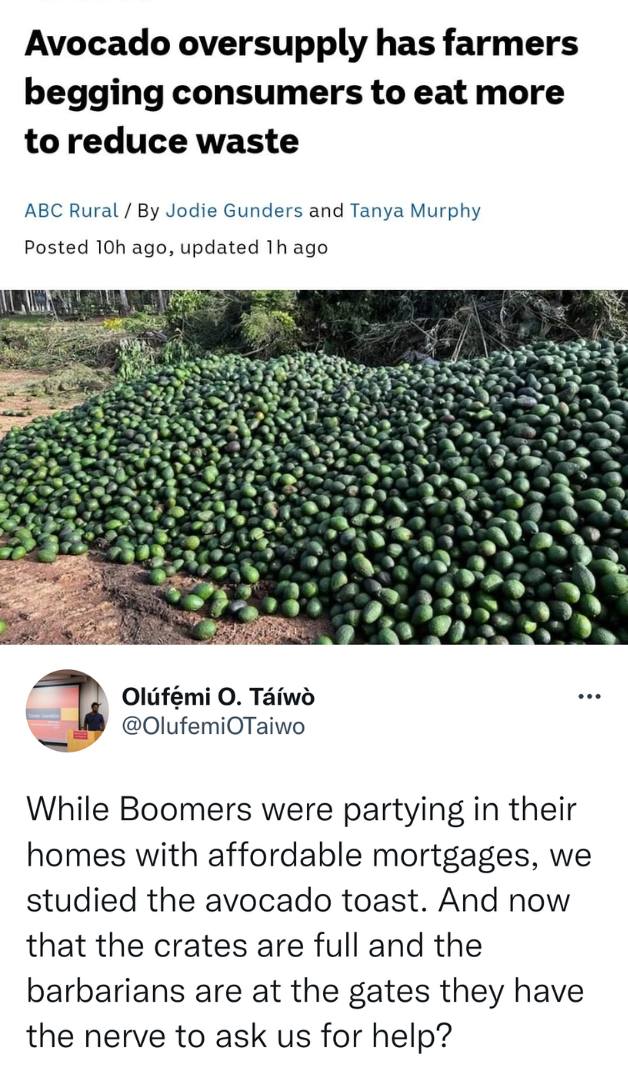
The meme is a humorous commentary on the concept of Millenial nihilism, which is the idea that the current generation is disillusioned with the state of the world and feels a sense of hopelessness and despair. The meme uses a photo of a person surrounded by empty avocado toast containers, implying that the person is overwhelmed by the pressure to constantly consume and be productive, and is now questioning the value of their life. The text "I've eaten all my avocado toast" is a sarcastic commentary on the pressures of modern life.
detailed-analysis (gemma3-27b-vision)
Okay, let's break down this image and accompanying tweet through several critical theory lenses.
Visual Description
The image displays a large quantity of avocados piled up, seemingly in crates. The avocados are green and appear fresh. The sheer volume suggests a surplus, visually reinforcing the claim in the headline about oversupply. The lighting is relatively bright, giving a sense of abundance. The composition emphasizes the quantity rather than any individual avocado, highlighting the scale of the problem.
Foucauldian Genealogical Discourse Analysis
This situation, framed by the headline and tweet, is ripe for analysis through a Foucauldian lens.
- Discourse of "Waste": The headline establishes a discourse of “waste” as a problem. It isn’t simply about surplus; it's framed as something needing to be solved by consumer action. This discourse frames avocados as a resource to be managed, and positions “waste” as an unacceptable inefficiency.
- Power/Knowledge: The article (and tweet response) reveals the power structures at play. The framing of the issue dictates the acceptable solutions (consumers eat more). It neglects other possible answers and reinforces a system where profit-driven agriculture can create “problems” that are then “solved” by consumer responsibility. The knowledge production around agricultural excess prioritizes the market-based framing of “waste” over addressing systemic issues of overproduction and distribution.
- Genealogy of Avocado Consumption: Tracing the history of avocado consumption would reveal how it has shifted from a niche fruit to a trendy, ubiquitous food item. This shift is tied to marketing, culinary trends, and changes in social values (health, "exotic" foods). Examining the genealogy reveals the power dynamics that constructed avocados as desirable and profitable, leading to the current oversupply issue.
Critical Theory
The image and tweet highlight a central theme in Critical Theory: the contradiction between production and consumption in late capitalism.
- Commodification: The image displays a commodity – avocados – being presented as a problem. It's a situation where the very success of production (producing too many avocados) leads to a perceived crisis.
- Ideology: The call for consumers to "eat more" is an ideological maneuver. It deflects attention from the underlying structural problems (overproduction driven by profit motives) and places the responsibility on individuals. The tweet calls out the absurdity of this framing, highlighting the hypocrisy of expecting "us" (likely millennials/gen Z) to solve a problem created by a previous generation's choices.
- Alienation: The tweet speaks to a sense of alienation. The user expresses frustration that they are being asked to fix a problem they didn't create. It illustrates the feeling of being powerless in the face of large-scale economic forces.
Marxist Conflict Theory
This scenario is a prime example of class conflict and exploitation within a capitalist system.
- Capitalist overproduction: The oversupply of avocados is a classic symptom of capitalist overproduction. The drive for profit encourages producers to maximize output, often leading to surpluses.
- Exploitation of Labor: The tweet subtly touches on the labor involved in producing these avocados. While not directly stated, the issue of surplus production points to potential exploitation of agricultural workers, who may be subjected to poor working conditions and low wages.
- Class Conflict: The tweet frames a perceived intergenerational conflict. The user sees a contradiction in expecting those who benefitted from a different economic system (“affordable mortgages”) to ask a newer generation to fix the consequences of their choices. This is an instance of how capitalistic practices and structures reproduce unequal relationships.
Postmodernism
The situation and the tweet response can be viewed through a postmodern lens focusing on the disruption of grand narratives and the fragmentation of meaning.
- Deconstruction of "Responsibility": The tweet deconstructs the idea of “responsibility” – who is responsible for solving the avocado surplus? It questions the assumption that consumers are the primary actors who must fix the problem, undermining the simplistic narrative presented by the headline.
- Irony and Pastiche: The tweet is laced with irony and a bit of pastiche. It playfully contrasts the economic realities of different generations, exposing the absurdity of the situation.
- Hyperreality: The "avocado toast" meme itself could be seen as an element of hyperreality. The avocado became a symbol of a certain lifestyle and culture, divorced from its origins as a simple food product.
Queer Feminist Intersectional Analysis
Although not overtly present, a queer feminist intersectional reading can be layered into this analysis.
- Precarity & Consumption: The image implicitly touches upon issues of precarity. Who is able to consume avocados? Who is excluded? This intersects with issues of economic inequality and access to resources.
- Labor & Gender: The agricultural labor that produces avocados is often gendered and marginalized. The oversupply issue may exacerbate the vulnerability of these workers, and this connects to broader feminist concerns about the exploitation of marginalized labor.
- Challenging Norms: The user’s snarky and critical response challenges the dominant narrative about consumer responsibility, aligning with a feminist approach to deconstructing power structures and offering alternative perspectives.
I hope this provides a comprehensive multi-faceted analysis of the image and accompanying tweet. Let me know if you'd like me to expand on any of these points!
simple-description (llama3.2-vision)
The meme is a humorous commentary on the struggles of the 2023 food crisis. The image shows a large pile of avocados, but the text below it reads: "While Boomers were partying in their homes with affordable mortgages, we studied the avocado toast." This implies that the current generation is struggling to afford basic food items, while the previous generation was able to enjoy luxuries like avocado toast.
tesseract-ocr
Avocado oversupply has farmers begging consumers to eat more to reduce waste ABC Rural / By Jodie Gunders and Tanya Murphy Posted 10h ago, updated 1h ago a. ee ; aa: Mee RT Wn > tone Kiel Ae ees te SS Gat a ite lee ee ee ss es le nant ite BEAT ie ES oe Se ee ee een SEAS BOS hk 2 EE ee TAS Fae ESET SE Son See ho Se ee Ge Nae Say PS Be ia rs Penh Sh eet ee a ae ee td eee ae SS BS Pee eT eh es iP et oS FEE SE a eg eS Sik RE ew De te ¥ EA AS Eee We YU Le IEG 1 Ln are 2) _ a orig a SAA) 9% ry COP FSE yy) SF 2 AIO Wie te Spgs ks A ie % Olufémi O. Téiwd ei = OlufemiOTai — @OlufemiOTaiwo While Boomers were partying in their homes with affordable mortgages, we studied the avocado toast. And now that the crates are full and the barbarians are at the gates they have the nerve to ask us for help?