First Seen
2023-05-10T21:03:36+00:00
simple-description (llama3.2-vision_11b)
The meme is a humorous take on the concept of "Millenihilism," which refers to the tendency of younger generations to be overly critical and dismissive of the past. The image shows a split-screen comparison of two people, with the top half showing a person from the past ( likely a 90s kid) saying "I'm not going to lie, I love being told what to do by a corporation that knows everything about me" and the bottom half showing a person from the present ( likely a 2020s kid) saying "I'm not going to lie, I love being told what to do by a corporation that knows everything about me". The meme is poking fun at the idea that people's attitudes towards technology and corporate control have not changed much over the years, despite the many advancements in technology and the increasing awareness of corporate surveillance.
detailed-analysis (gemma3-27b-vision)
Okay, let's break down this meme using the requested theoretical frameworks.
Visual Description
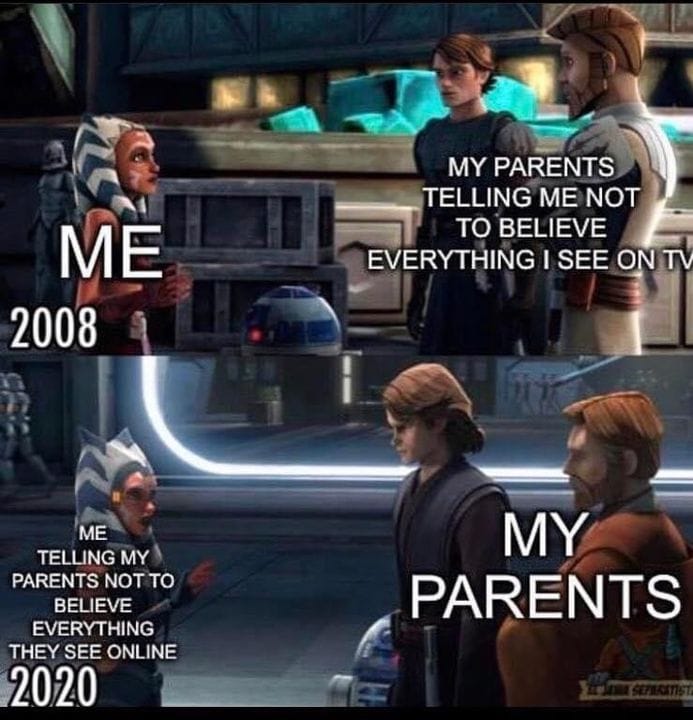
The meme is a “Drakeposting” format, meaning it uses two panels featuring Drake expressing differing opinions. The source material is from the animated series Star Wars: The Clone Wars.
- Panel 1 (2008): Ahsoka Tano (a Jedi Padawan) appears visibly upset, “disapproving” of Anakin Skywalker (her master) who is looking relatively unaffected. Text above reads "MY PARENTS TELLING ME NOT TO BELIEVE EVERYTHING I SEE ON TV", followed by "ME".
- Panel 2 (2020): The roles are reversed. Anakin Skywalker is now upset with Ahsoka, with the text reading "MY PARENTS TELLING ME NOT TO BELIEVE EVERYTHING THEY SEE ONLINE" followed by "ME". This illustrates a flipped power dynamic. The droid R2-D2 is also visible in the background of both panels.
The core joke is about the generational shift in where misinformation and distrust originate.
Foucauldian Genealogical Discourse Analysis
This meme can be analyzed through a Foucauldian lens by examining the discourse surrounding truth and authority.
- Shifting Power/Knowledge: Foucault argues that power and knowledge are inextricably linked. The meme shows a change in who holds the “knowledge” and the power to question it. In 2008, the adult authority (parents) is the source of reasoned skepticism towards media, and the child/young person (“ME”) is being told to accept it. By 2020, the meme implies the child/young person is now taking on the role of skeptic, questioning the beliefs of their parents regarding information they encounter online.
- Genealogy of Trust: A genealogical approach would trace the historical development of how we define “truth” and where we place our trust. In 2008, television was a centralized, curated form of media, while the internet (in its earlier forms) was less so. By 2020, the internet had become a primary source of information, but also a landscape of misinformation and polarized viewpoints. This change in the "landscape" changed who was seen as “the expert” in recognizing veracity.
- Discipline and Normalization: The initial panel echoes the “disciplinary” power of parents to instill values about media literacy. The second panel shows a breakdown of that traditional hierarchy, suggesting the younger generation has developed its own methods of “discipline” and “normalization” concerning online information.
Critical Theory
A critical theory approach examines how the meme critiques societal structures and power dynamics.
- Media & Ideology: The meme points to a shift in how ideology is communicated and consumed. Television was once seen as a tool for disseminating dominant narratives, prompting parental guidance to filter those narratives. The internet, however, fosters the spread of counter-narratives and alternative perspectives (and misinformation). The meme suggests a breakdown of a unified, centralized "truth" and a rise in fragmented realities.
- Generational Divide: The meme highlights a generational conflict in how information is perceived and validated. Parents, accustomed to traditional media, may struggle to grasp the complexities of the online world and the pervasiveness of misinformation. Conversely, the younger generation, digitally native, may be more adept at navigating online spaces but also more susceptible to echo chambers and confirmation bias.
- Culture Industry: Drawing on Adorno and Horkheimer, one could argue that the meme critiques how the “culture industry” (now massively expanded through the internet) shapes our perceptions of reality. Both television and the internet can be seen as powerful forces that manufacture consent and perpetuate dominant ideologies. The meme illustrates a change in where the danger of that manipulation lies.
Marxist Conflict Theory
While not a direct Marxist analysis, elements of conflict are present.
- Hegemony and Counter-Hegemony: The initial panel implies parental authority (representing the status quo) attempting to maintain hegemony over the child's understanding of reality. The 2020 panel suggests the emergence of counter-hegemony as the younger generation challenges those established beliefs and actively questions the information shared by their parents.
- Class and Access to Information: Implicitly, this meme also touches upon issues of class and access to information. The internet, while widely available, isn't equally accessible to everyone. There's a “digital divide” that can exacerbate existing inequalities. The generational conflict over online information may also be linked to differences in digital literacy based on socio-economic background.
Postmodernism
This meme heavily aligns with postmodern concepts.
- Meta-narratives and Deconstruction: Postmodernism rejects “grand narratives” or universal truths. The meme implicitly deconstructs the idea that any single source (parents, television, the internet) holds the key to objective reality. Instead, it suggests that truth is relative and socially constructed.
- Simulation and Hyperreality: The meme’s depiction of the internet as a space of endless information and potential misinformation aligns with Baudrillard’s concept of “simulation” and “hyperreality.” The line between reality and representation becomes blurred, making it difficult to discern what is “real” and what is manufactured.
- Irony and Parody: The meme itself employs irony and parody by flipping the power dynamic and highlighting the hypocrisy of telling children not to believe everything they see on television while simultaneously distrusting information encountered online.
Queer Feminist Intersectional Analysis
This is the least applicable framework, but some connections can be made.
- Power Dynamics and Authority: Feminist analysis examines power dynamics and the ways in which authority is constructed and maintained. The meme shows a shift in authority, challenging traditional hierarchies based on age and experience.
- Social Construction of Truth: The meme resonates with queer theory's deconstruction of “normal” and “natural” categories. The idea that truth is not objective but socially constructed aligns with the queer feminist argument that gender and sexuality are also socially constructed.
- Intersectionality and Online Spaces: Intersectionality recognizes that individuals experience oppression based on multiple, intersecting identities. Online spaces can be both empowering and disempowering for marginalized groups, and the spread of misinformation can exacerbate existing inequalities. A deeper analysis might consider how online misinformation disproportionately affects marginalized communities.
I've provided a detailed breakdown of the meme through several theoretical lenses. Let me know if you'd like me to elaborate on any particular framework or aspect of the analysis!
simple-description (llama3.2-vision)
This meme is a humorous comparison between a person's past and present. The top panel shows a character from the animated series "Star Wars: The Clone Wars" in 2008, with text stating "me" and "my parents". The bottom panel shows the same character in 2020, with text stating "me" and "my parents" again, but with a different message. The meme pokes fun at how societal norms and expectations have changed over time, particularly with regards to how people interact with others and the internet.
tesseract-ocr
| AF $ ¥ P| ee & : fe ' MY PARENTS 7 ME eae = Mi = = - ) ie ae ey 2008 > Yu | _ eae © aN R es ae <= 2 rey Nae stele i i i ad oo