First Seen
2023-05-10T21:03:36+00:00
simple-description (llama3.2-vision_11b)
The meme is a humorous take on the concept of Millenihilism, which refers to the idea that the younger generation (Millennials) is responsible for the downfall of society. The meme is a screenshot of a conversation where someone asks if the apocalypse is near, and the response is a sarcastic "no" because the person is too busy playing video games to care about the end of the world. The text on the image reads "just a normal Tuesday" and features a screenshot of a video game character, implying that the person is too engrossed in their gaming to worry about the apocalypse.
detailed-analysis (gemma3-27b-vision)
Okay, let's break down this image/text with analyses from the requested theoretical frameworks. It's a surprisingly rich little snippet.
Visual Description
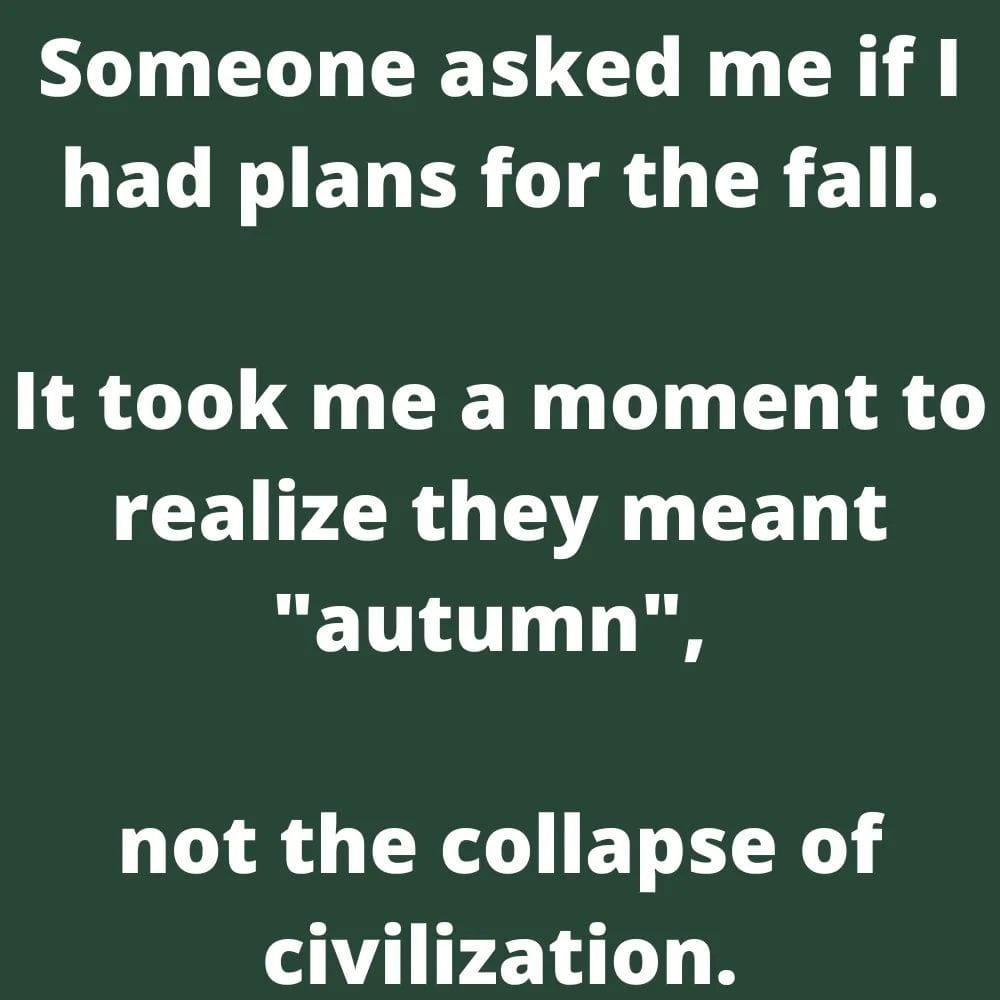
The image is a simple text graphic. The text is white against a deep green background. The font is sans-serif and relatively large, making it easily readable. The text is broken into three lines, creating a narrative structure. The layout is minimalist, emphasizing the content rather than any aesthetic design. The simplicity draws attention to the humor and the disconnect between possible meanings.
Foucauldian Genealogical Discourse Analysis
This seemingly simple exchange reveals how meaning isn't inherent but constructed within a discourse. We can see a shift in discourse at play. The question "Do you have plans for the fall?" initially activates a discourse of crisis, apocalypse, and disaster preparedness. The receiver, hearing "fall", accesses a discourse of seasons, cozy activities, and seasonal change. The humor stems from the rupture between these discourses.
Foucault would be interested in the power dynamics here – the initial question, however innocently meant, carries an implicit threat of a catastrophic future, while the speaker is brought down to the mundane with the seasonal reference. The receiver momentarily internalized the discourse of societal collapse before being "corrected" (returned) to the ordinary discourse of weather. This illustrates how power operates not through overt command, but through the subtle shaping of what is considered normal and thinkable. The "fall" as a season is a normalized discourse, while "the collapse of civilization" is relegated to fringe or speculative discussions.
Critical Theory
This snippet is ripe for Critical Theory analysis. The initial question, about "plans for the fall", is a symptom of a broader cultural anxiety about impending doom. This anxiety is fueled by news cycles reporting on climate change, political instability, and social unrest. The receiver's confusion highlights the way these anxieties pervade our thinking, even in everyday conversations. It's a demonstration of how the ideology of disaster permeates our lives, making us unconsciously prepare (even in conversation) for worst-case scenarios.
The contrast between the two meanings reveals a disconnect between everyday life and the existential threats that loom beneath the surface. Critical Theory would ask: Whose interests are served by keeping us focused on the mundane, while simultaneously amplifying anxieties about catastrophic events? Is this a distraction tactic, a way to control the narrative and maintain the status quo? The receiver's initial assumption about "the fall" reflects a subconscious acceptance of the discourse of crisis.
Marxist Conflict Theory
While subtle, there's a hint of Marxist potential here. The "collapse of civilization" implicitly brings forth anxieties about resource scarcity, power struggles, and the potential for social upheaval. The question, then, could be viewed as a veiled inquiry into preparedness for a class conflict in a dystopian future.
The receiver, assuming the seasonal meaning, represents the average individual focused on their immediate surroundings and the cyclical rhythms of life, largely oblivious to, or disengaged from, broader socio-political issues. The contrast underscores the alienation of labor and the disconnect between those who benefit from the status quo and those who are most vulnerable in times of crisis. The receiver is experiencing a blissful ignorance from the realities of conflict.
Postmodernism
This snippet embodies several Postmodern themes. The humor stems from the instability of meaning. The word "fall" has multiple, valid interpretations, and the context alone doesn't definitively determine which meaning is intended. This illustrates the Postmodern concept that truth is relative and subjective.
The image also plays with simulacra and simulation. The initial assumption about "the collapse of civilization" is a simulation – a mental construct based on anxieties and media representations. The receiver's realization that it's just "autumn" brings them back to the "real" – the cyclical rhythms of nature. However, the "real" itself is also a construct, shaped by our cultural and linguistic frameworks. Ultimately, the post-modern concept of fragmentation is evident as a disconnect between the speaker and receiver's interpretation.
Queer Feminist Intersectional Analysis
This is the least directly applicable framework here, but we can still find a potential angle. The initial assumption of "the fall" as societal collapse could be interpreted as a metaphor for the vulnerability felt by marginalized groups. For queer, feminist, and other marginalized communities, the threat of societal collapse is often already a lived reality. The "fall" represents a continuous state of precarity, vulnerability, and systemic oppression.
Furthermore, the receiver's correction to "autumn" could be seen as a form of normalization—a dismissal of the very real anxieties faced by marginalized communities. It's a return to the dominant, privileged perspective that doesn't recognize the ongoing "collapse" of safety and equality for those who are already marginalized. The receiver in a way has the luxury to assume "autumn" and not the collapse of civilization.
Let me know if you'd like me to elaborate on any of these analyses or explore other theoretical frameworks.
simple-description (llama3.2-vision)
This meme is a humorous response to a person's inquiry about their plans for the fall season. The text reads: "Someone asked me if I had plans for the fall. It took me a moment to realize they meant 'autumn', not the collapse of civilization." The meme pokes fun at the idea that someone might think the word "fall" has a different, apocalyptic meaning.
tesseract-ocr
Someone asked me if | had plans for the fall. It took me a moment to te P<-S teL "autumn", Cel Cm tl hme ror eeba el