First Seen
2023-05-10T21:03:36+00:00
simple-description (llama3.2-vision_11b)
The meme is a screenshot of a Twitter post from a user named "Millenihilism" that reads: "If I'm being honest with you, I'm not really sure why I'm even alive. I'm just a bunch of neurons firing off in my brain, and I'm just trying to make sense of the world, but it's all just a bunch of nonsense." The image is a humorous take on the existential crisis of being a millennial, where the user is poking fun at the idea that their generation is obsessed with finding meaning in a seemingly meaningless world.
detailed-analysis (gemma3-27b-vision)
Okay, let's break down this seemingly simple Twitter post through a variety of critical lenses.
Visual Description
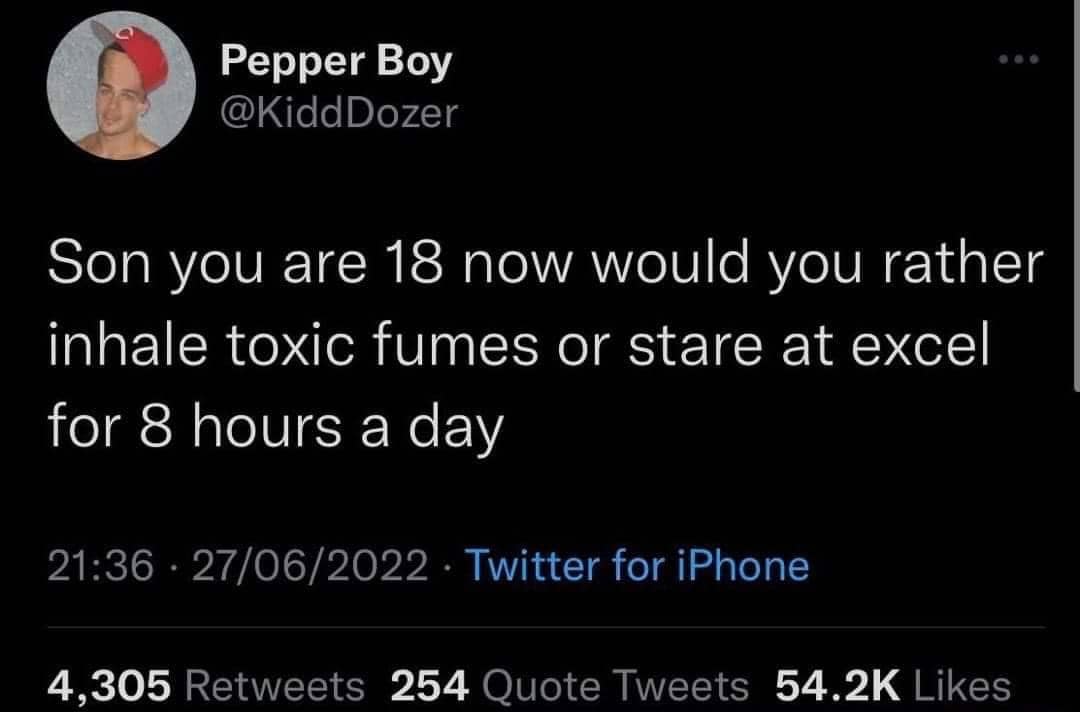
The image is a screenshot of a Twitter post. The username is "Pepper Boy @KiddDozer" and has a profile picture of a person with a red cap and blurred face. The main text of the post is a question posed as a parental directive: "Son you are 18 now would you rather inhale toxic fumes or stare at excel for 8 hours a day". Below the text are metrics: 4,305 retweets, 254 quote tweets and 54.2K likes. The post was made on June 27, 2022, using Twitter for iPhone. The background is a standard dark Twitter theme. The overall aesthetic is minimal and ironic.
Foucauldian Genealogical Discourse Analysis
This post is fertile ground for Foucault's methods. The question presented isn't about two literal choices, but a distillation of modern disciplinary power.
- Power/Knowledge: The question implicitly frames the "choices" as the only legitimate avenues of adult life. It defines adulthood as being trapped in one of these two forms of alienation. This demonstrates how power operates not through overt suppression, but through defining what is considered "normal" and "acceptable."
- Discipline: Both options—toxic fumes (representing manual, physically damaging labor) and Excel spreadsheets (representing cognitive, mentally draining labor)—are forms of discipline in the Foucauldian sense. They represent systems that regulate bodies and minds to make them productive. They are ways of normalizing the individual into the workforce.
- Genealogy: A genealogical analysis would trace the historical development of these options. How did modern work come to be structured in such a way that these are the dominant forms of "earning a living"? It would reveal the power relations that created these conditions, contrasting them with historical modes of production.
- Biopower: The question operates within the realm of biopower. It concerns the management of life – which work (and its risks) is deemed ‘acceptable’ to sustain an individual's existence.
Critical Theory (Frankfurt School)
This post embodies many concerns of Critical Theory.
- Domination: It highlights the pervasive nature of domination in modern society. The "choice" is no choice at all, but a reflection of systemic constraints on individual freedom. The subject is presented with only options that ultimately serve the interests of capital.
- Instrumental Reason: The question emphasizes the reduction of human value to utility. The individual is not asked about fulfillment or meaning, but about their ability to perform labor. This reflects a broader trend of instrumental reason, where everything is assessed based on its usefulness.
- Culture Industry: The meme-like, ironic presentation of the question is characteristic of the ways in which the Culture Industry (as described by Adorno and Horkheimer) commodifies and trivializes serious social concerns. It allows individuals to acknowledge the problem without engaging in meaningful critique.
- Alienation: Both options represent forms of alienation. The individual is alienated from their own labor, their potential, and their ability to live a meaningful life.
Marxist Conflict Theory
This post is deeply resonant with Marxist conflict theory.
- Class Struggle: The question exposes the inherent contradictions of the capitalist mode of production. It illustrates how the working class is forced to choose between physically harmful and mentally exhausting labor, regardless of their own well-being.
- Exploitation: Both options represent forms of exploitation. The worker is either physically or mentally drained in order to generate profit for the capitalist. The question underscores the fact that the worker does not receive the full value of their labor.
- False Consciousness: The ironic tone of the question can be seen as a symptom of false consciousness – the inability of the working class to recognize its own exploitation. By framing the question as a humorous choice, it obscures the underlying systemic problems.
- Commodification of Labor: The post subtly highlights the commodification of labor under capitalism – the reduction of human activity to a thing to be bought and sold.
Postmodernism
From a postmodern perspective, the post is interesting for its play with meaning and its embrace of irony.
- Deconstruction of Choice: The question dismantles the notion of genuine choice. It demonstrates how choices are often illusory, shaped by power structures and pre-existing conditions.
- Simulacra and Simulation: The question can be interpreted as a simulacrum – a copy without an original. It highlights the increasing detachment of modern life from authentic experience.
- Irony and Parody: The ironic tone of the question challenges traditional forms of authority and meaning-making. It suggests that serious social concerns are often trivialized in contemporary culture.
- Rejection of Grand Narratives: The post rejects the idea of a single, overarching narrative of progress or liberation. It embraces the fragmented, chaotic nature of modern life.
Queer Feminist Intersectional Analysis
While not immediately apparent, an intersectional lens can reveal further complexities.
- Gendered Labor: While the question doesn't explicitly mention gender, it’s worth noting that certain types of labor (e.g., physically harmful labor) are often disproportionately performed by marginalized groups.
- Precarity and Vulnerability: Both options highlight the precarity and vulnerability of marginalized groups, who are often forced to take on the most dangerous or exploitative jobs.
- Social Reproduction: The question can be linked to the concept of social reproduction, which refers to the ways in which capitalist society relies on unpaid or underpaid labor (often performed by women and other marginalized groups) to maintain itself.
- The Politics of Exhaustion: The post speaks to a broader phenomenon of "emotional labor" and the disproportionate burden of exhaustion faced by marginalized groups.
In conclusion: This seemingly simple tweet is rich with potential for critical analysis. It reveals underlying power dynamics, social inequalities, and the alienation of modern life. It’s a testament to how even seemingly trivial social media content can reflect profound social and political concerns.
simple-description (llama3.2-vision)
The meme is a humorous tweet that imagines a scenario where a person who is currently 18 years old is now 18 years in the future, and is asked what they would do differently if they could go back in time. The text reads: "Son you are 18 now would you rather inhale toxic fumes or stare at excel for 8 hours a day".
tesseract-ocr
Pepper Boy @KiddDozer Son you are 18 now would you rather inhale toxic fumes or stare at excel for 8 hours a day 21:36 - 27/06/2022 - Twitter for iPhone 4,305 Retweets 254 Quote Tweets 54.2K Likes