First Seen
2023-05-10T21:03:36+00:00
simple-description (llama3.2-vision_11b)
This meme is a commentary on the perceived pessimism and cynicism of younger generations, particularly those born in the 2000s and 2010s. The text "2000s kids are gonna hate this" is a tongue-in-cheek acknowledgment of the meme's potential to annoy or offend younger audiences, while also implying that their nostalgia-tinged preferences will be met with disdain.
detailed-analysis (gemma3-27b-vision)
Okay, here's an analysis of the tweet, broken down into sections relevant to the requested theoretical frameworks. Note that some frameworks are more applicable than others, and I'll indicate that clearly.
Visual Description
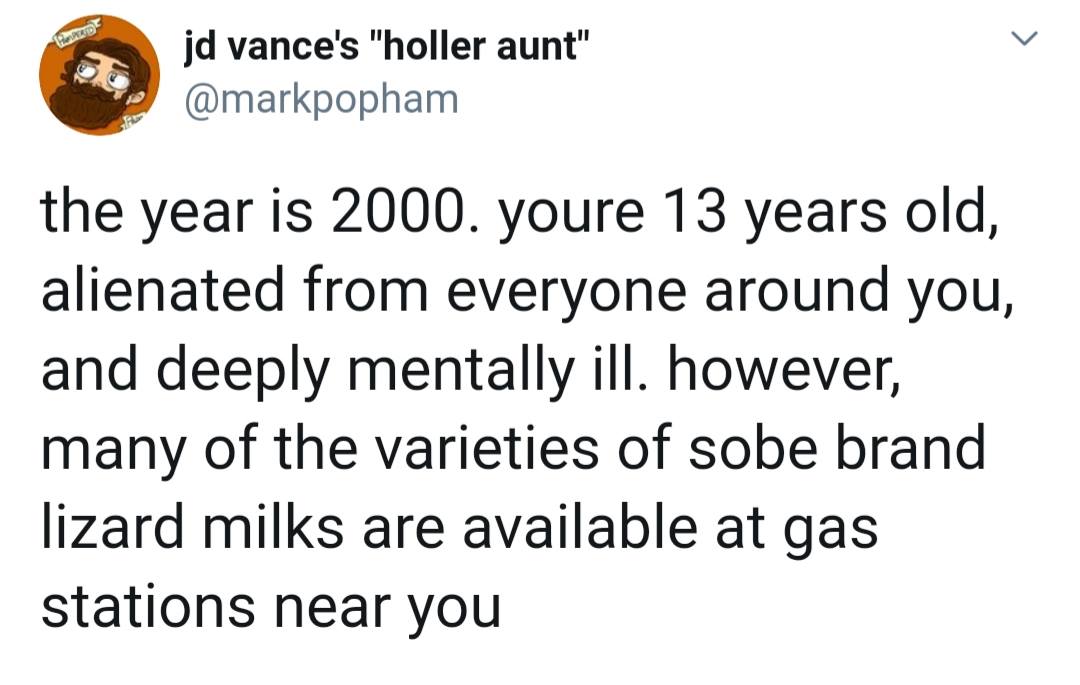
The image is a screenshot of a tweet from an account with a cartoon profile picture. The username "@markpopham" is visible. The tweet itself is written in lowercase and includes a jarring juxtaposition of description and a very mundane detail. The tweet’s content is described below under the applicable theoretical sections.
Foucauldian Genealogical Discourse Analysis
This tweet lends itself nicely to a Foucauldian reading. We can see a discourse being constructed around early 2000s adolescence, mental illness, and consumer culture.
- Power/Knowledge: The tweet implicitly suggests a power dynamic where the alienation and mental illness are defined by the dominant discourse. The very language used (“deeply mentally ill”) represents a medicalized categorization that exercises power over the individual described.
- Genealogy: The tweet gestures to a history of how adolescence and mental health were understood in the year 2000. The ubiquity of Sobeys – a branded sugar drink – at gas stations isn’t just a detail, but a symbol of the cultural landscape of that period. The genealogy reveals a context of hyper-consumerism and a particular type of "youth culture" that was heavily marketed. The tweet suggests the absurdity of this context.
- Discursive Formation: The tweet disrupts the expected discourse. Instead of a serious discussion of alienation or mental illness, it’s undercut with the trivial mention of Sobeys. This disruption highlights how seemingly unrelated discourses (mental health, consumerism, nostalgia) operate together to construct reality. It points to the arbitrary nature of categorization and meaning.
Postmodernism
This tweet is deeply rooted in postmodern sensibilities.
- Pastiche/Juxtaposition: The core characteristic of this tweet is the jarring juxtaposition of profound alienation and a banal consumer product. This is a classic postmodern technique of creating meaning through unexpected combinations. There's a deliberate lack of resolution or a traditional narrative arc.
- Irony/Self-Reflexivity: The tweet is inherently ironic. It implies a critique of the absurdity of early 2000s culture, where even in profound isolation, there was always access to branded sugar drinks. It is self-reflexive, acknowledging the absurdity of its own combination of elements.
- Fragmentation of Meaning: The tweet doesn't solve the problem of alienation or mental illness. It presents a fragmented snapshot that highlights the disjointedness of modern experience. There's a deliberate refusal of grand narratives or overarching explanations.
- Nostalgia: The reference to Sobeys, in the year 2000, creates a layer of nostalgia. Nostalgia is a postmodern affect, a longing for a past that is often idealized or fragmented. This adds to the tweet’s sense of detachment and ironic distance.
Critical Theory
The tweet can be read through a Critical Theory lens, pointing to the alienation produced by societal structures.
- Alienation: The initial statement – "you're 13 years old, alienated from everyone around you" – is a key concept in Critical Theory, particularly drawing on the work of Marx and the Frankfurt School. The tweet suggests that this alienation isn’t simply a personal failing, but a consequence of social forces.
- Commodity Fetishism: The mention of Sobeys can be interpreted through the lens of commodity fetishism (a concept from Marx). The drink is presented not as a mere product, but as something imbued with cultural meaning and even a potential solution (however ironic) to the alienation described.
- Culture Industry: The presence of a branded product like Sobeys points to the influence of the culture industry (Adorno and Horkheimer). This industry produces mass-produced culture that homogenizes experience and suppresses critical thought. The tweet implies that even in moments of profound isolation, we are still bombarded with consumer messaging.
Notes on frameworks that are less applicable:
- Marxist Conflict Theory: While the tweet touches on alienation (a concept central to Marxism), it doesn’t explicitly address class conflict or economic exploitation. The presence of a consumer product hints at capitalist structures, but the tweet doesn't focus on them.
- Queer Feminist Intersectional Analysis: The tweet, as presented, doesn’t contain any explicit references to gender, sexuality, or intersectionality. While these frameworks could be applied to a broader interpretation of the context, they are not inherent to the tweet's content.
In conclusion: The tweet is a surprisingly rich text. It functions as a miniature commentary on early 2000s youth culture, alienation, and the absurdity of modern life. The most effective analytical frameworks are Foucauldian discourse analysis, postmodernism, and critical theory, as they best illuminate the complex interplay of meaning and power within the text.
simple-description (llama3.2-vision)
This meme is a humorous commentary on the challenges of growing up in the early 2000s. The text reads: "the year is 2000. you're 13 years old, alienated from everyone around you, and deeply mentally ill. however, many of the varieties of sobe brand lizard milks are available at gas stations near you." It's a satirical take on the struggles of adolescence, exaggerating the challenges of being a teenager in the early 2000s. The joke is that the author is describing a typical teenager's life in 2000, but also mentioning a specific brand of milk that was popular at the time.
tesseract-ocr
3) jd vance's "holler aunt" v @markpopham the year is 2000. youre 13 years old, alienated from everyone around you, and deeply mentally ill. however, many of the varieties of sobe brand lizard milks are available at gas stations near you