First Seen
2023-05-18T19:05:42+00:00
simple-description (qwen3.5_2b-q8_0)
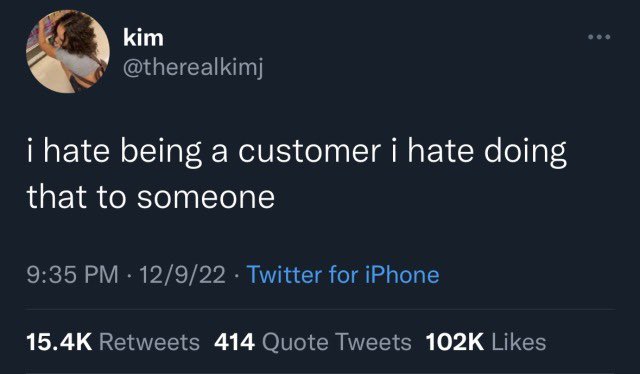
Millenihilism in this meme refers to a belief system where humanity is viewed as a biological function to serve other bodies. The tweet by "kim" captures this concept by expressing a deep rejection of the human instinct to serve, writing "i hate being a customer i hate doing that to someone." The text serves as a humorous commentary on how such a worldview would devalue the fundamental biological purpose of humans.
simple-description (llama3.2-vision_11b)
The meme is a screenshot of a tweet from a user named "millenihilist" with the text "i hate being a customer, i hate people, i hate my job, i hate my life". This is a relatable and humorous take on the struggles of modern life, particularly for millennials who are often expected to be constantly connected and engaged with others. The meme is a commentary on the pressures of modern life and the feelings of anxiety and overwhelm that can come with it.
detailed-analysis (gemma3-27b-vision)
Okay, here's an analysis of the tweet, broken down into sections based on the theories you requested. I'll indicate if a section doesn't apply based on the content.
Visual Description
The image is a screenshot of a Twitter post. The user, identified as “kim” with the handle @therealkimj, has a circular profile picture of a person with curly red hair. The background is black. The tweet itself is a short statement: “i hate being a customer i hate doing that to someone.” Beneath the tweet are timestamps (9:35 PM · 12/9/22) and platform information ("Twitter for iPhone") with a line of retweets, quotes and likes.
Foucauldian Genealogical Discourse Analysis
This tweet lends itself well to a Foucauldian reading. The statement "i hate being a customer" isn’t just a personal preference, but a rejection of the discourse surrounding customer-service interactions. Foucault would see the power dynamics inherent in this relationship. The customer, although appearing to be in a position of need, actually wields power through their ability to make demands (even implicitly). The power is also exercised by the service worker because they are required to fulfill those demands.
The "doing that" is crucial. It highlights the practices that constitute being a customer—making requests, potentially being demanding or asserting one's "rights," and participating in a system that forces another person to perform service. The "hate" expresses a discomfort with the role assigned within this power structure. The user seems to acknowledge their own participation in a system they perceive as problematic, even oppressive.
A genealogical approach would ask how this dynamic – the expectation of 'service' and the implicit power imbalance – emerged historically. What are the social and economic conditions that have created this specific way of interacting? How did this role develop through the history of commerce?
Critical Theory
The tweet resonates with themes of alienation and commodification found in Critical Theory, particularly within the Frankfurt School tradition.
The user's "hate" can be seen as a reaction to the depersonalizing effects of consumer culture. The act of being a customer turns both parties into roles or functions rather than recognizing them as whole individuals. The user is alienated from their own agency, as they are forced to participate in a system that reinforces power imbalances. The hate towards being a customer can be read as a critique of the entire system of exchange and the reduction of people to economic units.
The statement points to a loss of authentic human connection in the context of service. The user experiences the transaction as a source of discomfort, a recognition of their own role in a system that treats others as means to an end.
Marxist Conflict Theory
This tweet can be interpreted through a Marxist lens as a recognition of the inherent class conflict embedded in service interactions. The customer represents a position of economic power (having disposable income), while the service worker represents the laboring class.
The user’s discomfort stems from recognizing their participation in this unequal dynamic. The very act of "being a customer" inherently reinforces this class structure. The "hate" is a moral rejection of the power imbalance and a subtle acknowledgment of the exploitative nature of the system. The worker is required to smile, and serve, even if that is not how they feel.
The tweet implicitly criticizes the commodification of labor – the reduction of a person's worth to their ability to provide a service.
Postmodernism
A postmodern reading would focus on the deconstruction of the assumed roles of "customer" and "service provider." The tweet challenges the fixed meanings associated with these categories. The user is refusing to accept the script of the consumerist culture.
The "hate" can be seen as a rejection of grand narratives or universal truths about consumption and service. It highlights the subjective experience of participating in these interactions and acknowledges the ambiguity and complexity of these roles. The tweet is a fragment of experience, not a totalizing statement.
Queer Feminist Intersectional Analysis
This analysis is trickier to apply directly, but can be done by considering how intersecting systems of power might amplify the discomfort expressed in the tweet.
If the service worker is a member of a marginalized group (based on race, gender, sexuality, ability, etc.), the power imbalance is further exacerbated. The user's discomfort could be a subconscious awareness of these additional layers of oppression.
A feminist perspective would examine how the expectation of performance (being polite, accommodating, etc.) disproportionately affects service workers, particularly women.
An intersectional approach would consider how these different forms of oppression intersect and create unique experiences of powerlessness and exploitation. It's also possible the tweet reveals a recognition that the consumer is perpetuating a system that disadvantages others based on various identity markers.
Hopefully, this detailed breakdown is what you were looking for! Let me know if you'd like me to elaborate on any specific aspect.
simple-description (llama3.2-vision)
This meme is a screenshot of a tweet from a user named "kim" (not to be confused with the singer Kim) that reads: "i hate being a customer i hate doing that to someone". The text is in a plain white font on a black background, and the tone is sarcastic and relatable. The tweet has received a significant amount of engagement, with over 15,000 likes and 400+ retweets.
tesseract-ocr
f ati) as MONTE any) i hate being a customer i hate doing that to someone 9:35 PM - 12/9/22 - Twitter for iPhone 15.4K Retweets 414 Quote Tweets 102K Likes