First Seen
2023-05-20T14:34:40+00:00
simple-description (qwen3.5_2b-q8_0)
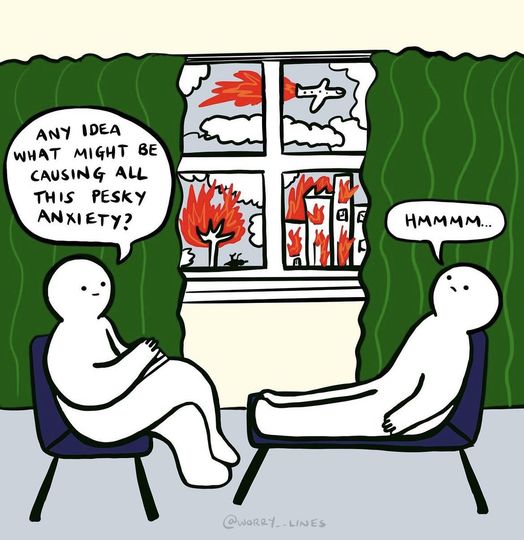
This meme illustrates the millenihilism (specifically the "small world" meme) philosophy, which suggests the world is chaotic, small, and ultimately insignificant. The image shows a window with a burning tree and a flying plane, representing a catastrophic disaster that is too overwhelming to control. The figure on the left questions the source of the "pescy anxiety," while the figure on the right hums in confusion, highlighting the absurdity of trying to manage a universe where nothing can stop a small, disastrous event.
simple-description (llama3.2-vision_11b)
The meme depicts a person sitting in a chair, looking out the window, with a thought bubble containing a question about existential dread. The image is captioned "Millenihilism" and features a character contemplating the meaninglessness of life. The text in the thought bubble reads "Is it just me or is everything just... pointless?"
detailed-analysis (gemma3-27b-vision)
Okay, let's break down this cartoon using the requested theoretical frameworks. It's a deceptively simple image, but allows for layered analysis.
Visual Description
The cartoon depicts a simplistic scene of two figure-like individuals in what appears to be a therapist's office or a similar counseling setting. Both figures are drawn in a minimalist, monochrome style with no defined facial features beyond dark circular eyes representing anxiety. They are seated in purple chairs facing each other. Behind them is a window showing a burning city. The city scene is divided into four panels, resembling a comic or news feed, each filled with fire and glimpses of buildings. One panel features a falling bird/plane, and another an ominous cat. The background is a simple dark green. One figure is holding a pen and paper (presumably taking notes), while the other is leaning forward, appearing to be listening. Speech bubbles indicate one figure asking, "ANY IDEA WHAT MIGHT BE CAUSING ALL THIS PESKY ANXIETY?" and the other responding with a simple "HMMMM…". The artist's signature "@WORRY-LINES" is at the bottom right.
Foucauldian Genealogical Discourse Analysis
This cartoon lends itself beautifully to Foucault’s work. We can view the “anxiety” as a modern discourse – a system of thought, language, and practices that constructs a particular understanding of a phenomenon.
- Power/Knowledge: The cartoon subtly points to how the discourse of "anxiety" (and its “causes”) operates within a power structure. The figure in the therapist’s chair (or assumed authority) is posed to diagnose anxiety, implicitly holding the knowledge to define its parameters. The burning city displayed behind them is a symbol of a catastrophic event.
- Genealogy: A Foucauldian genealogy might ask how this specific understanding of “anxiety” came to be. It wouldn’t necessarily look for a single cause but rather trace the historical shifts in how emotional states are categorized, labelled, and treated. The image suggests that contemporary anxiety isn't necessarily about personal failings but tied to broad, systemic issues symbolized by the burning city. It's as if the “cause” is so overwhelming and widespread it’s almost beyond individual therapeutic intervention.
- Disciplinary Power: The office setting itself represents a "disciplinary" space. The therapist aims to normalize behavior and thinking, often through applying labels like "anxiety" and finding "causes." The cartoon seems to question the efficacy of this system in the face of a large-scale crisis.
Critical Theory
This image strongly resonates with the themes of Critical Theory, particularly as it relates to mass media and alienation.
- The Culture Industry: The window displaying the burning city, divided into comic/news feed-like panels, represents the constant bombardment of traumatic images we receive through the media (news, social media, entertainment). The city could symbolize modern societal structures. This image suggests that our anxiety isn’t just personal, but is actively produced by the constant stream of catastrophic news and the feeling of being overwhelmed by global events.
- Alienation: The minimalist figures with blank faces exemplify alienation. They're detached from the events unfolding outside the window, or perhaps numbed by them. This could represent a sense of powerlessness in the face of overwhelming societal problems.
- Ideology: The “therapy” setting can be seen as a mechanism to manage and contain the symptoms of societal breakdown. Rather than addressing the root causes of anxiety (the burning city), therapy focuses on individual coping mechanisms.
Marxist Conflict Theory
From a Marxist perspective, this cartoon could be interpreted as a commentary on class and structural inequality.
- The Burning City: The burning city could represent the systemic failures of capitalism, the result of exploitation, and the resulting social unrest. The fire represents the consequences of these injustices.
- The Therapist's Office as Containment: The therapist's office, a space accessible primarily to those with privilege, functions as a way to manage the symptoms of societal conflict for those who can afford it, without addressing the structural inequalities that cause them. Those who can’t access such services are left to suffer the consequences of the burning city directly.
- False Consciousness: The simple "HMMMM..." response from the 'therapist' can be read as an acknowledgement of a problem, but a refusal to confront the underlying systemic causes. It symbolizes the upholding of the status quo.
Postmodernism
This cartoon embodies several Postmodern themes.
- Fragmentation and Simulacra: The window divided into panels mirrors the fragmented experience of modernity. The burning city can be seen as a simulacrum – a copy without an original. The image is not a “real” city, but a representation, a spectacle consumed through media.
- The Death of Grand Narratives: The cartoon implicitly questions the efficacy of traditional “grand narratives” (like the idea that therapy can “fix” anxiety) in a world marked by chaos and uncertainty.
- Irony and Self-Reflexivity: The minimalist art style and simple dialogue carry an ironic tone. It’s as if the cartoon is commenting on the absurdity of trying to address profound systemic problems with individual-focused interventions.
Queer Feminist Intersectional Analysis
While not immediately obvious, an intersectional analysis can offer a compelling reading.
- Disproportionate Impact of Crisis: The burning city represents a crisis that disproportionately affects marginalized communities (e.g., BIPOC, LGBTQ+ individuals, disabled people, low-income communities). The therapist's office, generally a space dominated by privileged demographics, isn’t equipped to address these specific experiences.
- The Myth of Neutrality: The seemingly neutral setting of the therapist's office is not neutral at all. It is informed by the dominant social norms and power structures that create and perpetuate inequalities.
- Emotional Labor: The minimalist figures can be seen as representing the emotional labor often expected of marginalized individuals to navigate and cope with systemic oppression, while being expected to present a "normal" front in spaces like therapy.
Let me know if you'd like me to elaborate on any of these interpretations or apply other theoretical lenses.
simple-description (llama3.2-vision)
This meme features a cartoon of two people sitting in chairs, with one person asking the other if they think anything is causing their anxiety. The second person responds with a "hmm" and a shrug, implying that they don't know what's causing the anxiety. The text in the image reads "any idea what might be causing all this anxiety?" and the second person's response is "hmm...".
tesseract-ocr
er or a (A Fh > _—————————— 7 Ji A \ <4