First Seen
2023-07-02T20:24:15+00:00
simple-description (qwen3.5_2b-q8_0)
Based on the image provided, here is an explanation of the meme:
The Text in the Image:
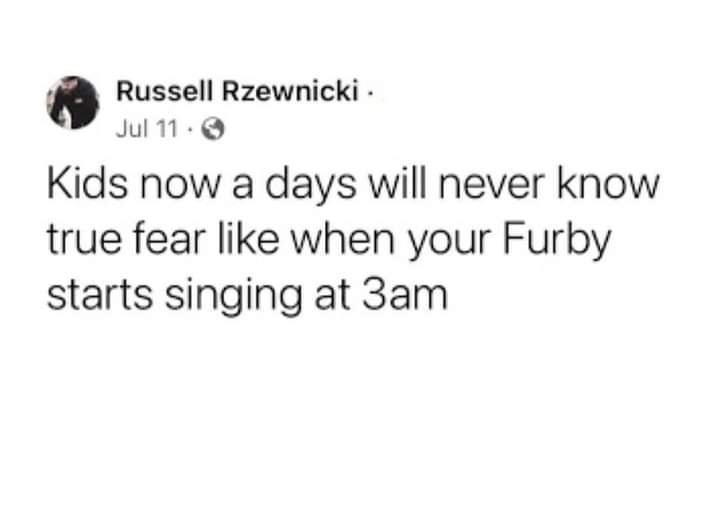
The post features a quote from an account named "Russell Rzewnicki" dated "Jul 11." The text reads: "Kids now a days will never know true fear like when your Furby starts singing at 3am."
Explanation of the Meme:
From a humorous perspective, this is a "Meme" or a "Millennial" joke. It relies on the absurdity of childhood fears, specifically targeting the strange and terrifying sound of a Furby (a remote-controlled pet) beginning to play music in the middle of the night. The joke implies that the sound of a Furby singing is so irrational and scary that it creates a unique, lifelong fear that adults will never fully understand.
To someone who cannot see it:
This image is essentially a text-based joke. It says: "Kids today are terrified of the sound of a Furby singing at 3 AM."
simple-description (llama3.2-vision_11b)
The meme is a screenshot of a tweet from a Twitter user named "Millenihilism" that reads: "Kids these days will never know what it's like to be scared of clowns, but they will know what it's like to be scared of their phone battery dying at 3%". The tweet is a commentary on the changing nature of fear and anxiety in modern society, specifically how it has shifted from being scared of things like clowns to being scared of mundane things like running out of battery.
detailed-analysis (gemma3-27b-vision)
Okay, let's break down this Facebook post through various theoretical lenses.
Visual Description
The image is a screenshot of a Facebook post. It features a profile picture (a black and white headshot) attributed to "Russell Rzewnicki" with a date stamp of "Jul 11." Below the profile information is the text of the post, which reads: "Kids now a days will never know true fear like when your Furby starts singing at 3am." The background is a solid white. It is a simple, direct, and conversational screenshot.
Foucauldian Genealogical Discourse Analysis
This post can be analyzed through a Foucauldian lens by examining the discourse of fear and technology. Foucault's genealogy wouldn't ask what is frightening, but how the idea of "fear" relating to technology has been constructed historically.
- Historical Construction of Fear: The post relies on a collective, but relatively recent, memory of the Furby toy as a source of unsettling experiences. This is not an inherent quality of the Furby, but a discursive construction. Marketing campaigns promoted the Furby as interactive, even learning, and thus, capable of unpredictability. This unpredictability, combined with its uncanny valley aesthetic (a robotic animal with human-like expressions), contributed to an early anxiety about AI and automated entities.
- Power/Knowledge: The post asserts a perceived gap between generations – "kids nowadays" cannot know this specific fear. This functions as a form of power. The author (and those who share the experience) position themselves as possessing knowledge about a primal, technological fear.
- Discipline & Surveillance: The 3 a.m. element is significant. It links the fear to the night, to a time when rationality is diminished and the subconscious reigns. It suggests an invasion of the domestic sphere by a technological entity when one is most vulnerable. The "singing" further evokes an intrusion—a forced, unwanted performance.
Critical Theory
From a Critical Theory perspective (heavily influenced by the Frankfurt School), this post taps into anxieties surrounding the proliferation of technology and its impact on human experience.
- Commodification of Fear: The Furby, as a manufactured commodity, becomes a vector for fear. Critical theorists argue that capitalism can co-opt and commodify even negative emotions like fear, transforming them into sellable experiences. The appeal of the Furby wasn't just in its interactivity, but in its potential to disturb.
- Alienation & Dehumanization: The post implicitly contrasts the experience of a tangible, yet unsettling, toy with the potentially more abstract and pervasive anxieties of contemporary digital technology. The author seems to mourn a time when technology’s intrusion into personal life was “simpler” – a single, bizarre object.
- Culture Industry: The Furby can be seen as a product of the "culture industry"—mass-produced entertainment designed to pacify and control. Its creepiness can be interpreted as a symptom of the culture industry's tendency to blur the lines between the real and the artificial.
Postmodernism
A postmodern reading of this post would highlight its playful deconstruction of traditional notions of fear and authenticity.
- Hyperreality & Simulation: The post suggests that the "true fear" isn’t about a genuine threat, but a simulation of fear created by an object. The anxiety isn't about the Furby itself but the idea of a haunted object.
- Irony & Nostalgia: The post is tinged with nostalgia for a simpler, more "authentic" form of technological anxiety. The "kids nowadays" framing is a characteristic postmodern gesture—a self-aware attempt to distinguish a “lost” past from a fragmented present.
- Playfulness with Meaning: The post doesn’t present a serious argument about fear; it’s a playful, almost whimsical observation. This emphasis on playfulness is a hallmark of postmodern thought.
In conclusion
This seemingly simple Facebook post, about a toy going off in the middle of the night, offers a surprisingly rich entry point for exploring complex theoretical concepts. It reveals anxieties about technology, consumerism, authenticity, and the changing nature of fear itself. The post’s resonance lies in its ability to tap into shared cultural memories and anxieties about the increasingly blurred lines between the real and the artificial.
simple-description (llama3.2-vision)
This meme is a humorous observation about how children's fears have changed over time. The text reads: "Kids now a days will never know true fear like when your Furby starts singing at 3am." The meme is likely referencing the classic toy Furby, which was known for its ability to speak and sing at random times, often startling children in the middle of the night. The meme is poking fun at how kids today are more likely to be scared of something like a smartphone or a video game, rather than a seemingly innocuous toy like a Furby.
tesseract-ocr
a) Russell Rzewnicki : Jula1-@ Kids now a days will never know true fear like when your Furby starts singing at 3am