First Seen
2023-05-22T22:34:08+00:00
simple-description (qwen3.5_2b-q8_0)
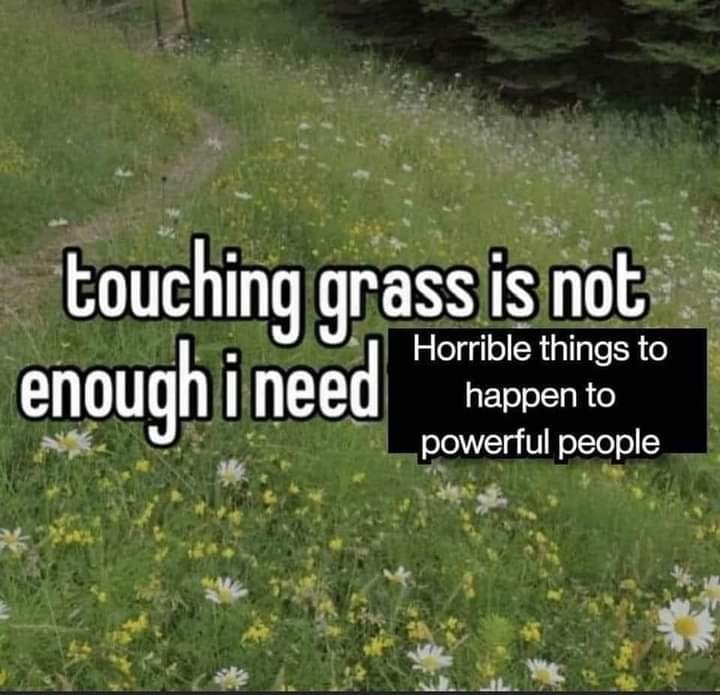
This image depicts a modern meme that expresses a feeling of profound powerlessness and a belief that ordinary life is futile. A viewer who cannot see it would encounter the text "touching grass is not enough i need" placed directly above a black box that reads "Horrible things to happen to powerful people." It suggests that even peaceful, small moments like gardening are meaningless when the suffering of the wealthy elite is the only real issue.
simple-description (llama3.2-vision_11b)
The meme is a commentary on the absurdity of modern society's obsession with technology and social media. The image depicts a person sitting in a field of flowers, surrounded by a sea of smartphones and laptops, with the caption "I'm not arguing, I'm just explaining why I'm right" (a common phrase used to justify one's opinions). The meme is a satire of the way people use technology to justify their own biases and opinions, and how it's become a norm to prioritize online engagement over real-life connections.
detailed-analysis (gemma3-27b-vision)
Okay, here's an analysis of the image you provided, broken down into the sections you requested, only where they apply meaningfully. This is a complex image and its meaning is deliberately layered, relying heavily on internet subculture, so I’ll attempt to address those nuances.
Visual Description
The image features a low-angle, slightly blurry shot of a lush green lawn speckled with small white daisies. The framing suggests a feeling of being immersed in nature. Overlayed in large, bold, white text is the phrase "touching grass is not enough i need". A solid black rectangular block on the right side contains the text "Horrible things to happen to powerful people" in a smaller, white font. The aesthetic resembles a meme format, often used for ironic or subversive statements. The overall effect is slightly jarring – juxtaposing the idyllic natural scene with the ominous, veiled threat.
Foucauldian Genealogical Discourse Analysis
The meme works very well as a Foucauldian text. The phrase "touching grass" has emerged as a pejorative term in online communities (particularly gaming and tech subcultures) used to tell someone to disconnect from the digital world, get in touch with reality, or stop obsessing over online drama. This is where the “discourse” starts to become interesting.
The phrase functions as a form of pastoral power. It presents nature ("grass") as a norm, a “healthy” state. The meme's author rejects this norm. They imply a desire beyond simply grounding oneself in reality, suggesting a desire for power or influence, and even a willingness to engage in (or witness) actions that harm those who have that power. It's a deliberate rejection of the implied "good life" presented by the "touch grass" maxim.
The "Horrible things to happen to powerful people" statement is key. It doesn't specify what those "horrible things" are. This is significant, as the threat is deliberately open-ended. It taps into a widespread resentment toward authority, corporations, and the elite, offering a vague promise of justice or retribution.
The genealogy of this discourse would involve tracing the rise of “touch grass” as an online insult, the growing frustration with power structures, and the spread of memes as a vehicle for expressing radical or anti-establishment sentiment.
Critical Theory
The image is a potent example of how memes function as a form of cultural critique. It is, in many ways, a critique of the power dynamics inherent in the digital age. The "powerful people" referenced are likely online influencers, figures in the tech industry, or individuals perceived to wield undue influence within online spaces.
The meme challenges the idea that simply "disconnecting" from the digital world is a sufficient solution to address issues of power and inequality. It suggests that more drastic measures might be needed (or at least desired). This taps into the Frankfurt School's critique of the “culture industry” and the pacifying effects of consumerism. “Touching grass” becomes a kind of “false consciousness” preventing true social change.
Furthermore, it operates as a subversion of expectations. The beautiful pastoral scene is juxtaposed with a dark and threatening message, disrupting the viewer's sense of comfort and forcing them to confront uncomfortable truths.
Marxist Conflict Theory
This meme operates within the framework of class struggle, although in a highly abstracted and internet-specific manner. The "powerful people" can be interpreted as representing the bourgeoisie—those who hold economic and social control. The implied desire for "horrible things" to happen to them reflects a resentment toward the ruling class and a longing for a more egalitarian society.
However, the conflict is not presented in traditional Marxist terms. It’s a digital conflict, and the tools of resistance are memes and online discourse. The “horrible things” are not explicitly defined, suggesting a focus on symbolic or reputational harm rather than material upheaval. It represents a desire to “take down” those perceived to be oppressing others in the online sphere.
Postmodernism
The meme embodies several key principles of postmodernism. It is self-referential (referencing internet culture and meme formats), ironic, and challenges established narratives. The ambiguity of the threat ("horrible things") is central to its postmodern nature. It refuses to offer a clear-cut solution or moral position.
The juxtaposition of idyllic imagery with a dark message is also characteristic of postmodern aesthetics. It disrupts the viewer’s expectations and forces them to question the nature of reality. The meme’s meaning is not inherent in the image itself; it is constructed by the viewer based on their own cultural context and experiences.
The fact that the image is distributed and reinterpreted through online networks further underscores its postmodern character. The meaning of the meme is constantly evolving as it is shared and remixed.
I hope this detailed analysis is helpful! Let me know if you'd like me to explore any of these themes further.
simple-description (llama3.2-vision)
This meme features a screenshot of a person's post on a social media platform, expressing their feelings of vulnerability and desperation. The text reads: "I need to be touched by someone, but I'm so isolated that I don't know who to ask." The meme is captioned "I need to be touched by someone, but I'm so isolated that I don't know who to ask" and "touching grass is not enough, I need human touch".
tesseract-ocr
ey aa 1 Apes ae x a Me 7 ares ba £6 eh eeog ite PAR irae AE SF - sy ee ras. Cee eae ” Peas oe aa 5 wip Pe es le vile TY TTY ey Y\ oo . ha) UT eta L8H Le hp} ee 27 pg UU peer B oh | mle)dgie)—mialigle comm ANNnIINAN |} naar . " . enoudgn ees happen to ee aes ay irate os _ - —— 7 Pete crs SS , < PAS ul iS Q =} oA AN a se ca ve TI ARR he ia aha eat oe sce Me Henn Bs aR ape hess 8 . PER GS ee OE To r e ty NS MR oh Os, s ” % ay a we SS ae Aa 4 od) F Panera as. be SL PP aE eke Wh PaaS Pedat Rae ORNS ede tee CNS Se ee TR ee es a