First Seen
2023-06-16T19:37:43+00:00
simple-description (qwen3.5_2b-q8_0)
The image satirizes the concept of millenihilism—the idea that the ultimate goal is ultimately futile or meaningless—by depicting a conversation where a trivial small goal (going out) is simply agreed to without any real effort or consequence.
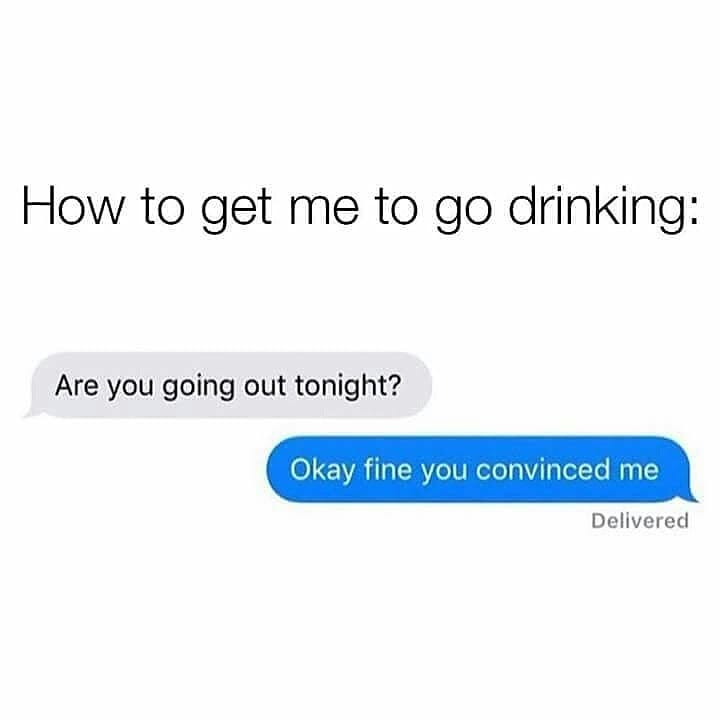
The text includes the header "How to get me to go drinking:", a question "Are you going out tonight?", a reply "Okay fine you convinced me", and a footer status "Delivered," highlighting the absurdity of a small social promise as a major life achievement.
simple-description (llama3.2-vision_11b)
The meme is a humorous take on the concept of "millenialism" or the idea that younger generations are more focused on their personal lives and relationships than on traditional societal norms. The meme presents a conversation between two people, where one asks if the other is "going out tonight", implying a desire for social interaction and connection. The response, "I don't know, I'm still trying to figure out how to adult", is a relatable and humorous commentary on the challenges of growing up and becoming independent.
detailed-analysis (gemma3-27b-vision)
Okay, here's a breakdown of the image, utilizing the requested theoretical lenses. Some lenses won't be as applicable, and I'll explain why if that's the case.
Visual Description
The image is a screenshot of a text message exchange. The top message reads, "Are you going out tonight?". The response is, "Okay fine you convinced me". Underneath the response is the word "Delivered," indicating the message was successfully sent. The screenshot is presented under the title "How to get me to convince me", presenting the exchange as a formula.
Foucauldian Genealogical Discourse Analysis
This exchange is ripe for Foucauldian analysis. The exchange exemplifies a power dynamic operating through discourse. The question "Are you going out tonight?" isn't just a request for information; it's a disciplinary tactic. It establishes an expectation, subtly implying a 'normal' or desirable behavior (going out, socializing, presumably involving consumption).
The response, "Okay fine you convinced me," is crucial. It demonstrates subjection – the individual isn't saying they wanted to go out, but that they've been persuaded or coerced into it. The language ("fine") communicates resistance masked as compliance. It suggests a negotiation of power.
The ‘formula’ framing – “How to get me to convince me” – reveals how the individual understands they’ve been subject to a normalizing power. They recognize the tactic used on them and ironically articulate it. Foucault would argue this exchange doesn’t represent a conscious ‘manipulator’ and ‘victim’ but rather the functioning of discourse creating subjects through power relations.
Critical Theory
This exchange can be viewed through the lens of Critical Theory, which examines how power structures are maintained and reinforced. The question can be seen as participating in a larger system of social norms and expectations. Going out (and potentially consuming alcohol) is presented as the default, the 'normal' activity.
The responder’s reluctant agreement signifies the colonization of daily life by these norms. The individual internalizes the pressure to conform, sacrificing their own desires or preferences to meet unspoken social expectations. The image critiques how seemingly innocuous interactions can contribute to the perpetuation of dominant ideologies.
Marxist Conflict Theory
This lens is less directly applicable, but some connections can be drawn. Consumption, particularly of alcohol in a social setting, can be linked to commodity fetishism. Going "out" often involves spending money on drinks, cover charges, transportation, etc. The exchange could be interpreted as a micro-level illustration of how individuals are drawn into capitalist systems of consumption through social pressures. However, this interpretation requires stretching the meaning of the image. The focus is more on social coercion than economic exploitation.
Postmodernism
The image resonates with postmodern themes of the breakdown of grand narratives and the fluidity of identity. The "How to..." framing implies that there isn't a true self, only a series of responses to external stimuli. The responder’s agreement isn't based on internal desire but external persuasion, highlighting the constructed nature of selfhood.
The ironic presentation of the exchange (“How to get me to convince me”) challenges the idea of authenticity and intentionality. It suggests that actions are often driven by subtle forces and external pressures. The image fits the postmodern emphasis on the fragmentation of experience and the loss of stable meaning.
Queer Feminist Intersectional Analysis
This lens is also less directly applicable, but it offers potential insights. Social expectations around going "out" and drinking can be gendered and coded. Often, social outings are tied to courtship, validation, or fitting into gendered norms of sociability. It's possible that the responder is feeling pressure to conform to these norms, particularly if they identify as someone who may be marginalized in social settings.
Furthermore, if we consider the intersection of gender, class, and race, social expectations around drinking and socializing may be even more pronounced. This individual might feel obligated to participate in social activities to avoid being seen as an outsider or to maintain a certain social standing. However, without knowing more about the individuals involved, this remains a speculative interpretation.
In conclusion, the seemingly simple text exchange is surprisingly rich for theoretical analysis, particularly when viewed through the lenses of Foucault, Critical Theory, and Postmodernism. It provides a compelling example of how power dynamics operate on a micro-level, shaping our behaviors and challenging our assumptions about agency and authenticity.
simple-description (llama3.2-vision)
This meme is a humorous take on the common experience of being asked to go out for drinks or a night out. The image features two text conversations: the first asks "Are you going out tonight?" and the second responds with "Okay fine you convinced me" followed by "In 2 hours". The meme pokes fun at the idea that someone can be easily convinced to go out for a night of drinking, and the subsequent "In 2 hours" implies that the person is already planning to leave for the night.
tesseract-ocr
How to get me to go drinking: Are you going out tonight? Delivered