First Seen
2023-07-03T22:57:47+00:00
simple-description (qwen3.5_2b-q8_0)
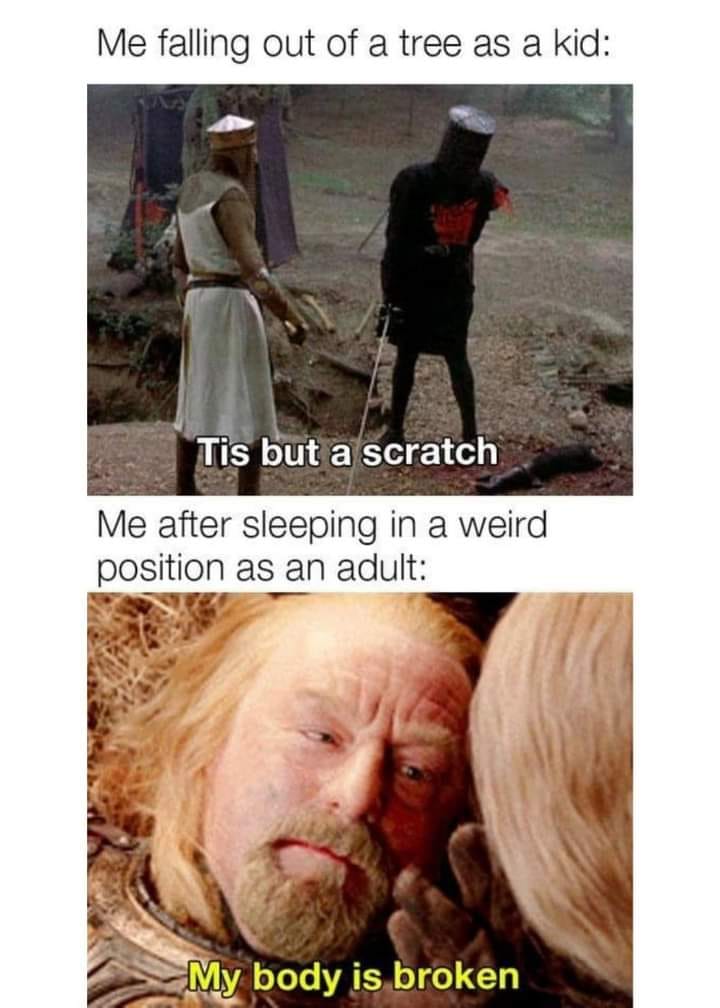
This meme plays on the concept of the "Millenium," an ancient Roman holiday of celebration, by contrasting a minor childhood annoyance with the total destruction of one's body. The top caption ("Tis but a scratch") suggests a trivial victory, while the bottom image ("My body is broken") reveals the absurdity that an entire body can be destroyed by its own weapon. This creates a dark, ironic contrast between a minor annoyance and total self-destruction.
simple-description (llama3.2-vision_11b)
This meme is from the category of Millenialism, which refers to the experiences, anxieties, and cultural references that are unique to people who grew up during the 21st century. The meme is likely a humorous take on the challenges of growing up in the 21st century, with the image showing a character from a classic children's book (Alice in Wonderland) being traumatized by the modern world. The text "I can remember when..." is likely the caption, implying that the character is shocked by the changes in the world since their childhood.
detailed-analysis (gemma3-27b-vision)
Okay, let's analyze this meme using the requested theoretical lenses. It's important to remember that applying these dense theories to a meme is often a playful exercise, highlighting potential connections rather than a rigorous academic analysis.
1. Visual Description
The meme is a two-panel comparison.
- Panel 1: Depicts a still from the film Monty Python and the Holy Grail. A young boy (the protagonist) is in mid-air, falling from a tree. An adult, dressed as a knight (presumably King Arthur) stands looking up, a mix of concern and bemusement on his face. The text overlay reads "Tis but a scratch."
- Panel 2: Features a close-up image of a heavily weathered, pained, and disheveled face of Ron Perlman, looking distressed. The text overlay reads "My body is broken."
The humor relies on the stark contrast between childhood resilience (represented by the dismissive "Tis but a scratch") and adult physical fragility ("My body is broken").
2. Foucauldian Genealogical Discourse Analysis
- Discourse of Childhood & Resilience: The meme reveals a discourse around childhood. Childhood is constructed as a period of inherent robustness, a time when injuries are easily dismissed and quickly healed. The phrase "Tis but a scratch" performs this discourse, reinforcing the idea that youthful bodies are forgiving. Foucault's genealogy would examine how this discourse developed historically – how did we come to believe children are inherently resilient? What social practices and institutions contribute to this belief?
- Discourse of Aging & Decline: Conversely, the second panel represents a discourse surrounding aging and physical decline. The image performs the idea that bodies become vulnerable, fragile, and subject to constant breakdown with age. The declaration "My body is broken" is not just a statement of physical pain, but a performativity of this discourse. Foucault would ask how this discourse positions aging bodies as deficient, and what power structures benefit from the normalization of physical decline.
- Power/Knowledge: The meme subtly highlights how power/knowledge operates. The seemingly innocent phrase about a "scratch" reinforces the power of defining what constitutes injury and valid pain. In childhood, that definition is often controlled by adults ("It's not that bad"). As an adult, the claim of a "broken" body, while arguably accurate (through lived experience) might not be perceived the same way as if said by a child.
3. Critical Theory (Frankfurt School)
- Alienation and the Body: From a critical theory perspective (think Adorno or Horkheimer), the meme can be read as a comment on the alienation inherent in modern life. The lost innocence and carefree physicality of childhood is contrasted with the worn-down, pain-ridden body of adulthood. The "broken" body signifies a loss of connection to the self, and an objectification of the body as a machine subject to wear and tear.
- Commodification of the Body: The image of Ron Perlman's damaged visage can be connected to the commodification of the body in contemporary culture. We're bombarded with images of "ideal" bodies, and anything that deviates from that ideal is seen as flawed or broken. The meme taps into the anxiety surrounding aging and the pressure to maintain a youthful appearance.
- Loss of Authenticity: The meme suggests a loss of authenticity as we age. The carefree fall from the tree represents a moment of uninhibited experience, while the "broken" body represents a burdened and self-conscious state.
4. Postmodernism
- Hyperreality and Simulation: The meme relies on intertextuality (referencing Monty Python and a recognizable actor). This is a hallmark of postmodernism. The meaning isn't simply derived from the images themselves, but from our cultural understanding of the references. It’s a simulation of experience, not the experience itself.
- Deconstruction of Childhood & Aging: The meme deconstructs the traditional narratives surrounding childhood and aging. It subverts the idea of childhood as a perpetually joyous and carefree period, and it challenges the notion that aging is a natural and inevitable process.
- Irony and Parody: The juxtaposition of the two panels is inherently ironic. It’s a playful commentary on the human condition, and it uses parody to challenge conventional norms.
5. Queer Feminist Intersectional Analysis (Likely applicable, but requires some stretching)
- Bodily Vulnerability & Societal Expectations: While the meme isn't explicitly gendered or queer, we can apply an intersectional lens by considering how societal expectations around bodies (shaped by gender, race, ability, etc.) contribute to the experience of physical vulnerability. For example, women and LGBTQ+ individuals are often subjected to greater scrutiny and pressure regarding their bodies, which can exacerbate feelings of fragility and vulnerability.
- Challenging Ableist Norms: The meme's focus on a "broken" body can be read as a subtle challenge to ableist norms. The declaration of being "broken" disrupts the expectation of physical perfection and acknowledges the reality of living with physical pain or limitations.
- The Body as a Site of Power: Feminist theory emphasizes the body as a site of power and control. This meme highlights how the body is subject to the forces of time and wear, and how our experiences of embodiment are shaped by social and cultural factors.
Important Note: These are interpretations. Applying these theories to a meme is often playful and meant to illuminate potential connections, not to provide a definitive analysis.
simple-description (llama3.2-vision)
The meme is a humorous comparison between a child's fear of a tree falling on them and the fear of a partner's death in bed. The top image shows a child being told to "tis but a scratch" after falling out of a tree, implying that the injury is minor. The bottom image shows a person in a medieval-style death scene, saying "my body is broken" after a partner's death in bed.
tesseract-ocr
Me falling out of a tree as a kid: _ a an “Tis butiajscratch Me after sleeping in a weird position as an adult: ry. “ 7 Les ‘ x ad i ‘3 4 \ ,