First Seen
2023-07-16T22:36:57+00:00
simple-description (qwen3.5_2b-q8_0)
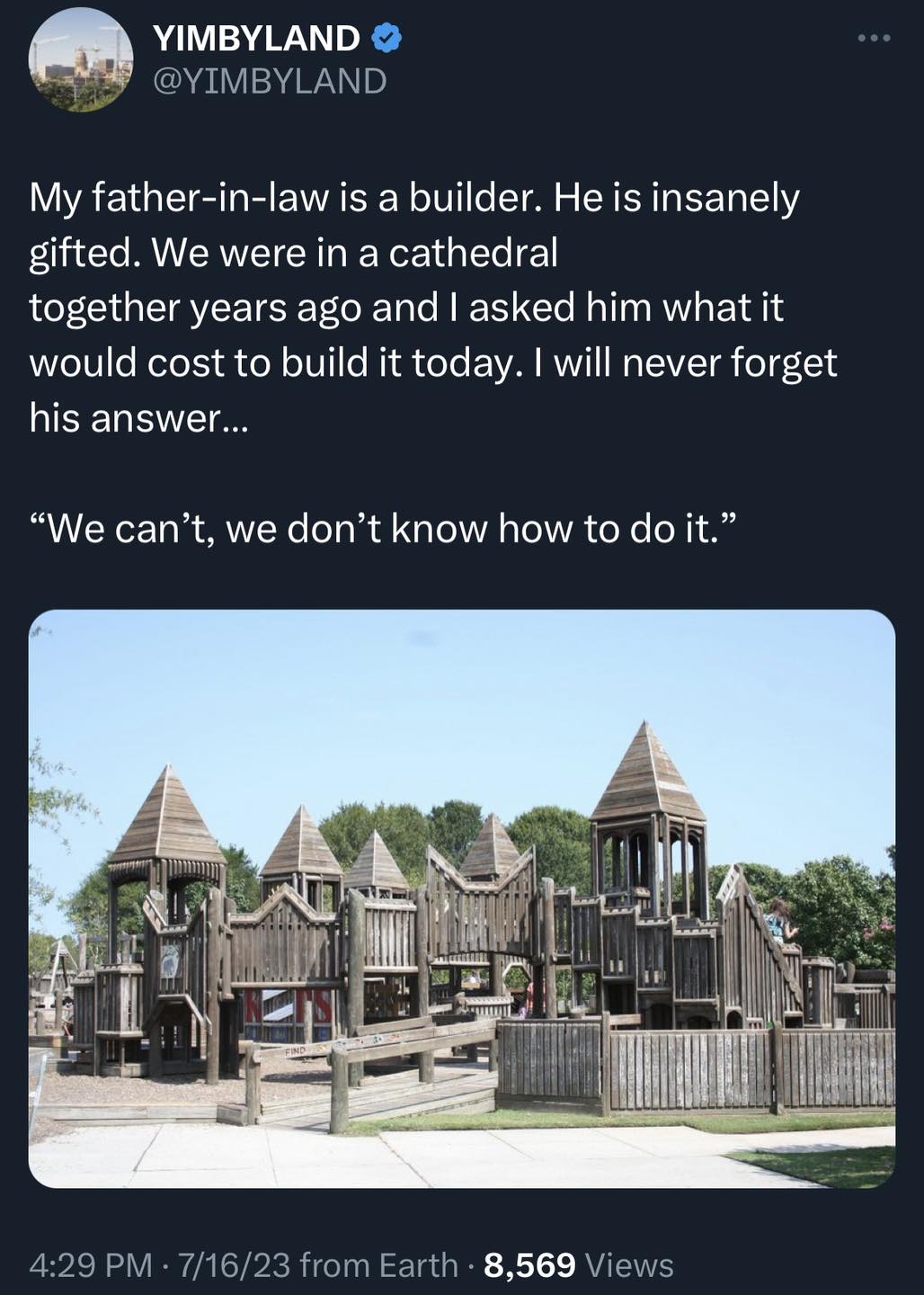
This meme captures the Millenihilist sentiment surrounding the "Great Un-Buildering," a theory that claims humanity has lost the ability to build or create true perfection. The joke comes from a grandfather admitting he cannot build a magnificent cathedral today simply because the world has changed, resulting in the cynical reply: "We can't, we don't know how to do it." The image of a weathered, overgrown wooden playset further underscores this rejection of idealized grandeur, suggesting that no structure ever truly holds value in a cynical world.
simple-description (llama3.2-vision_11b)
This meme is a humorous take on the concept of "millenihilism," a term that refers to the idea that the current generation is more focused on preserving their own lives and experiences than on creating a better future for the next generation. The meme features a screenshot of a Twitter conversation between two people, with one person asking the other if they would be willing to sacrifice their own life to save their child. The other person responds with a sarcastic comment about the absurdity of the question, implying that it's ridiculous to expect someone to sacrifice their life for their child. The meme is captioned "millenihilism" and includes a link to a Wikipedia article about the term.
detailed-analysis (gemma3-27b-vision)
Okay, here’s an analysis of the image and the accompanying text, broken down into relevant theoretical frameworks, as requested. I'll assess whether each section is applicable before proceeding.
Please note: These analyses are interpretations. The inherent nature of these theories allows for multiple readings, and the strength of application depends on how deeply one wants to delve. I will aim for a well-supported and insightful approach.
1. Visual Description
The image depicts a complex wooden play structure resembling a small, fantastical village or fortress. The structure is multi-tiered, with numerous towers, bridges, and connecting platforms. The style evokes a medieval or fairytale aesthetic. The wood is stained a natural color. It’s situated in a grassy area, and a paved walkway runs in front of it. The overall impression is one of intricate craftsmanship and imaginative play. It feels like a high-end, custom-built playground feature, not something mass-produced. The scale suggests it's meant for multiple children to explore simultaneously.
2. Foucauldian Genealogical Discourse Analysis
This section is highly applicable, given the text's emphasis on lost knowledge and skill.
- Discourse & Power/Knowledge: The statement “We can’t, we don’t know how to do it” isn't simply an admission of technical inability. It reveals a breakdown in a discourse – the shared ways of understanding and practicing building, particularly complex, ornate construction. Michel Foucault would argue that this loss of skill isn't accidental but is linked to shifts in power/knowledge relations.
- Genealogy: A genealogical analysis traces how this skill came to be lost. We can speculate (without historical context, but that's often part of the exercise) that the rise of standardized construction, prefabricated materials, and simplified building techniques led to the atrophy of these traditional, highly specialized skills. Previously, these skills were likely held by guilds, passed down through apprenticeships, and connected to specific social roles. The shift towards industrial/modern building methods disrupted this system.
- Episteme: The statement could be seen as indicative of a shift in the episteme— the underlying set of rules and assumptions that govern knowledge in a particular era. The modern episteme prioritizes efficiency, cost-effectiveness, and scalability in construction, often at the expense of artistry, intricacy, and traditional techniques.
- Disciplinary Power: Modern building codes and regulations, while intended for safety, could also be seen as forms of disciplinary power that standardize and control building practices, effectively extinguishing alternative ways of knowing and doing.
The statement isn't about a lack of materials or capital; it’s about the loss of the practical knowledge itself – the embodied expertise that allowed for such construction.
3. Critical Theory
Applicable, particularly in relation to the alienation of labor and the commodification of skills.
- Loss of Authenticity: The statement points to a broader concern in Critical Theory regarding the loss of authenticity and the erosion of craftsmanship in a capitalist system. Traditional skills, like those required to build this structure, are often replaced by mass-produced goods and standardized processes, leading to a sense of alienation and dispossession.
- Commodification of Skill: The expertise to create this structure could be seen as a form of "cultural capital" that has been devalued or lost through the forces of modernization. The focus shifts from the intrinsic value of the skill itself to its economic value.
- Frankfurt School Influence: Drawing on the Frankfurt School, we might interpret the loss of building skill as a symptom of the "instrumental reason" that dominates modern society—the tendency to evaluate everything solely in terms of its utility or efficiency. This diminishes the importance of artistry, creativity, and the human connection to craft.
- Dialectic of Enlightenment: The ability to build something beautiful and intricate has been lost in the relentless pursuit of progress.
4. Marxist Conflict Theory
Strongly applicable, especially concerning the division of labor and the control of means of production.
- Division of Labor: The statement can be interpreted through a Marxist lens as a consequence of the increasing division of labor in modern construction. Specialized skills required for such a structure are no longer concentrated in a single individual or within a community of craftspeople. They have been fragmented and outsourced, or lost altogether.
- Control of Means of Production: The loss of skill might also reflect the concentration of control over the means of production in the hands of large corporations and developers. Traditional craftspeople and small-scale builders have been marginalized, and their knowledge is no longer valued or preserved.
- Alienation: Marxist theory emphasizes the alienation of labor under capitalism. The inability to build this structure represents a loss of creative agency and a disconnection from the material conditions of production. It suggests a society where individuals are increasingly dependent on external systems and lack the skills to create things with their own hands.
- Class Struggle: The loss of skill can also be seen as a form of class struggle, where the knowledge and expertise of working-class craftspeople have been devalued and displaced by the interests of capital.
5. Postmodernism
Somewhat applicable, concerning the fragmentation of knowledge and the rejection of grand narratives.
- Fragmentation of Knowledge: Postmodern thought emphasizes the fragmentation of knowledge and the rejection of universal truths. The statement could be interpreted as a symptom of this fragmentation, suggesting that knowledge is no longer cumulative or holistic. The skill to build this structure has been lost, and there is no easy way to recover it.
- Rejection of Grand Narratives: Postmodernism challenges grand narratives of progress and modernization. The loss of skill can be seen as a critique of these narratives, suggesting that progress often comes at the expense of traditional knowledge and cultural heritage.
- Simulacra and Simulation: One could potentially argue that modern architecture and building techniques are increasingly reliant on "simulacra"— copies without originals— and that the loss of skill represents a move away from authentic craftsmanship towards artificial or simulated experiences.
6. Queer Feminist Intersectional Analysis
Less directly applicable, but potentially insightful.
- Devaluing of "Feminine" Skills: One could argue that complex, artistic craftsmanship like that needed for this structure was historically associated with "feminine" forms of labor—detail-oriented, collaborative, and aesthetically driven. These skills were often devalued and marginalized within patriarchal systems.
- Marginalization of Non-Standardized Knowledge: Queer theory often critiques systems that enforce standardization and conformity. The loss of skill could be seen as a form of cultural erasure that marginalizes alternative ways of knowing and doing.
- Intersectional Perspective: An intersectional analysis would consider how race, class, gender, and other social categories intersect to shape access to knowledge and skills. The loss of building skill may disproportionately affect marginalized communities who have historically been excluded from apprenticeship programs and educational opportunities. However, this connection is weaker than the others.
Let me know if you’d like me to elaborate on any of these analyses or explore other theoretical frameworks!
simple-description (llama3.2-vision)
The meme is a screenshot of a tweet that reads: "My father-in-law is a builder. He is incredibly gifted. We were in a cathedral together years ago and I asked him what it would cost to build it today. He said, 'We can't, we don't know how to do it.' The image is a picture of a playground, but the tweet is actually referring to a cathedral.
tesseract-ocr
rel YIMBYLAND @ ==) @YIMBYLAND My father-in-law is a builder. He is insanely gifted. We were in a cathedral together years ago and | asked him what it would cost to build it today. | will never forget his answer... “We can’t, we don’t know how to do it.” Sei dl iota Ig ca ahi | ow i) Bs ais | oe) (| ua eee IE WAP OUN TT LEAN ey = fancies Susie ee 4:29 PM - 7/16/23 from Earth - 8,569 Views