First Seen
2023-07-16T22:37:54+00:00
simple-description (qwen3.5_2b-q8_0)
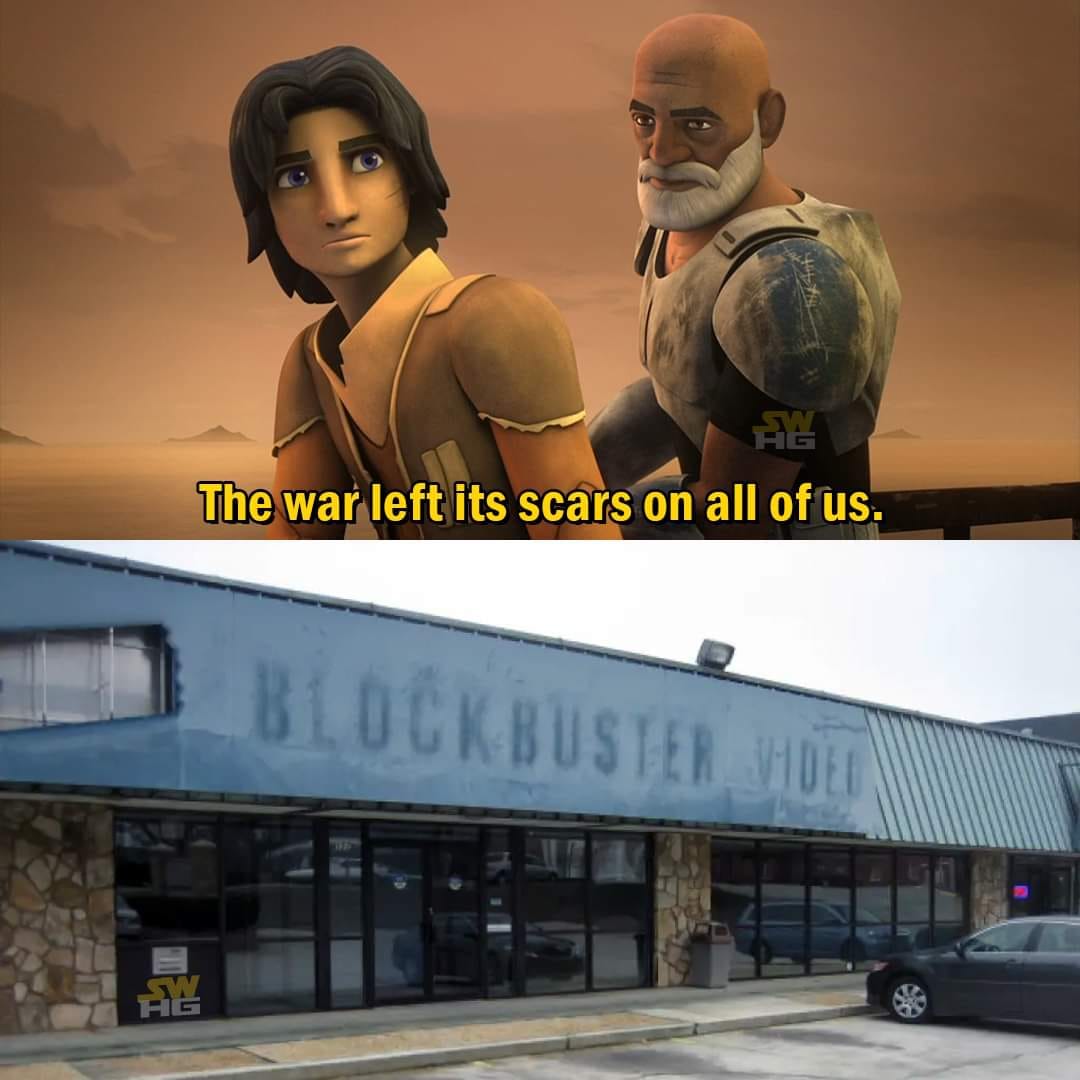
This meme is a visual pun that plays on the text "The war left its scars on all of us." On the top, two animated characters from a video game are shown in a desolate landscape, stating that the war has inflicted physical injuries. On the bottom, a real-world storefront is displayed, with a sign reading "BLOCKBUSTER VIDEO," implying that the characters' "scars" are actually the location of that specific video store. It creates a humorous contrast between a story about tragedy and the mundane reality of a shopping center.
simple-description (llama3.2-vision_11b)
The meme is a reference to the decline of physical video stores, specifically Blockbuster, which was once a dominant player in the industry but ultimately went bankrupt. The image shows a still from a sci-fi movie where a character says "The end of the world is at hand" and is captioned "The end of Blockbuster". The meme is making a humorous comparison between the impending doom of the world in the movie and the demise of Blockbuster, implying that the end of the world is just as catastrophic as the end of a beloved video store.
detailed-analysis (gemma3-27b-vision)
Okay, let's break down this image using the requested theoretical frameworks. It's a rather intriguing juxtaposition, and rich for analysis.
Visual Description
The image is a diptych (two-panel image). The top panel features two characters depicted in a style reminiscent of The Walking Dead animated series. One is a young boy with a slightly worried expression, and the other is a more weathered, grizzled man, presumably a protector figure. They are set against a blurry, ochre-toned backdrop that suggests post-apocalyptic desolation. A logo with the letters "SW AG" appears in both the upper left and lower left corners. The text "The war left its scars on all of us" is overlaid on the upper portion of the image.
The bottom panel shows an exterior shot of a Blockbuster Video store. It's a standard storefront, seemingly abandoned or at least in a state of disuse, judging by the lack of activity and the somewhat faded appearance. It's a brightly colored building in otherwise somewhat faded surroundings.
The contrast between the characters in a clear post-apocalyptic setting and the physical reality of a Blockbuster Video store is striking. It’s a deliberate visual pairing that invites interpretation.
Foucauldian Genealogical Discourse Analysis
The image can be analyzed through a Foucauldian lens by examining the discourses that shaped both the represented "war" (in the upper panel) and the rise and fall of Blockbuster (in the lower panel). Foucault’s genealogy focuses on how power operates through discourse—the systems of thought, language, and practice that construct our understanding of reality.
- War & Discipline: The “war” depicted isn’t defined, allowing for broad interpretation. It could be literal, but it could also refer to the “war on terror”, or even the Cold War. Regardless, war is always a site of intense disciplinary power, establishing norms and controlling bodies. The characters’ “scars” are not merely physical; they represent internalized norms, trauma, and the imposition of societal control. The older man embodies the disciplinary forces, while the young boy represents the generation shaped by it.
- Blockbuster & Control: Blockbuster, as a once-dominant video rental chain, was a key player in the control of media consumption. It dictated what was accessible, how long people could access it, and shaped a specific pattern of entertainment experience. The decline of Blockbuster is a case study in how discourses around technology (Netflix, streaming) actively displaced and replaced existing power structures. The abandoned Blockbuster represents a shift in power dynamics, and the obsolescence of a particular system of control.
- The Juxtaposition: The image links the visible “scars” of war with the more subtle “scars” of capitalist competition and technological disruption. Both have left lasting effects on individuals and communities, shaping how we experience the world.
Critical Theory
From a broadly Critical Theory perspective, the image functions as a critique of modernity and its consequences. Here's how:
- Alienation: The ruined Blockbuster and the scarred characters represent a form of alienation. The Blockbuster embodies the loss of community experiences that physical stores once provided. The scarred characters represent the damage inflicted by war and trauma. The loss of physical and communal spaces replaced by digital isolation can be seen as a key feature of modern alienation.
- Commodification: Blockbuster itself was a system of commodification—turning entertainment into a product to be bought and sold. The rise and fall of such systems demonstrate the inherent instability of capitalism.
- Power Structures: The image implicitly questions the power structures that allow war and unchecked capitalist competition to flourish. It suggests that these forces inflict lasting harm on individuals and communities.
Marxist Conflict Theory
A Marxist interpretation highlights the class conflict inherent in both scenarios.
- War as Class Conflict: Wars are often driven by economic interests and benefit specific classes. The "scars" inflicted are not evenly distributed; the working class and marginalized communities bear the brunt of the suffering. The image implies that the war (whatever it is) is tied to broader economic inequalities.
- Blockbuster & Capitalist Competition: Blockbuster's downfall is a perfect example of capitalist competition. The rise of Netflix was driven by a desire for profit, and it ultimately displaced Blockbuster, leading to job losses and economic disruption. This represents a constant dynamic of accumulation and dispossession.
- The Link: The image links physical warfare with the economic "warfare" of the marketplace. Both are forms of conflict that leave lasting "scars" on individuals and communities.
Postmodernism
The image lends itself to a postmodern reading through its intertextuality and deconstruction of meaning.
- Juxtaposition & Fragmentation: The pairing of the post-apocalyptic characters and the abandoned Blockbuster is a deliberate act of juxtaposition. This fragmentation challenges traditional narratives and invites multiple interpretations.
- Simulacra & Hyperreality: Blockbuster, as a symbol of a bygone era, can be seen as a simulacrum—a copy without an original. Its abandonment suggests that the "reality" it represented has been replaced by a hyperreality of streaming services and digital entertainment.
- Loss of Grand Narratives: The image implicitly questions the "grand narratives" of progress, consumerism, and military dominance. It suggests that these narratives have failed to deliver on their promises and have left behind a legacy of trauma and loss.
Queer Feminist Intersectional Analysis (This might be the most subtle application but still relevant)
While not immediately obvious, an intersectional lens can reveal some interesting dynamics.
- Trauma & Vulnerability: The “scars” represent vulnerability, and marginalized communities (particularly LGBTQ+ individuals and people of color) are disproportionately affected by both war and economic hardship. Intersectionality helps us recognize the compounded effects of oppression.
- Disrupted Spaces: The Blockbuster, as a public space, offered potential opportunities for queer community and visibility. Its abandonment represents a loss of safe spaces and a shrinking of public life.
- Re-imagining Futures: The pairing of desolation with the ruins of a social space might also encourage us to think about reimagining the future, prioritizing community, care, and resistance to systems of oppression.
Let me know if you’d like me to elaborate on any of these interpretations!
simple-description (llama3.2-vision)
This meme is a humorous commentary on the nostalgia and pain of watching a beloved cultural institution (Blockbuster) go out of business. The image shows a scene from the animated series Star Wars Rebels, with two characters looking at a desolate landscape. The text "The war left its scars on all of us" is overlaid on the image, implying that the destruction of Blockbuster is a traumatic event that has left a lasting impact.
tesseract-ocr
: = k . a ae 7 a Al Foo ; 1 f Se 4 \\\\\\\\\ Z s —— cs Ss —