First Seen
2023-08-22T17:57:09+00:00
simple-description (qwen3.5_2b-q8_0)
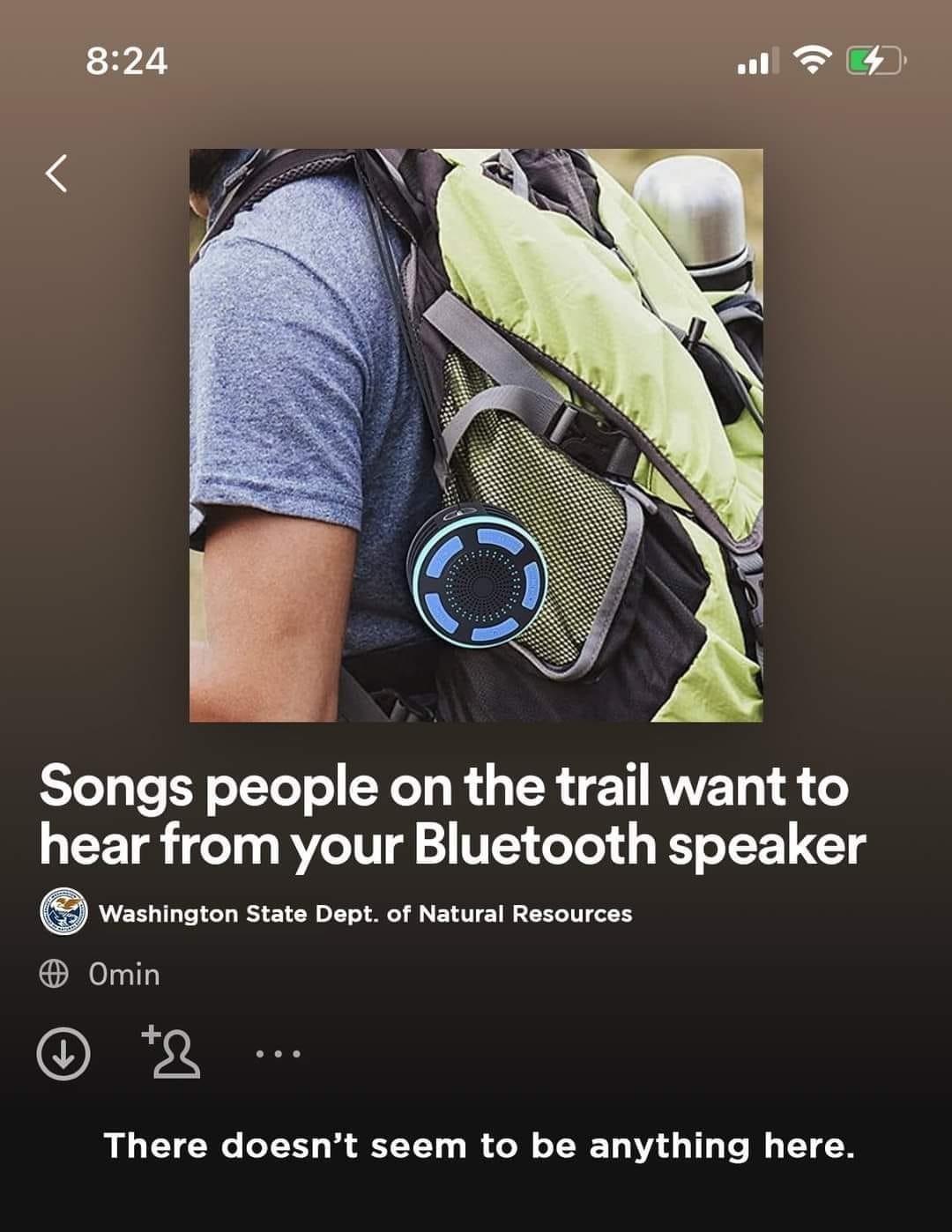
From the lens of Millenihilism—the philosophy that existence is a void or devoid of inherent meaning—this image perfectly illustrates the concept of nothingness. The scene presents a stark emptiness: a hiker on a trail with a device that promises sound ("Songs people on the trail want to hear"), yet concludes with a cynical admission that there is no actual scenery left ("There doesn't seem to be anything here").
This joke is hilarious because it cynically mocks the Washington Department of Natural Resources for filling nature with a commercial product that offers "nothing," reducing the wilderness to a void where music is the only "stuff" available, leaving any genuine beauty completely empty.
simple-description (llama3.2-vision_11b)
The meme is an image of a person's Spotify playlist, with the title "Millenihilism" and a song called "I'm So F***ing Mad at You" by a fictional artist. The song's lyrics are a commentary on the struggles of modern life, with the artist expressing frustration and anger towards the world. The meme is a humorous take on the struggles of being a millennial, with the song's title and lyrics serving as a commentary on the absurdities of modern life.
detailed-analysis (gemma3-27b-vision)
Okay, let's break down this image and the accompanying text using the lenses you requested. I'll only cover sections that seem applicable. Given the subject matter, we'll likely focus heavily on Critical Theory and Postmodernism, with lighter touches of others.
1. Visual Description
The image shows a close-up view of a person's back and upper torso wearing a hiking backpack. The person is wearing a gray t-shirt. Attached to the shoulder strap of the backpack is a small, circular Bluetooth speaker. The pack appears to be a darker color, with a brighter green portion visible on the side. The background is blurry. The image is clearly a screenshot from a short video on social media (presumably TikTok, given the indicators at the bottom). A text overlay reads "Songs people on the trail want to hear from your Bluetooth speaker." Below that is an icon indicating the source is the Washington State Dept. of Natural Resources, along with a runtime of "0min." There are icons for downloading and sharing.
2. Critical Theory
This image, paired with the text, is a prime example of how technology is integrated into the experience of nature. Critical Theory focuses on examining power structures and how they are maintained through cultural norms. Here, the Washington State Department of Natural Resources (a government entity) is promoting the bringing of technology (Bluetooth speakers) into natural environments.
- Commodification of Experience: The text implicitly suggests that the natural experience is not enough on its own; it needs to be supplemented by personal entertainment (music). This turns nature into a backdrop for individual enjoyment, rather than respecting its inherent value.
- Normalization of Auditory Pollution: Encouraging music on trails normalizes adding artificial sounds to a naturally quiet environment. This contributes to auditory pollution, which can disrupt wildlife and diminish the sense of peacefulness others seek in nature.
- Control & Subjectivity: The framing of the question "Songs people on the trail want to hear..." positions the Department as knowing what people want and promoting that desire. It subtly directs visitor behavior and expectations.
3. Postmodernism
The image embodies several tenets of Postmodernism:
- Blurring Boundaries: The image intentionally blurs the boundaries between the natural world and the technological/artificial world. Nature isn’t untouched; it's actively being curated through personal technology.
- Hyperreality: The emphasis on the songs people want to hear suggests a focus on constructed experiences over "authentic" nature experiences. The experience is increasingly mediated through technology and personal preference.
- Deconstruction of “Nature”: By presenting nature as a space for personal entertainment, the image deconstructs the traditional notion of nature as something sacred and separate from human activity. It's a space to be consumed and personalized.
- Fragmentation: The short-form video format and the simple, direct question contribute to a fragmented, bite-sized presentation of information, characteristic of postmodern communication.
4. Foucauldian Genealogical Discourse Analysis
A Foucauldian analysis would focus on the discourse surrounding “nature” and “recreation.”
- Power/Knowledge: The Department of Natural Resources, by posing this question, exercises power through its control of the discourse. It implicitly defines what constitutes a “good” outdoor experience (one enhanced by music).
- Genealogy of “Outdoor Recreation”: Tracing the historical development of the idea of “outdoor recreation” would reveal how it has moved from a focus on wilderness preservation to a commodified, entertainment-driven activity. This image is a moment in that historical process.
- Disciplinary Practices: Encouraging speakers on trails subtly disciplines hikers to conform to a certain expectation—that nature is a place for personal enjoyment, even at the potential expense of its serenity.
Sections Not Applicable:
- Marxist Conflict Theory: While commodification is present, there isn't a clear class struggle or economic conflict evident in the image itself.
- Queer Feminist Intersectional Analysis: There is no overt gender, sexuality, or intersectional dynamic readily apparent.
In conclusion, this image is a seemingly innocuous advertisement that, when examined through critical lenses, reveals deeper issues about how we relate to nature, the role of technology in shaping our experiences, and the subtle ways in which power structures operate within the realm of recreation.
simple-description (llama3.2-vision)
The meme is a screenshot of a Spotify playlist called "Songs people on the trail want to hear from your Bluetooth speaker". The image features a person hiking in the woods with a backpack and a small Bluetooth speaker attached to it. The text "There's no signal here" is displayed at the bottom of the screen, implying that the speaker's music is not being received by anyone on the trail.
tesseract-ocr
8:24 TL is &) tA Sz \ = = a Sy , Songs people on the trail want to hear from your Bluetooth speaker © Washington State Dept. of Natural Resources @® Omin a There doesn’t seem to be anything here.