First Seen
2023-09-15T17:01:58+00:00
simple-description (qwen3.5_2b-q8_0)
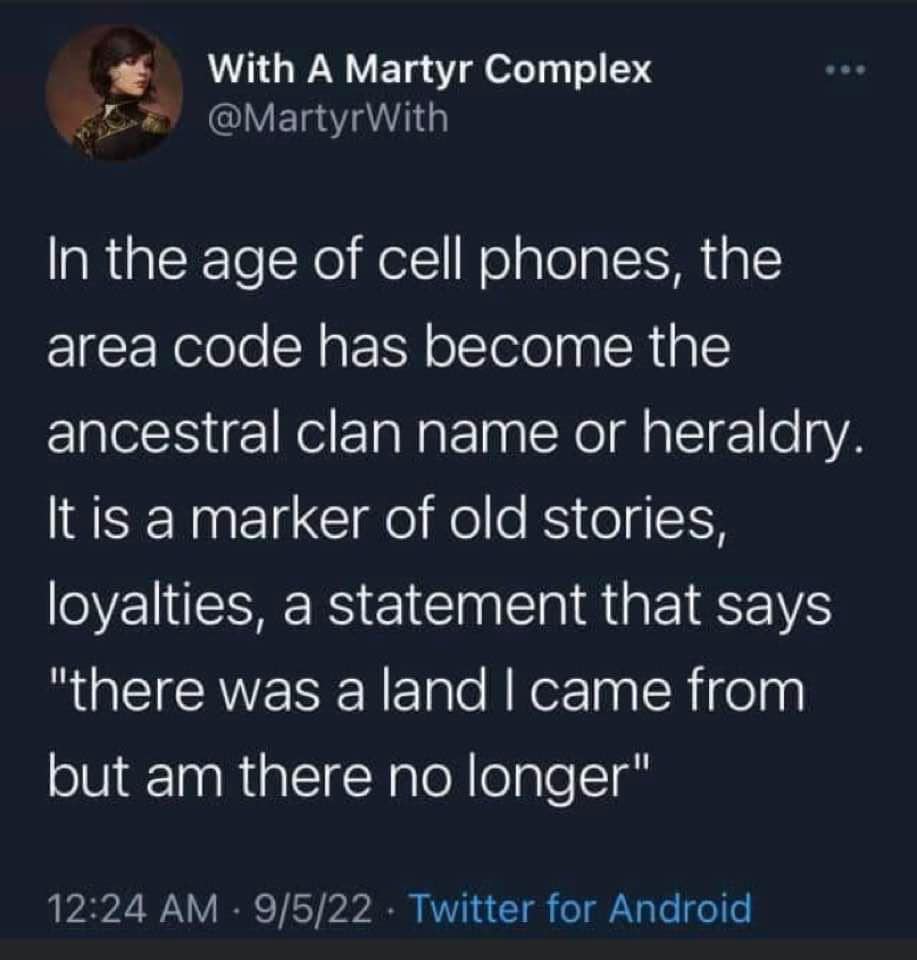
This meme is a satirical example of Millenihilism, a philosophical concept that views human existence as fleeting, insignificant, and ultimately meaningless.
The user argues that in the age of cell phones, permanent area codes have become like ancestral clan names—things that define who you are from a historical perspective. By stating "there was a land I came from but am there no longer," they suggest that while your old identity or "clan" might once be fixed, the actual location is gone forever and can no longer be accessed or found.
simple-description (llama3.2-vision_11b)
The meme is a humorous commentary on the societal shift from physical to digital communication, with a tongue-in-cheek reference to the "millenium" (2000s) generation's nostalgia for a bygone era. The image is a screenshot of a Twitter post that reads: "I just found my old myspace profile and I'm shocked to see how much of a millenial I am. I'm not even mad, I'm just... nostalgic."
detailed-analysis (gemma3-27b-vision)
Okay, here's an analysis of the provided Twitter post, broken down into sections relevant to the theoretical frameworks you requested. I'll indicate where a section isn't applicable.
Visual Description
The image shows a screenshot of a Twitter post from the account "@MartyrWith". The profile picture is a black and white illustration of a figure with an elaborate hairstyle, appearing to be a character from historical or fantasy art. The text of the tweet is black on a white background, set within the typical Twitter interface frame. The timestamp shows the post was made at 12:24 AM on September 5, 2022, using the Twitter app for Android. The visual aesthetic is relatively simple and clean, highlighting the text as the primary focus.
Foucauldian Genealogical Discourse Analysis
This tweet lends itself particularly well to a Foucauldian analysis. The statement suggests a genealogy of identity, tracing how the notion of "belonging" has shifted. Traditionally, belonging was marked by lineage, geographical origin, clan names, and heraldry. Foucault would see the discourse of belonging as something historically constructed, not natural or inherent.
The tweet posits that the area code has replaced these traditional markers. This is a radical shift – moving from a system of inherited identity to one based on infrastructure, consumerism, and telecommunications. This points to a power dynamic: The institutions that control infrastructure (telephone companies, governmental regulations establishing area codes) now shape a kind of modern "tribal" affiliation.
The phrase "there was a land I came from but am no longer" is crucial. It speaks to the disappearance of older discourses of belonging and the emergence of a new, perhaps more fragmented and precarious, sense of place. Foucault would be interested in how this shift creates new possibilities for control and resistance. What new power dynamics are created by the reliance on area codes? What possibilities exist in being disconnected from a traditional “land”?
Critical Theory
From a Critical Theory perspective (drawing on thinkers like the Frankfurt School), the tweet speaks to the commodification of identity and the erosion of authentic connection. The area code, as a marker of place, is tied to the logic of capitalism – it's a function of networks, infrastructure, and consumer participation. This contributes to what Adorno and Horkheimer might call the "culture industry," where even deeply meaningful concepts like “home” and “belonging” are reduced to commodities.
The “no longer” aspect of the statement is significant. It suggests a sense of alienation and rootlessness, a common theme in Critical Theory. The individual is disconnected from traditional sources of meaning and identity, left adrift in a fragmented, capitalist world. The tweet implicitly critiques the way modern technology and capitalism have reshaped our understanding of place and belonging.
Marxist Conflict Theory
While not as central as the other frameworks, Marxist Conflict Theory can provide some insight. The shift from traditional markers of identity to area codes represents a shift in the basis of social organization. Historically, identity and belonging were often tied to land ownership and feudal relationships. The modern system is based on access to infrastructure – a form of technological and economic control.
The “no longer” aspect could be seen as a reflection of class struggle. Those who are displaced, marginalized, or lack access to the infrastructure that defines modern belonging may feel disconnected from their “land” in a different way than those who benefit from the system. This could be interpreted as a form of alienation rooted in economic inequality.
Postmodernism
This tweet is deeply embedded within a postmodern sensibility. It reflects the rejection of grand narratives and fixed identities. The idea of belonging is deconstructed, becoming fluid and contingent. The area code, a seemingly arbitrary symbol, becomes a marker of identity, demonstrating the power of signifiers to create meaning.
The "no longer" speaks to the postmodern condition of fragmentation and loss of authenticity. There is no stable "home" or "land" in the traditional sense; identity is always constructed and provisional. The tweet embraces this fluidity, suggesting that belonging is no longer tied to a specific place, but to a network of communication. The tweet embodies a skepticism towards essentialist notions of place and identity.
Queer Feminist Intersectional Analysis
While not immediately apparent, a Queer Feminist Intersectional reading can be layered onto this analysis. The loss of traditional land/territory can be seen as parallel to experiences of displacement and dispossession felt by marginalized groups, particularly queer and trans people who may have been actively excluded from or forced to leave traditional spaces.
The idea of a constructed identity, where even something as seemingly fundamental as "belonging" is not fixed but rather made, resonates with queer and trans experiences of performing or constructing gender and sexuality. The tweet implicitly questions what it means to “come from” a place when identity itself is fluid and constantly negotiated.
Intersectionality suggests that the experience of displacement and the loss of a "land" will be different depending on one's social location. Race, class, gender, and sexuality all shape how we relate to place and belonging. The "no longer" aspect could be read as a particularly acute experience for those who have historically been denied access to land, resources, or a sense of belonging.
I hope this detailed breakdown, using the requested theoretical frameworks, is helpful! Let me know if you’d like me to elaborate on any particular point.
simple-description (llama3.2-vision)
This meme is a humorous commentary on the evolution of language and how it reflects the changing times. The text reads: "In the age of cell phones, the area code has become the ancestral clan name or heraldry. It is a marker of old stories, loyalties, a statement that says 'there was a land I came from but I am no longer there'".
tesseract-ocr
@ With A Martyr Complex oes Se OVE agai alaa) In the age of cell phones, the area code has become the ancestral clan name or heraldry. It is a marker of old stories, loyalties, a statement that says "there was a land | came from but am there no longer" 12:24 AM - 9/5/22 - Twitter for Android