First Seen
2023-10-21T21:06:51+00:00
simple-description (qwen3.5_2b-q8_0)
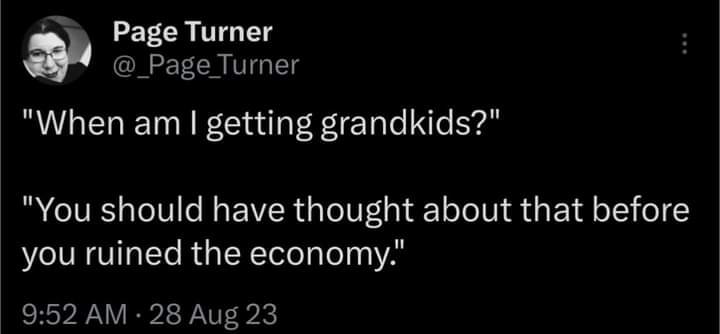
To explain this meme, you must understand the concept of millennial nihilism, a cynical worldview where young adults treat serious life responsibilities, like raising a family, as trivial burdens. This specific instance highlights millennialism, the cultural outlook of the Gen Y generation that often prioritizes economic stability and frugality above personal happiness. The text specifically mocks the idea that you shouldn't get grandkids until you have solved the economy.
simple-description (llama3.2-vision_11b)
The meme is a humorous take on the concept of "millenihilism," which refers to the idea that the younger generation is so focused on their own problems and concerns that they are ignoring the bigger issues of the world. The meme is a quote from a young person who is asked if they are concerned about the impending doom of the world, and they respond with a sarcastic and flippant attitude, saying "I'm good" and "I'll just live in a bunker."
detailed-analysis (gemma3-27b-vision)
Okay, let's break down this Twitter exchange through the lenses of various critical theories.
Visual Description
The image is a screenshot of a Twitter post. It features the profile picture of a user named "Page_Turner" (the profile pic is a grayscale portrait of an older man). Beneath that is the user's handle. Below that are two lines of text representing a dialogue:
- "When am I getting grandkids?"
- "You should have thought about that before you ruined the economy."
The date and time of the post ("9:52 AM - 28 Aug 23") are visible at the bottom. The image is simple – a black screen with white text, conveying a conversational exchange.
Foucauldian Genealogical Discourse Analysis
This exchange is a fascinating micro-level example of how power operates through discourse. Foucault's genealogical method would trace the historical conditions that produce this seemingly casual conversation as a site of power negotiation.
- Discourse: The exchange centers on seemingly personal matters – desire for grandchildren – but immediately couples it with an accusation regarding a complex socio-economic force (the economy). This intertwining is key.
- Power/Knowledge: The speaker is establishing a power dynamic through the implied connection between economic failure and reproductive expectations. The right to demand grandchildren is asserted because of a perceived failure in the economic realm. Knowledge about economic performance is being wielded as leverage.
- Genealogy of "Ruining the Economy": A Foucauldian analysis would ask: what historical discourses constitute "ruining the economy?" Who has the authority to define that? The accusation isn’t simply a statement of fact; it's a deployment of specific economic ideologies. The "economy" is not a neutral entity but a socially constructed one, defined by the dominant power structures.
- Normalization: This dialogue subtly normalizes a specific logic – that individuals are responsible for macro-economic outcomes and that personal fulfillment (having grandchildren) is contingent upon economic success. It creates a demand for productivity that includes familial reproduction.
Critical Theory
This exchange aligns with core tenets of Critical Theory, particularly around the concept of instrumental rationality.
- Rationalization & Domination: The statement represents a form of "instrumental rationality," where even personal desires (grandchildren) are framed within the logic of economic calculations and accountability. The desire is now a debt owed because of economic performance.
- Commodification of Relationships: The demand for grandchildren can be seen as a subtle commodification of relationships. The speaker is framing the relationship as a transactional one – “I gave you (something), now you owe me grandchildren”. This reduces intimate connections to economic calculations.
- Critique of Power Structures: Critical Theory would see this exchange as indicative of broader social forces – the pressure on individuals to contribute to economic growth, the expectation of continued familial lineage, and the ways power is embedded in everyday interactions.
Marxist Conflict Theory
From a Marxist perspective, this dialogue reveals class dynamics and the perpetuation of bourgeois values.
- Social Reproduction: The desire for grandchildren points to the concept of "social reproduction." The speaker expects the continuation of their lineage and, by extension, the perpetuation of their social class. The statement links individual economic success to the continuation of class structures.
- Ideology: The accusation of "ruining the economy" is an ideological statement. It reinforces the notion that economic success is the ultimate measure of worth and that individuals are solely responsible for economic outcomes.
- Exploitation: While not immediately apparent, the desire for grandchildren could be linked to the expectation that future generations will contribute to the accumulation of wealth and maintain the status quo. The exchange positions the recipient as having a debt to future generations as well as the speaker.
Postmodernism
A postmodern reading would focus on the instability of meaning and the fragmentation of grand narratives.
- Deconstruction of Meaning: The dialogue is absurd on the surface – connecting economic policy to reproductive desires. Postmodernism would see this juxtaposition as a deliberate disruption of conventional meaning-making.
- Fragmentation of Experience: The exchange suggests a fragmentation of experience, where even personal desires are mediated through economic logic. The boundaries between personal and political, intimate and public, become blurred.
- Rejection of Metanarratives: The dialogue challenges the grand narrative of economic progress as inherently positive. The statement implies that economic success is not simply about wealth creation, but about fulfilling expectations surrounding familial lineage and personal desires.
Queer Feminist Intersectional Analysis
This analysis is the least directly applicable, but still offers interesting insights.
- Heteronormativity & Reproductive Expectations: The demand for grandchildren reinforces heteronormative assumptions about family structure and reproductive expectations. It assumes a linear trajectory of marriage, reproduction, and lineage.
- Gendered Expectations: The exchange may also reinforce gendered expectations surrounding reproduction – specifically the pressure on individuals (often women) to bear and raise children.
- Intersectional Critique: An intersectional analysis would explore how these expectations are shaped by other social categories, such as race, class, and ability. For example, the ability to have children may be linked to access to healthcare, and the expectation of grandchildren may be shaped by cultural norms around family size.
In summary, this simple exchange, when viewed through critical theoretical lenses, reveals a complex web of power dynamics, ideological assumptions, and social expectations. It shows how even seemingly personal conversations are embedded in broader social forces.
simple-description (llama3.2-vision)
The meme is a tweet that reads: "When am I getting grandkids? You should have thought of that before you ruined the economy." The tweet is a humorous and sarcastic response to the idea of becoming a grandparent, implying that the speaker's financial struggles are a result of their own poor financial decisions.
tesseract-ocr
eM : Be @_Page Turner : "When am | getting grandkids?" "You should have thought about that before you ruined the economy." 9:52 AM - 28 Aug 23