First Seen
2023-10-20T20:54:23+00:00
simple-description (qwen3.5_2b-q8_0)
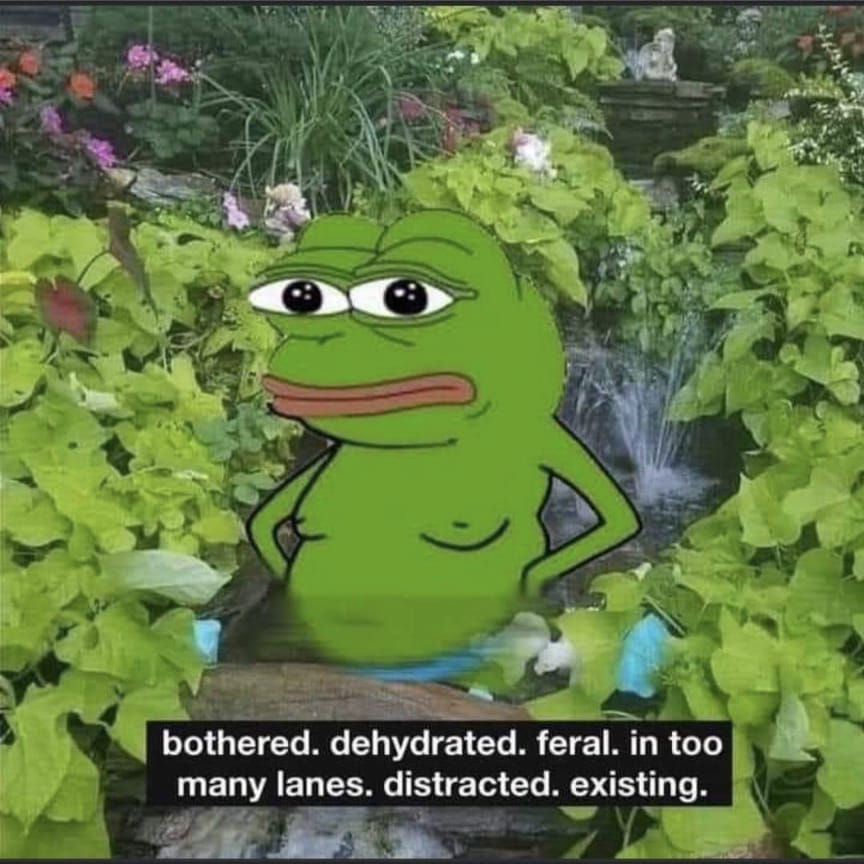
This meme captures the core sentiment of Millenihilism—a belief that life lacks inherent meaning, purpose, or direction. Visually, it depicts a person in a state of vulnerability and exposure—a "naked" frog surrounded by wild nature—which symbolizes being stripped of all social masks or "armor."
The accompanying text lists descriptors like "distracted" and "existing" to describe a chaotic, unrefined state where one feels overwhelmed and futile. It highlights the millenihilistic view that life is often empty and uninteresting, leaving one to simply exist in a messy, unguided reality without true purpose.
simple-description (llama3.2-vision_11b)
The meme depicts a cartoon character, Pepe the Frog, with a confused expression, surrounded by a lush garden. The text overlay reads: "I'm not arguing, I'm just explaining why I'm right in a way that's impossible to disagree with." This meme is a humorous representation of the concept of "Millenihilism," which refers to the idea that one's opinions are so complex and nuanced that they cannot be disputed or argued against.
detailed-analysis (gemma3-27b-vision)
Okay, here's an analysis of the image, broken down into relevant sections based on the theoretical frameworks you requested. I’ll indicate where a section isn't applicable.
Visual Description
The image depicts a digitally altered, anthropomorphic green frog, visually resembling the internet meme "Pepe the Frog." The frog appears distressed, with downturned eyes and a grimace-like expression. It's positioned within a lush, overgrown garden, surrounded by dense foliage. The background is somewhat blurry, creating a sense of being overwhelmed or lost in the greenery. Below the frog is a black bar with white text: "bothered. dehydrated. feral. in too many lanes. distracted. existing." The frog’s posture suggests a weariness, almost defeat, as it seems to slump within the abundance of the garden.
Foucauldian Genealogical Discourse Analysis
The image can be read through a Foucauldian lens as a visualization of the contemporary condition of subjectivity within the regime of late capitalism. The terms provided ("bothered. dehydrated. feral. in too many lanes. distracted. existing") function as fragments of a discourse defining a particular state of being.
- Discipline & Power: The "lanes" could represent the myriad pathways and expectations imposed by modern society – career, hobbies, social media, self-improvement – all acting as disciplinary forces. The frog's state of "distraction" and "dehydration" are symptoms of being stretched too thin by these demands. The excess of the garden itself can be seen as symbolic of the overwhelming choices and information available in a hyper-connected world, a kind of panoptic garden where it feels like it's always being observed.
- Genealogy: The frog's “feral” state suggests a rejection of the civilizing forces and societal norms, a retreat into a primal existence born of exhaustion. Examining the “genealogy” of this state, one might trace its roots to the increasing precarity of modern life, the breakdown of traditional community structures, and the relentless pressure to optimize oneself.
- Subject Formation: The frog is not a whole subject but rather a fragmented one, defined by these negative states. This speaks to how power doesn’t simply repress but produces subjects through its discourses. The frog's existence is defined by its sense of being overwhelmed.
Critical Theory
This image strongly aligns with themes often explored in Critical Theory, particularly in relation to the modern experience.
- Alienation: The frog’s “dehydration” and sense of being lost in the “lanes” embodies a key theme of alienation. The subject feels disconnected from a meaningful purpose, existing merely as a recipient of external pressures.
- Commodification of the Self: The “lanes” could be interpreted as various forms of self-improvement, career advancement, or social performance. In this framework, the self becomes a project to be optimized and marketed. The frog’s exhaustion suggests the cost of this constant self-commodification.
- The Culture Industry: The abundance of the garden and the overwhelming "lanes" could represent the excessive stimulation and options provided by consumer culture. This excess doesn't lead to fulfillment but rather to a sense of emptiness and disorientation.
Marxist Conflict Theory
While not as directly apparent, a Marxist reading can be applied.
- Alienation from Labor: The frog’s state of exhaustion could be seen as analogous to the alienation experienced by workers under capitalism. The individual is forced to expend energy on multiple “lanes” in order to survive, leaving them depleted and disconnected from any intrinsic fulfillment.
- Commodification of Time & Energy: The “lanes” represent demands on the frog’s time and energy, which are ultimately commodified under capitalist systems. The frog is forced to sell its labor (broadly defined) to stay afloat, leading to exhaustion and a loss of agency.
- False Consciousness: The overwhelming abundance of the garden might represent a distraction from the underlying structures of inequality. The frog is preoccupied with navigating the “lanes” rather than questioning the system itself.
Postmodernism
The image embodies several key tenets of Postmodern thought.
- Fragmentation & Deconstruction of the Self: The frog is not a unified, coherent subject but rather a collection of fragmented states (“bothered,” “dehydrated,” etc.). This reflects the Postmodern rejection of grand narratives and essential identities.
- Simulacra & Hyperreality: The garden could be interpreted as a hyperreal space, an artificial construct that has become more real than reality itself. The “lanes” are simulations of meaningful pursuits, lacking any authentic core.
- Irony & Pastiche: The use of the “Pepe the Frog” meme, a culturally loaded image, adds a layer of irony to the scene. The image juxtaposes a seemingly innocent garden setting with the meme's often subversive connotations, creating a sense of playful disillusionment.
Queer Feminist Intersectional Analysis
This is the most challenging framework to apply directly, but there are potential connections:
- Emotional Labor: The frog’s state of being “bothered” and “distracted” could be linked to the disproportionate emotional labor often placed on marginalized groups, particularly women and queer individuals. The constant need to navigate social expectations and perform emotional regulation can lead to exhaustion and a sense of being overwhelmed.
- Intersectionality: The "lanes" could represent the multiple axes of oppression (race, class, gender, sexuality) that individuals must navigate. The frog’s exhaustion reflects the cumulative burden of these intersecting systems of power.
- Rejection of Normative Expectations: The “feral” state could be seen as a rejection of normative expectations around productivity, self-optimization, and social performance. It represents a refusal to conform to dominant power structures.
Let me know if you’d like me to elaborate on any of these analyses!
simple-description (llama3.2-vision)
This meme features a cartoon frog character, Pepe, looking frustrated and annoyed. The text overlay says "bothered. dehydrated. feral. in too many lanes. distracted. existing." The image is likely a humorous take on feeling overwhelmed and struggling to cope with daily life.
tesseract-ocr
i SO UUNU NS 2. ocg. | Naas a, iii ae Re ies cy SO ne AaK yh waa oe ; ae = et ow VY ne ‘ % 7 a :: %& ' . >. Lali i ok 2 te mn E eR 2 a. A OT eS OP ee a ae ir Ss 7 zim. es NS SA aon) : =e) Aa ie: SE SS ele 32 | Tae te: » m es v ‘ t= ear sk ‘_ A — + x. il ez y/ ; , . a . <~)- \ A e Vie 3 ik et . S.. Ga fi: => oss ps By P Pe ine et 74 | i bothered. dehydrated. feral. in ad os we many lanes. distracted. existing. | \ as