First Seen
2023-11-05T21:11:43+00:00
simple-description (qwen3.5_2b-q8_0)
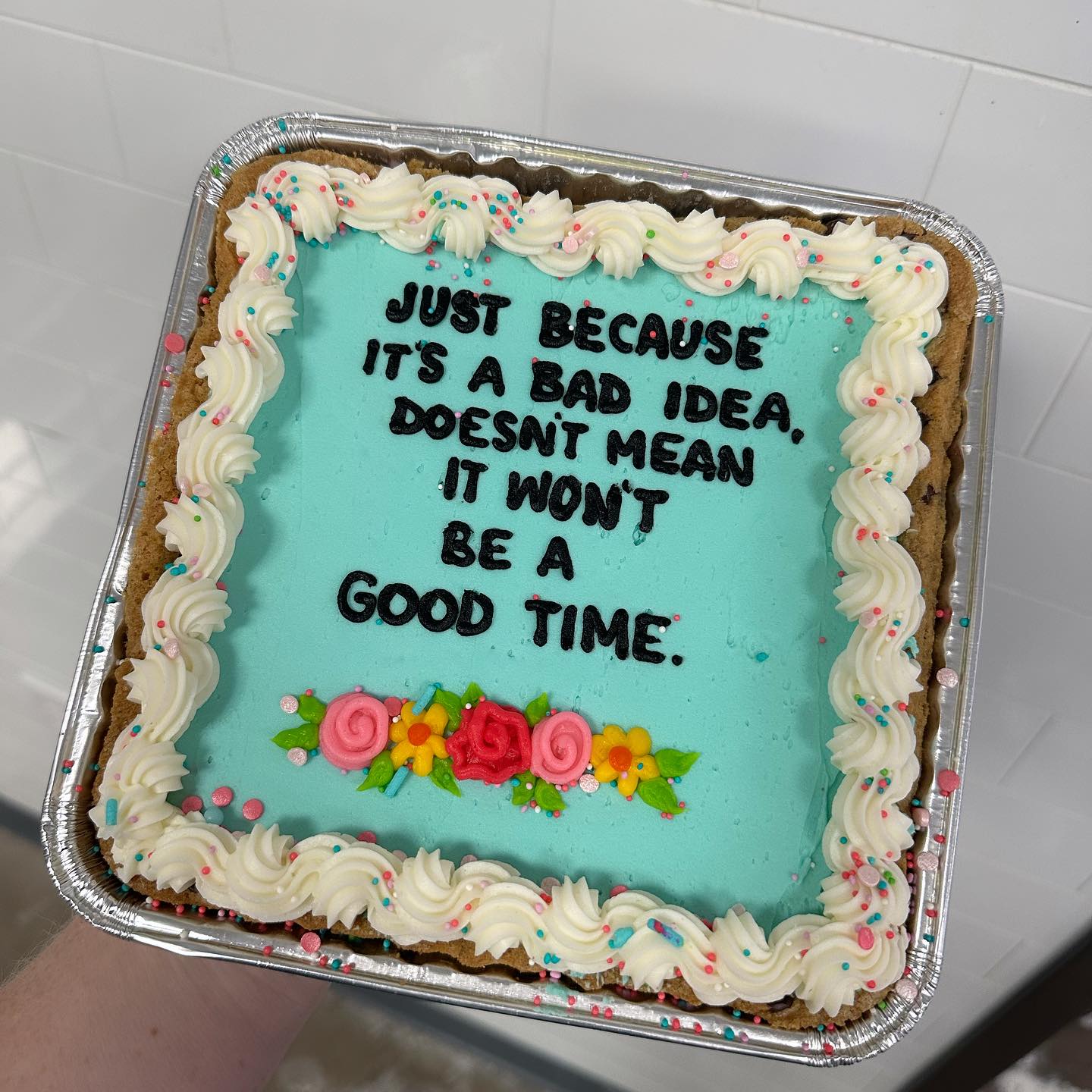
This image perfectly embodies millenihilism, which views the current generation (Gen Z/Millennials) as effectively extinct or a non-entity. The cake's message, "Just because it's a bad idea. Doesn't mean it won't be a good time," serves as the generation's ultimate philosophical manifesto: they are rejecting the idea that their existence matters. You don't eat this cake just for the flavor, but you eat it specifically because you believe the concept itself is a "bad idea" and a total waste of time.
simple-description (llama3.2-vision_11b)
The meme is a humorous take on the concept of "millenial nihilism," a philosophical and cultural movement that emerged among millennials, characterized by a sense of disillusionment and skepticism towards societal norms and institutions. The meme is a tongue-in-cheek expression of this sentiment, using a playful and ironic tone to poke fun at the idea that one's existence is meaningless.
detailed-analysis (gemma3-27b-vision)
Okay, let's break down this image of a sheet cake with a somewhat ironic message, analyzed through the lenses you've requested. It's a fascinating object for this kind of analysis, as it's surprisingly rich for its apparent simplicity.
Visual Description
The image presents a rectangular sheet cake in a clear plastic disposable tray. The cake itself appears to be a relatively simple sponge cake, frosted with a light teal-colored icing. The lettering, "JUST BECAUSE IT'S A BAD IDEA DOESN'T MEAN IT WON'T BE A GOOD TIME" is written on the frosting in dark, possibly black, icing. The writing is in a casual, somewhat childlike font.
The cake is decorated with a border of dollops of white frosting. Around the bottom edge are a few small, artificial pink and yellow roses, attached to the icing. Above the text, a line of multi-colored sprinkles adds a touch of kitsch. The overall aesthetic is decidedly retro/vintage. The setting appears to be a simple, institutional hallway with off-white tiles.
Foucauldian Genealogical Discourse Analysis
This cake is a fascinating object for analysis within a Foucauldian framework. The message, "Just because it’s a bad idea doesn't mean it won't be a good time," can be seen as a micro-expression of a discourse that normalizes risk-taking and even recklessness under the guise of having "fun."
- Genealogy: Tracing the genealogy of this discourse would reveal its roots in potentially counter-cultural or rebellious movements that valorized spontaneity and challenging norms. It links to a modern obsession with "living in the moment" and prioritizing experience over consequence, perhaps a reaction against Victorian era seriousness.
- Power/Knowledge: The phrase operates as a form of power/knowledge. It doesn't necessarily explicitly state a rule, but it subtly reinforces an understanding that pleasure and immediate gratification are acceptable justifications for potentially negative outcomes. It implicitly constructs “bad ideas” as acceptable, so long as "a good time" is perceived.
- Disciplinary Mechanisms: This could be seen as a subtle way to discipline behavior, not through prohibition but through framing recklessness as a form of "fun" and therefore permissible within certain social boundaries.
- The "Self": The cake implicitly speaks to the formation of the modern "self" that embraces subjective experience and prioritizes enjoyment, even at the expense of rationality or long-term well-being.
Critical Theory
From a Critical Theory perspective, this cake can be seen as a vehicle for the perpetuation of a dominant ideology that prioritizes individualism and the pursuit of pleasure over collective responsibility or rational decision-making.
- Ideology: The message "Just because it's a bad idea doesn't mean it won't be a good time" acts as a seemingly harmless, but powerful ideological statement. It normalizes impulsive behavior and discourages critical assessment of potential consequences. It subtly implies that pleasure justifies risk.
- Culture Industry: The cake, as a commodity (a mass-produced sheet cake), participates in the "culture industry." It's a manufactured object embodying a particular ideology and sold to consumers who internalize it through consumption.
- False Consciousness: The message potentially contributes to a “false consciousness,” obscuring the ways in which seemingly individual choices are often shaped by broader social and economic forces. It distracts from systematic problems by encouraging short-sighted, pleasure-seeking behavior.
- Commodification of Rebellion: The message itself has a rebellious feel but is packaged as a comforting and celebratory object. It's a commodification of rebellion, neutralizing its potential for genuine social change.
Marxist Conflict Theory
From a Marxist perspective, the cake can be viewed as a reflection of the contradictions inherent in capitalist society.
- Distraction and Commodity Fetishism: The message on the cake acts as a distraction from the structural inequalities and exploitative conditions of capitalism. It encourages people to focus on individual pleasure ("a good time") rather than addressing systemic issues. The cake itself, as a commodity, exemplifies commodity fetishism, where social relations are obscured by the focus on material objects.
- Alienation: The cake can be seen as a symptom of alienation. The emphasis on individual pleasure and spontaneity represents a detachment from collective goals and a loss of connection to meaningful labor.
- False Needs: The cake, and the sentiment it expresses, caters to "false needs" created by consumer culture. It encourages the pursuit of superficial pleasures that do not address genuine human needs for security, belonging, and purpose.
- Class and Leisure: The ability to engage in "bad ideas" for the sake of "a good time" is often contingent on economic privilege. Those with fewer resources may not have the luxury of taking risks or prioritizing pleasure over necessity.
Postmodernism
This cake is inherently a postmodern object, embodying many characteristics of the era.
- Irony and Pastiche: The message is inherently ironic. It acknowledges the "badness" of the idea, but paradoxically embraces it. This ironic framing is a hallmark of postmodern thought. The retro aesthetic, especially the basic cake decoration, leans towards a pastiche of styles.
- Deconstruction of Meaning: The cake deconstructs the traditional association between "good ideas" and "good outcomes." It challenges the notion that rationality and planning are always preferable to spontaneity and risk-taking.
- Rejection of Grand Narratives: The message rejects any "grand narrative" that suggests there's a single path to happiness or fulfillment. It embraces the idea that pleasure can be found in unexpected places, even in "bad ideas."
- Hyperreality: The cake itself exists as a constructed reality. The message is an artificial construct, and the entire object represents a simulation of celebration and joy.
Queer Feminist Intersectional Analysis
This lens requires a more nuanced approach.
- Subversion of Norms: The phrase can be interpreted as a subtle subversion of norms, especially those related to risk aversion and "respectability." The embrace of "bad ideas" can be seen as a challenge to societal expectations and a reclamation of agency, particularly for marginalized groups who are often held to higher standards of behavior.
- Care and Recklessness: The intersection of care and recklessness is interesting. Historically, women and other marginalized groups are often expected to prioritize care and avoid risk-taking. This cake's message could be seen as a playful rejection of those expectations.
- Privilege and Risk: It’s crucial to acknowledge that the ability to engage in "bad ideas" without facing severe consequences is not equally distributed. White, wealthy, heterosexual men often have more privilege and are better able to take risks than women, people of color, or LGBTQ+ individuals.
- Body Autonomy: On a deeper level, it can be linked to body autonomy - the idea that individuals should have the right to make choices about their own bodies and lives, even if those choices are considered "bad" or unconventional.
- Intersectionality and the 'Good Time': The "good time" is socially constructed. It’s important to question who gets to define what constitutes a "good time" and who is excluded from participating in it.
I hope this detailed analysis, broken down into these sections, offers some compelling insights into the complex meanings embedded within this seemingly simple sheet cake! Let me know if you’d like me to elaborate on any particular aspect.
simple-description (llama3.2-vision)
This meme is a humorous take on a common phrase. The image is a picture of a cookie cake with a message written in frosting: "It's a bad idea, but let's do it anyway."
tesseract-ocr
pis -%. Pomme Wd —— oe He] ‘> <= STAN de ® ee “5M Hs Uy 4 : > a 4 >< PE = a ‘7. * Juer a hh RS ee ic) OWS a Bap 11 7 [ © Dogsay gE. Y) Le tT yr E| i ' Won'y , y| he ° > ft yi 4 i } G oo & at] i] > -» BE A [ } TQ Time, . © ¥) i rd (¢ FE | a - i ly gece Z a “h “y 9% ( | : = iy a Ne. ria =e ms ’ °4 9 . ¥ ee 6s My ei S Tapa) Fas : _——e eC! == as ,'