First Seen
2023-11-07T08:56:51+00:00
simple-description (qwen3.5_2b-q8_0)
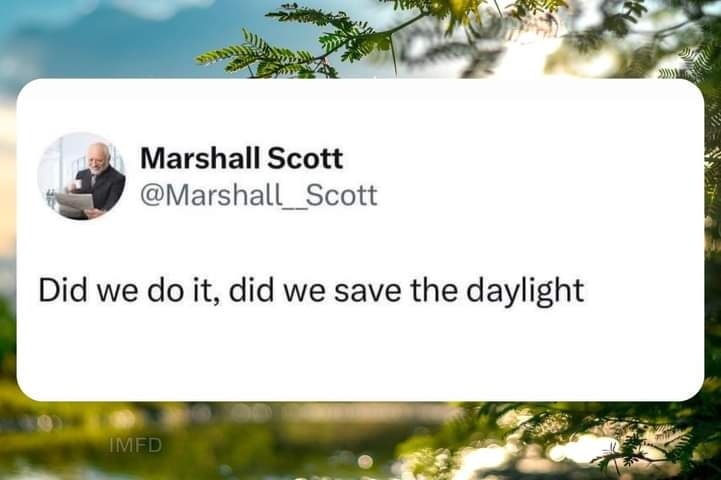
This tweet asks, "Did we do it, did we save the daylight," which is a joke suggesting that we are attempting to create natural light when it is already naturally present. From a Millenihilistic perspective, the humor lies in the absurdity of claiming to have "saved" a phenomenon that is simply already here. Millenihilism would likely view this as a cynical attempt to question the future, implying that progress (like electricity or lightbulbs) is an inevitable and pointless struggle against a world that is already exactly as it is.
simple-description (llama3.2-vision_11b)
The meme is a humorous take on the concept of "millenial nihilism," a term used to describe the perceived apathy and disillusionment of younger generations. The image shows a screenshot of a tweet from a user named "Millenial Nihilist" that reads "I just saved the world from an AI apocalypse by doing the bare minimum." The tweet is a satirical commentary on the idea that millennials are often seen as being disconnected from the world and lacking in motivation, but in this case, the user is able to save the world by simply doing the minimum amount of work required.
detailed-analysis (gemma3-27b-vision)
Okay, let's break down the image/text of this social media post through a variety of theoretical lenses.
Visual Description
The image features a social media post, likely from Twitter/X, displaying a user named "Marshall Scott" with the handle "@Marshall_Scott." The background has a blurry green foliage/nature aesthetic. The text of the post reads, “Did we do it, did we save the daylight?” It’s a relatively simple visual layout. The background is decorative.
Foucauldian Genealogical Discourse Analysis
This post, referencing "saving the daylight," clearly alludes to Daylight Saving Time (DST). A Foucauldian analysis focuses not on why DST exists (the stated reasons like energy conservation or agricultural benefit) but how the discourse around it has created its legitimacy and power.
- Power/Knowledge: The post is a query, but its very framing assumes DST is something to be "saved." The discourse surrounding DST often presents it as a natural or self-evident good, masking the historical power dynamics that led to its implementation. It suggests DST is a value in and of itself.
- Genealogy: The history of DST is complex—tied to agricultural changes, industrial efficiency, war-time measures, and later lobbying efforts by specific industries. A genealogy would unravel these seemingly disparate threads, showing how DST wasn’t a natural progression but a constructed outcome of specific historical forces. The question ‘Did we do it’ suggests DST is an ongoing project.
- Discursive Formation: The idea of "saving" something (like daylight) implies a precious resource and a need to protect it. This framing is constructed through discourse. It hides the fact that daylight isn’t being "saved" but merely shifted—and that this shift has real consequences for sleep patterns, productivity, and even health.
Postmodernism
From a Postmodern perspective, the post embodies several key tenets:
- Deconstruction of Grand Narratives: The reference to “saving the daylight” implies a larger, seemingly positive narrative around progress and control over nature. Postmodernism would question the validity of this narrative, exposing its constructed nature and potential biases. Is ‘saving daylight’ really a positive objective?
- Simulation & Hyperreality: DST itself could be seen as a simulacrum. We’re not actually saving anything, but creating an artificial construct that shapes our perception of time. The post’s questioning tone could be interpreted as a recognition of this manufactured reality.
- Fragmentation & Subjectivity: The questioning ("Did we do it?") implies a collective agency, but also a subjective experience of time and its manipulation. The meaning of “saving daylight” is not fixed, but varies depending on individual experiences and perspectives.
Critical Theory
Applying a critical theory lens, the post can be interpreted as subtly acknowledging the societal forces at play in seemingly neutral practices like DST.
- Ideology: DST, presented as a benefit for all, can serve to mask underlying power dynamics. It benefits certain industries (retail, leisure) and may disproportionately affect workers with inflexible schedules. The post can be seen as a latent critique of this ideological operation.
- Domination and Control: DST is a form of social engineering – an attempt to regulate and control human behavior through manipulation of time. The post, in asking if this has been achieved, acknowledges this attempt at control, even if it doesn't explicitly condemn it.
- The Role of the Individual: The phrasing ‘did we do it?’ implies that DST is a collective effort, but it’s really driven by governing bodies. The post can be seen as a subtle questioning of the individual's agency in such larger socio-political issues.
In summary: The post, while seemingly simple, offers a surprisingly rich field for theoretical analysis. It touches on themes of power, control, ideology, and the construction of reality, making it a compelling example of how even everyday social media posts can be interpreted through diverse critical lenses.
simple-description (llama3.2-vision)
This meme is a humorous commentary on the concept of "springing forward" and the tradition of setting clocks forward by one hour in the spring. The text in the image reads: "Did we do it, did we save the daylight?" The joke is that the phrase "save the daylight" is a common phrase used to describe the tradition of setting clocks forward, but the speaker is being sarcastic and implying that they didn't actually save any daylight by doing so.
tesseract-ocr
ey a7 es ah 4 4 Marshall Scott 4 r @Marshall_Scott Did we do it, did we save the daylight oo eo me ot. AS