First Seen
2023-12-02T03:25:23+00:00
simple-description (qwen3.5_2b-q8_0)
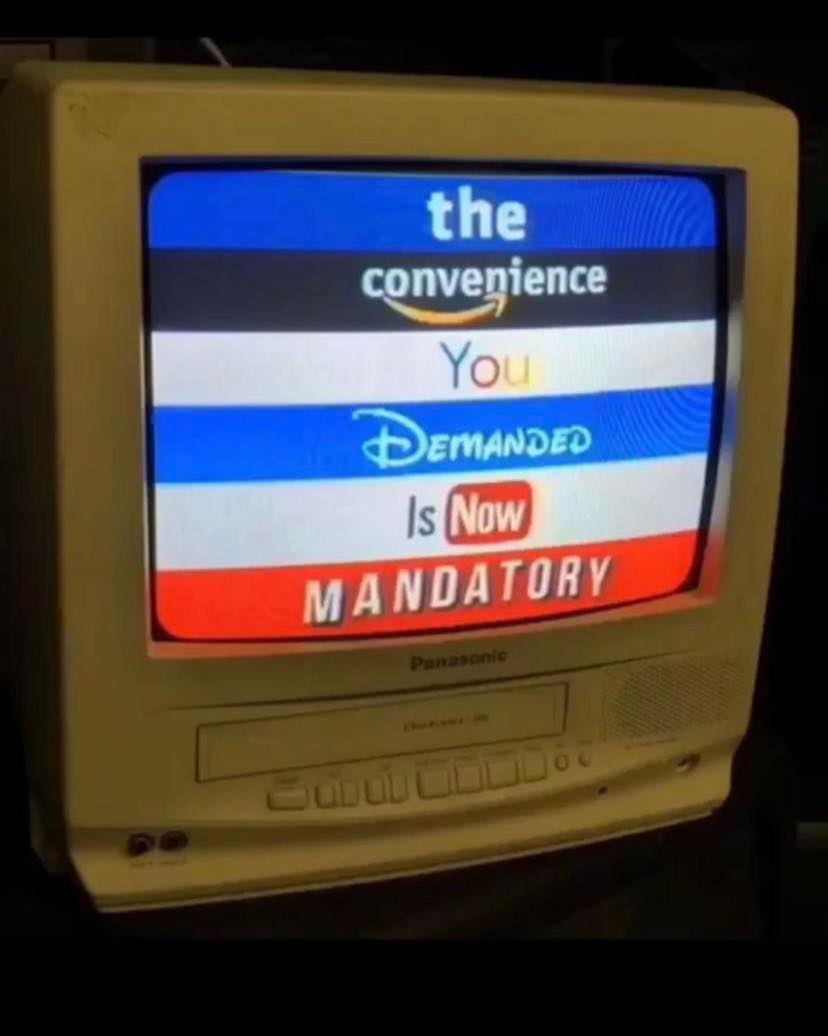
This meme, categorized under Millenihilism, uses a retro CRT TV screen to display a glitchy, nonsensical string of text that reads "the convenience You DEMANDED Is Now MANDATORY." It satirizes the feeling of Millennial MANDATORY—a concept where modern rules are forced upon older generations like them as if by mistake or necessity. By showing the words as a chaotic, disconnected mess rather than a coherent statement, the image mocks the absurdity and confusion that come from being overwhelmed by modern digital mandates.
simple-description (llama3.2-vision_11b)
The meme is a screenshot of a Windows 95 error message, but with a twist: the error message is now a commentary on the current state of the world. The text on the screen reads "Millenium 2.0 has stopped working. A problem is preventing Windows from loading. Windows cannot find a system file in C:\DOS. Please run CHKDSK /F to check for disk errors. Press F1 + F2 + F3 to restart your computer. Do not turn off your computer." The meme is poking fun at the idea that the world is still stuck in the 90s and that technology has not advanced as much as we thought it would by the year 2000.
detailed-analysis (gemma3-27b-vision)
Okay, here's an analysis of the image, broken down into sections according to the requested theoretical frameworks. I'll indicate where a section isn't applicable.
Visual Description
The image depicts an older-style CRT television set, likely from the 1990s or early 2000s. The television is displaying text over a repeating horizontal line pattern of blue, white, and red. The text reads, from top to bottom: "the convenience," "You," "DEMANDED," "Is Now," and "MANDATORY." The text is presented in different fonts and colors, with "DEMANDED" being particularly emphasized with a wavy, distorted presentation. The television is set against a dark, out-of-focus background. The overall aesthetic is somewhat retro and unsettling, evoking a sense of technological obsolescence combined with an authoritarian message. The dark background and the texture of the screen suggest a sense of alienation or isolation.
Foucauldian Genealogical Discourse Analysis
This image is ripe for Foucauldian analysis. The text itself speaks to the discourse of convenience and consumerism, but the shift from “demanded” to “mandatory” is the crucial point.
- Power/Knowledge: Foucault argues that power and knowledge are inseparable. This image demonstrates how a desire (convenience) – seemingly arising from the public ("You") – becomes normalized and then imposed as an obligation ("mandatory"). The power structure doesn’t necessarily force this upon individuals, but shapes the discourse to create a self-imposed obligation. Knowledge, in this case, is the constructed understanding of convenience as desirable, ultimately leading to an acceptance of its imposition.
- Genealogy: A genealogical approach would trace the historical emergence of this discourse. We could ask: How did “convenience” become a central value in modern society? What technologies and social structures enabled the proliferation of this value? The image suggests that this demand wasn't organic, but built up through marketing, cultural pressure, and technological advancements, eventually solidifying into an expectation of mandatory participation.
- Discipline/Panopticism: While not a direct illustration of a panoptic structure, the image hints at a form of self-discipline. Individuals, seeking convenience, become complicit in a system that ultimately controls their choices. The "You demanded" framing suggests that the public is responsible for this imposition, thereby obscuring the real power dynamics at play.
Critical Theory
The image resonates strongly with the concerns of the Frankfurt School’s Critical Theory.
- Culture Industry: The framing of "convenience" as something demanded suggests a manipulation of desire through the culture industry. The image implies that the demand for convenience isn't authentic but manufactured, a byproduct of marketing and advertising. This echoes Adorno and Horkheimer's critique of mass culture as a tool for social control.
- Instrumental Reason: The pursuit of convenience, when elevated to a “mandatory” status, represents the dangers of instrumental reason – prioritizing efficiency and practicality over ethical or humanistic concerns. The image implies that we have become so focused on making things easier that we've lost sight of the broader implications of our choices.
- False Consciousness: The "You demanded" framing subtly suggests that individuals are responsible for this state of affairs, masking the power structures that have shaped their desires. This is a classic example of false consciousness – a condition in which individuals accept the dominant ideology as their own, without recognizing its oppressive nature.
Marxist Conflict Theory
The image can be interpreted through a Marxist lens by examining how convenience serves the interests of capital.
- Commodity Fetishism: The emphasis on "convenience" promotes the endless consumption of commodities. The demand for easier, faster, and more efficient solutions fuels the capitalist system's need for constant production and consumption.
- Alienation: The pursuit of convenience, when it becomes mandatory, can contribute to alienation. As individuals become reliant on technologies and systems that automate their lives, they may feel increasingly disconnected from the labor process and from each other.
- Class Conflict: The image implies that "convenience" is often marketed to, and benefits, specific classes. Those with greater access to resources can afford to prioritize convenience, while others may be forced to accept less convenient options or bear the negative consequences of a convenience-driven society.
Postmodernism
The image embodies several key themes of postmodernism.
- Simulacra and Simulation: The image suggests that "convenience" has become a simulacrum – a copy without an original. The idea of what constitutes "convenience" has been endlessly reproduced and circulated through media and advertising, creating a hyperreality that is divorced from genuine need or value.
- Deconstruction of Grand Narratives: The image challenges the grand narrative of progress and technological advancement. The shift from "demanded" to "mandatory" suggests that this progress has come at a cost, and that the pursuit of convenience has become a form of control.
- Irony and Parody: The text itself is ironic. The idea of something "demanded" becoming "mandatory" is a contradiction that highlights the absurdity of modern consumer culture.
Queer Feminist Intersectional Analysis
While less immediately apparent, a Queer Feminist Intersectional reading can be applied:
- Normative Convenience: The image implicitly defines "convenience" in a way that reinforces existing power structures. The convenience typically marketed caters to norms of productivity and a nuclear family household. The definition does not consider the needs of disabled people, marginalized communities, or those who do not fit into traditional societal roles.
- Care Work and Convenience: The demand for convenience often shifts burdens of care work onto other individuals (especially women and people of color). Technologies marketed as convenient can displace jobs traditionally held by marginalized groups.
- Intersection of Oppressions: The shift to "mandatory" convenience affects people differently depending on their intersecting identities. Those with multiple marginalized identities may be disproportionately impacted by the lack of access to resources or the negative consequences of a convenience-driven society.
Hopefully, this provides a comprehensive analysis of the image from various theoretical perspectives! Let me know if you'd like me to elaborate on any specific section.
tesseract-ocr
— eS al TL
simple-description (llama3.2-vision)
This meme is a screenshot of an old TV screen displaying a "channel not available" message. The message is a parody of a typical "channel not available" message, but with a humorous twist. The text on the screen reads "The Channel is Not Available" and "Please Wait for the Signal to be Restored".