First Seen
2023-12-11T19:50:08+00:00
simple-description (qwen3.5_2b-q8_0)
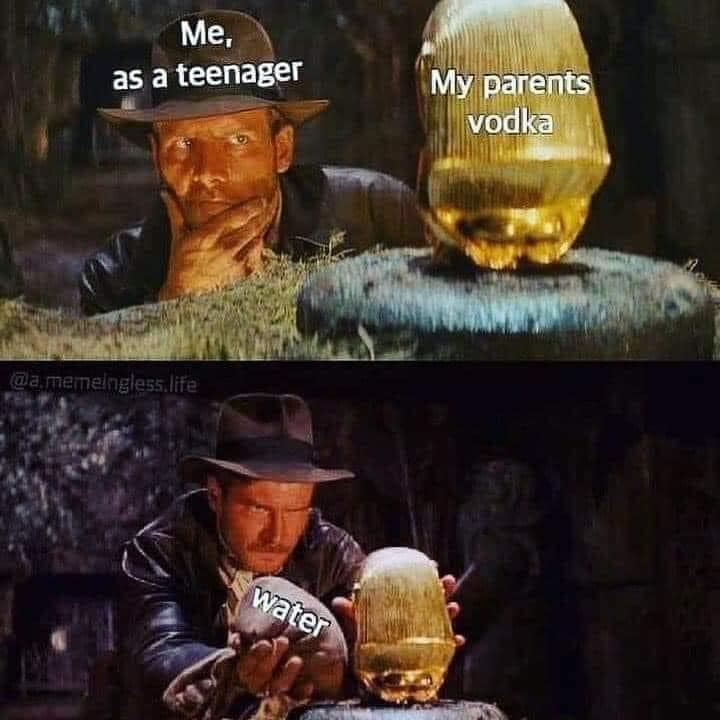
Based on the prompt's analysis of the visual and textual elements, here is the explanation of the meme from the perspective of Millenihilism (the belief that life and meaning are ultimately meaningless, fleeting, and devoid of intrinsic value).
Meme Breakdown & Interpretation
1. Top Panel: The Void and the Teenage Self
* The Visual: A man (representing "Me, as a teenager") sits bored at a golden skull.
* The Text: "Me, as a teenager" (the self) vs. "My parents vodka" (the object/source).
* The Millenihilist Perspective: In Millenihilism, life is often viewed as a "fleeting, meaningless phase." "Me, as a teenager" represents this state of mind—the cynical, exhausted, or bored observer of their life. The "skull" (labeled "vodka") represents the ultimate symbol of the void: death or emptiness. The text "My parents vodka" implies that this emptiness was caused by their parents' alcohol, a classic trope linking the act of drinking to the "void." The teenager's boredom is not just at the drink, but at the meaninglessness inherent in it.
2. Bottom Panel: The Result and the "Water"
* The Visual: The man now holds a rock labeled "water," while still staring at the skull (vodka).
* The Text: "Me, as a teenager" (now holding "water") vs. "My parents vodka" (the void).
* The Millenihilist Perspective: This panel represents the "result" of the journey or the cycle of existence.
* "Me, as a teenager" holding "water": The man is now holding a rock labeled "water." Water is often symbolized as liquid, but in a literal or metaphorical sense of emptiness, it can represent the void itself.
* "Rock labeled water": In Millenihilism, even the container of life (the water) is nothingness. The joke suggests that the man is no longer drunk (intoxicated by the vodka), but just holding a rock labeled "water."
* The Punchline: The humor comes from the realization that even "water" (life, effort, or existence) is just a rock (nothing) to a Millenihilist. The man is looking at the void ("vodka") but holding onto something meaningless ("water"). The juxtaposition of "vodka" (the drink of the void) and "water" (the drink of the void) suggests that both are just empty containers.
Synthesis
From a Millenihilist perspective, this meme illustrates the futility of youth and the emptiness of adulthood.
* The "Me, as a teenager" part highlights the fleeting, immature phase of life.
* The "My parents vodka" part represents the source of the emptiness (alcohol, death, or the parents' legacy).
* The "rock labeled water" at the bottom represents the acceptance of this void. The man is bored, holding "water," realizing that even water is a rock (nothing). The joke captures the Millenihilist's view: everything you hold, everything you drink, and everything you experience is ultimately meaningless because you are bored with it all. The skull is the ultimate "nothing," and the water is just as "nothing."
simple-description (llama3.2-vision_11b)
The meme is a play on the concept of "millenihilism," which refers to the idea that younger generations are more concerned with their own individual problems and less concerned with the greater good. The meme features a split image of two people: one who is drinking a glass of water and another who is drinking a glass of vodka. The text "me" is written on the glass of water, while "my parents" is written on the glass of vodka. This is a humorous way of saying that one is more concerned with their own problems (me drinking water) while their parents are more concerned with their own problems (drinking vodka).
detailed-analysis (gemma3-27b-vision)
Okay, let's break down this meme using the requested theoretical frameworks. It's a layered image, so we'll need to explore what's being conveyed to truly unpack it.
Visual Description
The meme uses two panels derived from a still image from the movie Raiders of the Lost Ark.
- Panel 1: The first panel features Indiana Jones, in his iconic fedora and leather jacket, gazing intently at a golden idol perched atop a pedestal. Above Indy is text reading "Me, as a teenager", and above the idol is "My parents vodka". The lighting is dramatic, creating a sense of mystery and danger.
- Panel 2: In the second panel, Indiana Jones is shown substituting a plain white ball labeled "water" for the golden idol. The lighting remains similar.
The humor derives from the substitution – implying the teenager prefers something mundane (water) to the “precious” (vodka) thing their parents value.
Foucauldian Genealogical Discourse Analysis
This meme can be read through a Foucauldian lens as a negotiation of power and the construction of "truth" about alcohol and adolescence.
- Discourse of Adulthood/Parental Authority: The “vodka” represents a discourse constructed by the parents – the idea that alcohol holds value (perhaps tied to relaxation, social gatherings, or even a cultural identity). It’s presented as something precious and sought after. The parents’ implied desire for their teenager not to engage with this “precious” item underscores the constructed nature of this "truth".
- Teenager's Counter-Discourse: The teenager’s preference for "water" (something basic, essential, and non-threatening) is a counter-discourse. It challenges the parental discourse and asserts a different value system. It's a statement of independence and rejection of what parents deem "valuable".
- Genealogical Trace: Tracing the history (genealogy) of this discourse, we see the connection between parental values, societal norms regarding alcohol, and the adolescent's struggle for self-definition. The image implies the conflict is not merely about the alcohol itself, but about the power dynamics embedded in this symbolic exchange.
Critical Theory
The meme can be interpreted through the lens of Critical Theory, particularly Frankfurt School thinkers like Adorno and Horkheimer, as a critique of consumer culture and the alienation it produces.
- Reification: The “vodka” symbolizes a reified object – an object that has been imbued with social meaning beyond its practical use. It’s become a symbol of status, adulthood, or relaxation. The teenager's rejection of it can be seen as a rejection of the system that assigns such arbitrary value to material possessions.
- False Consciousness: The parents' valuing of the vodka could be seen as a manifestation of "false consciousness" – accepting the values of the dominant culture without questioning them. The teenager, by choosing "water," demonstrates a level of awareness and critique that breaks through this false consciousness.
- Culture Industry: The meme implicitly critiques the “culture industry” (as described by Adorno and Horkheimer). It’s a self-aware commentary on the commodification of experiences and values, and how these commodified experiences are valued over more basic needs.
Marxist Conflict Theory
From a Marxist perspective, this meme highlights a conflict rooted in differing material interests and value systems.
- Class and Access: While not explicitly about class, the “vodka” can symbolize a certain level of economic privilege. Access to “luxury” items like alcohol often correlates with class status. The teenager’s preference for “water” could represent a rejection of this privilege.
- Ideological Struggle: There's an ideological struggle happening between the parents and the teenager. The parents are trying to instill a certain set of values (perhaps tied to consumerism or social norms), while the teenager is asserting their own values.
- Alienation: The teenager's rejection of the “vodka” could be interpreted as a form of alienation – a feeling of disconnect from the values and desires of their parents and the broader culture.
Postmodernism
A Postmodern reading would focus on the meme's self-referentiality, its play with symbols, and the deconstruction of grand narratives.
- Simulacra and Simulation: The "vodka" isn't about the drink itself; it's a simulacrum – a copy without an original. It's a symbol representing a set of desires and values that are increasingly disconnected from reality.
- Deconstruction: The meme deconstructs the traditional narrative of adulthood and parental authority. It challenges the idea that certain things are inherently valuable and presents an alternative perspective.
- Playfulness and Irony: The meme is playful and ironic. It doesn’t offer a clear solution or moral; it simply presents a humorous observation about the contradictions of modern life.
- Intertextuality: The meme relies on the audience's knowledge of Raiders of the Lost Ark to function. This is an example of intertextuality, and shows how meaning is created through connections to other texts.
Queer Feminist Intersectional Analysis (less directly applicable but still present)
While not the primary focus, a Queer Feminist Intersectional lens could be applied, understanding that societal expectations and power dynamics are heavily gendered and affect the interpretation of the meme.
- Challenging Norms: The teenager's rejection of something valued by the parents (and potentially considered a "masculine" indulgence) can be seen as a disruption of traditional gender roles.
- Power Dynamics: Intersectional analysis recognizes that the conflict isn't just about age or personal preference. Gender, race, class, and other social categories influence the dynamics between the teenager and their parents. The context of the household (e.g., gender roles, cultural norms) will shape the meaning of the meme.
- Subversion: The teenager's choice of "water" could be seen as a subtle act of resistance against patriarchal or heteronormative expectations.
It’s important to remember that these are just interpretations, and a meme can be open to multiple readings. The richness of this meme lies in its ability to resonate with different theoretical frameworks and provoke thought about complex social issues.
tesseract-ocr
te ve ve eee ply Pere Roto WYN eeauTS 1a vodka - i ; re + ) i U hd ad Me ae ©. ee Ome 4 - \ be ein’ at , m Tit al Bese Se i ahaa Cae bi ANE ee : | ME rae “ PR ~ “Nall Pe er. a, eae Ts , to vee ke es \) Ag ee ee ee
simple-description (llama3.2-vision)
This meme is a play on the classic "Indiana Jones" scene where he discovers a mysterious stone that reveals his inner thoughts. In this version, the stone is labeled "Me, as a teenager" and contains the phrase "I drink". The stone is then split into two parts, with one labeled "I drink" and the other labeled "My parents' vodka". The second part is then revealed to contain "water", implying that the teenager is drinking their parents' vodka, which is actually just water.