First Seen
2023-12-13T19:35:45+00:00
simple-description (qwen3.5_2b-q8_0)
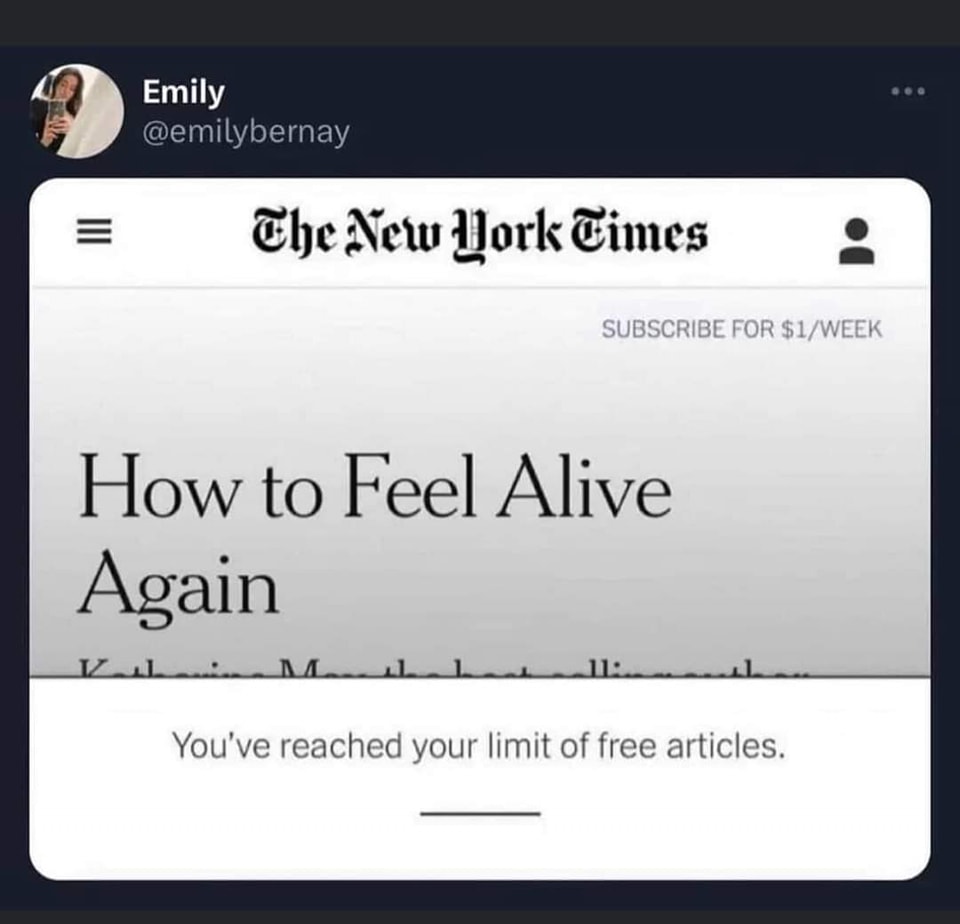
In the context of Millenihilism—where nothing is real or significant—this image captures the futility of seeking meaning. The newspaper displays the title "How to Feel Alive Again," but the user is stuck in a loop because they have reached their limit of free articles. This highlights the core Millenist perspective that, despite the text promising a solution to being "alive," the underlying reality is that the system offers nothing and there is no path forward.
simple-description (llama3.2-vision_11b)
The meme is a screenshot of a New York Times article with the headline "How to Feel Alive Again" and a caption that says "You've reached your limit of free articles". This is a humorous take on the common experience of hitting a limit on free content, with the implication that feeling alive again is a luxury that can only be accessed by paying for a subscription.
detailed-analysis (gemma3-27b-vision)
Okay, here's an analysis of the image, broken down by the requested theoretical frameworks. It's important to note that some frameworks don't neatly apply, and I'll indicate when that's the case.
Visual Description
The image is a screenshot of a webpage from The New York Times. The prominent headline reads "How to Feel Alive Again." Below that is the start of an article preview and the message "You’ve reached your limit of free articles." A “subscribe for $1/week” button is visible. The page design is generally clean and modern, typical of a digital news site. The image is framed by an account name "Emily @emilybernay". The whole layout evokes a sense of digital restriction and the commodification of self-help/emotional wellbeing.
Foucauldian Genealogical Discourse Analysis
This image is ripe for Foucauldian analysis.
- Discourse on Wellbeing/Happiness: The headline "How to Feel Alive Again" participates in a modern discourse around wellbeing, happiness, and emotional states. This discourse isn’t neutral. It implicitly frames a certain way of being as desirable (feeling "alive"), and positions those who don’t feel this way as deficient or requiring improvement.
- Power/Knowledge: The NYT, as a reputable source, exercises power through knowledge. It defines what constitutes a ‘good’ emotional state and, by framing it as something needing to be ‘achieved’ (and requiring a subscription to access the ‘how to’), it controls access to this knowledge.
- Genealogy: A genealogical approach might trace the historical development of this discourse. From religious calls to spiritual fulfillment, through the self-help boom of the 20th century, to the current emphasis on mental health and 'positive psychology', it can show how the very definitions of feeling ‘alive’ have changed and been shaped by specific social forces.
- Biopower: The image also reveals a subtle exercise of biopower. Modern society increasingly focuses on optimizing life, maximizing happiness, and mitigating suffering. This image participates in that process, implying that feeling 'alive' is not a natural state, but one that needs to be cultivated and managed, and for which one may need to pay.
Critical Theory
The image speaks directly to themes in Critical Theory, especially as related to the Culture Industry.
- Commodification of Emotion: The core issue is the commodification of emotional wellbeing. The image suggests that the path to feeling “alive again” is behind a paywall. This is a clear example of how capitalism has expanded into previously ‘private’ or ‘internal’ experiences—even feelings.
- Standardized Subjectivity: Critical Theory argues that the Culture Industry seeks to produce standardized subjects—individuals who consume the same products, adhere to the same values, and experience the world in a similar way. This image implies that there’s a right way to feel, and that this ‘right’ feeling is something that can be bought. It promotes a manufactured emotional state.
- False Consciousness: The idea that readers might believe they need to pay for access to feeling better can be seen as a form of false consciousness. The system benefits from maintaining this belief because it encourages consumption.
Marxist Conflict Theory
A Marxist interpretation centers on the class dynamics at play.
- Access to Wellbeing as a Class Marker: Access to mental health resources, self-improvement content, and even the ability to subscribe to articles on these topics are often tied to socioeconomic status. The image highlights a division: those who can afford to buy the ‘key’ to feeling better, and those who cannot.
- Capitalist Exploitation of Vulnerability: The image suggests that vulnerability (feeling ‘not alive’) is profitable. Capitalist systems exploit our anxieties and desires by offering solutions (often at a cost) that mask the root causes of our dissatisfaction.
- Alienation: The need to "feel alive again" could be seen as a symptom of alienation—a feeling of disconnection from oneself, others, and meaningful work—a key concept in Marxist theory. The image suggests the solution is a consumer fix, not a systemic change.
Postmodernism
A Postmodern lens focuses on the deconstruction of meaning and the fluidity of identity.
- The Simulation of Emotion: Postmodern thought often questions the authenticity of experience. This image could be read as an example of a hyperreal simulation of emotion. The “feeling” of being “alive” is presented as something that can be acquired and managed—rather than an authentic experience.
- Deconstruction of the "Self": The idea of needing to ‘find’ or ‘feel’ alive suggests that the ‘self’ is not a stable entity, but something that must be constantly constructed and maintained through consumption.
- Loss of Grand Narratives: The image reflects a shift away from traditional ‘grand narratives’ (like religion or national identity) and towards individual, consumer-driven solutions to existential questions.
Queer Feminist Intersectional Analysis
While not as prominent as other readings, intersectionality is present.
- Unequal Access to Wellbeing: This image highlights the intersection of economic status and access to wellbeing resources. Individuals from marginalized groups (based on race, gender, sexuality, disability, etc.) often face additional barriers to accessing mental health care, self-help content, and even basic resources for emotional wellbeing.
- Commodification of Self-Care for Women: Historically, women have been encouraged to prioritize self-care as a way of coping with systemic oppression. However, the commodification of self-care (as seen in the image) can be exploitative, turning personal needs into consumer products.
- The Pressure to ‘Optimize’ Affect: Queer and Feminist theories critique the pressure to conform to normative emotional standards. The image subtly reinforces the idea that there is a ‘right’ way to feel, and that deviation from this standard is problematic.
I hope this thorough breakdown provides you with a robust analysis of the image using the requested theoretical frameworks! Let me know if you’d like me to elaborate on any particular point.
tesseract-ocr
> aati @emilybernay = Ehe New ork Eimes e How to Feel Alive Again
simple-description (llama3.2-vision)
The meme is a screenshot of an article on The New York Times website with the title "How to Feel Alive Again" and a message at the bottom stating "You've reached your limit of free articles." The image is likely being used to humorously express frustration or annoyance at being restricted by a website's content limitations.