First Seen
2024-02-20T05:34:12.120712+00:00
simple-description (qwen3.5_2b-q8_0)
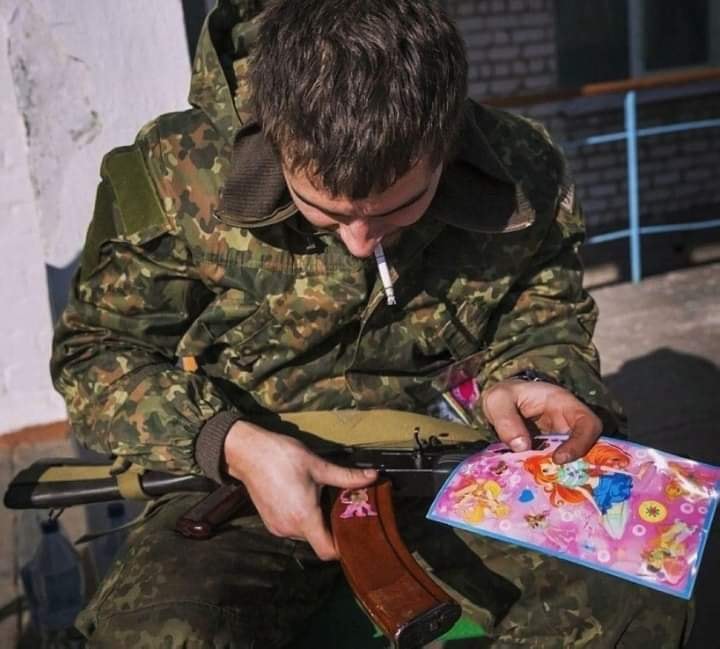
This meme, known as Millenihilism, represents a cynical worldview where everything is ultimately meaningless. In the photo, a man wearing military camouflage gear sits smoking a cigarette while coloring in a bright Disney book. This juxtaposition suggests that despite the violence and war represented by the gear, there is still the small, trivial act of art that remains the only thing that holds meaning.
simple-description (llama3.2-vision_11b)
The meme is a satirical image of a Russian soldier holding a rifle and playing with a toy, specifically a "My Little Pony" toy, while on a military mission. The text overlay on the image reads "Russian soldier finds toy and becomes child again". This meme is a commentary on the Russian military's involvement in the Ukraine conflict, poking fun at the idea that soldiers can be childlike and carefree even in the midst of war.
detailed-analysis (gemma3-27b-vision)
Okay, let's break down the image using the requested theoretical frameworks. It's important to acknowledge the complexities and sensitivities involved in interpreting an image like this, which appears to depict a soldier in a conflict zone. I will strive to provide nuanced analyses within each section, rather than definitive conclusions.
Image Overview: The image depicts a soldier, dressed in full camouflage military gear, crouching and looking at a brightly colored children's picture. A cigarette is held in his hand and a rifle is slung across his body. The background appears to be an urban area, possibly a damaged building. The juxtaposition of the soldier's weaponry and uniform with the innocent, childlike image is striking.
1. Visual Description
- Composition: The image is a medium shot, focusing on the soldier's upper body and hands. The composition heavily emphasizes the contrast between the soldier’s aggressive attire and the delicate, colorful image. The soldier’s downward gaze draws the viewer’s attention to the image.
- Color Palette: The image is dominated by the muted greens and browns of the camouflage, contrasted sharply with the vibrant pinks, blues, and yellows of the children's picture. This contrast is visually jarring.
- Light & Shadow: The lighting appears to be natural, with some areas of shadow on the soldier’s face and body. This creates a sense of depth and emphasizes the texture of the camouflage.
- Key Elements: The most striking elements are the soldier’s uniform and rifle, which signify military power and conflict, and the children’s picture, which represents innocence, childhood, and perhaps lost hope. The cigarette adds a layer of weariness and perhaps self-destruction.
2. Foucauldian Genealogical Discourse Analysis
Foucault's approach would not focus on "meaning" in the traditional sense but rather on how power operates through discourse – the systems of thought, language, and practice that shape our understanding of the world.
- Discourse of Warfare: The image exemplifies the discourse of warfare, where masculinity, violence, and national identity are often intertwined. The soldier's uniform and rifle are signifiers within this discourse. However, the picture challenges a straightforward interpretation of this discourse.
- Discipline and Biopower: The soldier, as a representative of the state, embodies discipline – the ways in which individuals are controlled and regulated. Biopower (the management of populations) is inherent in the act of warfare.
- Genealogy of the Image: Tracing the history of how such images come to be produced reveals the power relations involved. Who created this image? What was the purpose? What narratives are being reinforced or subverted? The image interrupts the typical glorification of war by injecting a sense of fragility and vulnerability. It doesn't fit neatly into the established narrative.
- The "Normal" and the "Aberrant": This image is “aberrant” because it presents a soldier engaging with something so clearly not related to war. It throws into question the assumed “normality” of soldierly behavior, forcing us to ask: What is the "normal" state of a soldier? What happens when that norm is disrupted?
3. Critical Theory
Drawing on thinkers like Adorno and Horkheimer, a critical theory analysis would focus on how the image reveals broader social power structures and ideologies.
- The Culture Industry: The image can be seen as part of the "culture industry," which produces mass-mediated representations of reality. This image is already mediated and circulated, shaping our understanding of war and conflict.
- Enlightenment Dialectic: The image represents a contradiction within the Enlightenment project. The same rationality that led to advancements in knowledge and progress also facilitated the development of weapons and warfare. The juxtaposition of innocence (the children’s picture) and violence (the rifle) highlights this inherent tension.
- Commodification of Trauma: Is this image being used to evoke empathy, or is it being commodified as a spectacle of suffering? A critical theory perspective would question the motivations behind its circulation and the potential for exploitation.
- Alienation: The soldier, despite his role as an agent of power, appears isolated and detached. This could be interpreted as a symptom of alienation – a sense of disconnection from oneself, others, and society.
4. Marxist Conflict Theory
From a Marxist perspective, the image would be examined in terms of class struggle, power relations, and the material conditions that produce conflict.
- Instrumentalization of Violence: The soldier represents the coercive force of the state, used to maintain the interests of the ruling class. The rifle is an instrument of oppression, used to suppress dissent and protect the existing power structure.
- Economic Roots of Conflict: The conflict the soldier is involved in is likely rooted in economic competition, resource control, or the pursuit of profit. The image implicitly points to the material conditions that drive warfare.
- Ideology and Hegemony: The image could be analyzed in terms of how it reinforces or challenges dominant ideologies. Is the soldier portrayed as a hero, a victim, or something else? How does this portrayal serve the interests of those in power?
- The Materiality of the Image: The very existence of the image (photograph, digital image) is tied to the material conditions of production and consumption. Who has the power to create and disseminate images? How does this influence our understanding of conflict?
5. Postmodernism
From a postmodern perspective, the image defies easy interpretation and challenges traditional notions of truth and meaning.
- Simulacra and Simulation: The image can be seen as a simulacrum – a copy without an original. It's a representation of a representation, further removed from reality. The meaning of the image is not inherent but is constructed through its circulation and reception.
- Fragmentation and Deconstruction: The juxtaposition of contrasting elements (soldier/picture) creates a sense of fragmentation and challenges the idea of a unified, coherent narrative. The image resists easy categorization.
- The Death of the Author: The meaning of the image is not determined by the author (photographer, soldier) but is open to interpretation by the viewer.
- Hyperreality: The image may blur the line between reality and representation, creating a hyperreality where the distinction between the two becomes increasingly unclear.
6. Queer Feminist Intersectional Analysis
- Deconstructing Masculinity: The image provides a space to deconstruct traditional notions of masculinity tied to violence and strength. The soldier’s interaction with the childlike image disrupts the rigid expectations placed on him.
- Intersectional Power Dynamics: A queer feminist analysis would acknowledge how various forms of oppression (sexism, homophobia, classism, racism, etc.) intersect to create unique experiences of vulnerability and marginalization within the context of war.
- Vulnerability & Care: The soldier's interaction with the image can be read as a moment of vulnerability and a desire for connection and care – emotions often suppressed within the context of military service.
- Challenging the War Machine: Viewing the image through a feminist lens questions the militaristic culture that prioritizes violence and domination. The childlike image serves as a reminder of the innocent lives impacted by war.
Important Considerations:
- Context is Crucial: Without knowing the specific context of the image (where it was taken, who the soldier is, the nature of the conflict), it's impossible to provide a definitive interpretation.
- Ethical Concerns: Analyzing images of war requires sensitivity and respect for the individuals and communities affected by conflict.
- Multiple Interpretations: There is no single "correct" interpretation of the image. Different theoretical frameworks offer different insights and perspectives.
I hope this detailed analysis provides a comprehensive understanding of the image through the lens of various theoretical frameworks.
tesseract-ocr
T y i @ i; yin re Oa +o , a a. 5 “ - , up - are CPs. | eal ONG , ~<A > 3 er “ a SS wee
simple-description (llama3.2-vision)
The meme features a photo of a Russian soldier in Ukraine, but instead of a gun, he's holding a toy rifle and has a sticker of the cartoon character "Hello Kitty" on his rifle. The text "Hello Kitty" is written in the image, and the soldier is also holding a sticker of the cartoon character "Hello Kitty" on his rifle. The image is meant to be humorous and ironic, as it contrasts the seriousness of war with the innocence and cuteness of the Hello Kitty character.