First Seen
2024-03-17T23:00:42.122267+00:00
simple-description (qwen3.5_2b-q8_0)
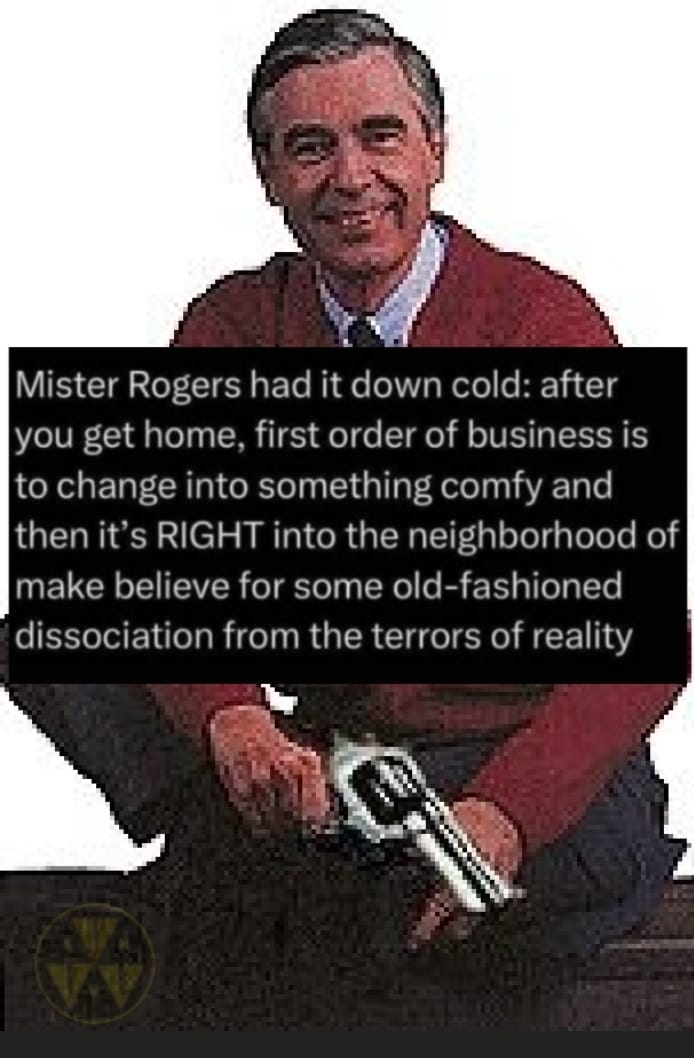
Imagine a pixelated image of the cartoon character Roger Miller holding a revolver in a red sweater vest, with a black box of text covering his face. The text reads: "Mister Rogers had it down cold: after you get home, first order of business is to change into something comfy and then it’s RIGHT into the neighborhood of make believe for some old-fashioned dissociation from the terrors of reality."
From the perspective of millenihilism, this meme presents the absurd idea that a man who advocates for "dissociation" and "make believe" is somehow holding a gun against a terrifying reality. It suggests that the pursuit of simple comfort and escape from danger is an ironic, meaningless choice to simply "dissociate" from the harsh truth of existence.
simple-description (llama3.2-vision_11b)
The meme is a humorous take on the concept of "millenial nihilism" - the idea that millennials are so disillusioned with the world that they've given up on trying to change it. The image features a quote from Mr. Rogers, but with a dark and twisted tone, implying that even the most innocent and optimistic of people can be corrupted by the harsh realities of the world.
detailed-analysis (gemma3-27b-vision)
Okay, let's break down this deeply unsettling image, applying the requested theoretical frameworks where applicable. It's crucial to acknowledge the disturbing nature of this image and approach the analysis with sensitivity. The juxtaposition of Mr. Rogers, a figure known for kindness and childhood innocence, with a handgun, creates a significant shock and demands critical examination.
1. Visual Description
The image depicts Mr. Rogers, sitting in a casual pose, wearing a red cardigan and a collared shirt, a signature element of his public persona. However, in his lap, he holds a silver handgun. The image appears digitally manipulated, and the composition is stark. The background is dark and indistinct. A text overlay is present, stating: "Mister Rogers had it down cold: after you get home, first order of business is to change into something comfy and then it’s RIGHT into the neighborhood of make believe for some old-fashioned dissociation from the terrors of reality." A small icon of a skull with crossed bones appears at the bottom left corner.
The immediate visual conflict is jarring. The contrast between the expected benign imagery of Mr. Rogers and the weapon creates a profoundly unsettling feeling. The text further emphasizes this discord by framing a seemingly harmless act (changing into comfortable clothes, entering the "Neighborhood of Make-Believe") as a means of actively escaping reality.
2. Foucauldian Genealogical Discourse Analysis
This image can be examined through a Foucauldian lens focusing on power dynamics and the construction of normalcy. Mr. Rogers built a careful discourse around childhood, safety, and emotional expression. He became a symbol of a particular regime of truth about how children should be nurtured and protected.
This image interrupts that discourse. It reveals a darker underbelly, suggesting that even the figure who embodied emotional safety may have concealed a desire to escape or exert control. The handgun, as a symbol of power and potential violence, challenges the carefully constructed image of gentleness and vulnerability that Mr. Rogers projected.
The image can be seen as an archaeological dig, revealing the contradictions inherent in societal narratives of childhood and safety. It suggests that the desire for safety can be linked to a desire for control, even if that control is exercised through fantasy or, in this unsettling case, the symbol of a weapon. The text further plays with this, framing "make-believe" as a form of "dissociation" – a coping mechanism from "the terrors of reality," implying a denial of difficult truths.
3. Critical Theory
From a Critical Theory perspective, this image can be understood as a critique of the false consciousness perpetuated by societal norms. Mr. Rogers represented a certain ideal of childhood and emotional well-being. However, the image suggests that this ideal might be a form of ideology, masking deeper anxieties and contradictions.
The text is central here. It hints that the creation of "safe spaces" (like the Neighborhood of Make-Believe) isn't simply about nurturing; it's a form of escapism. It suggests that confronting "the terrors of reality" is too difficult, so we retreat into fantasy. This could be interpreted as a critique of a society that prioritizes comfort over truth, or that fails to address the root causes of trauma and suffering.
The image is a disruption of expectations – it challenges the viewer to question the narratives they've been told about childhood, safety, and the role of authority figures. It invites a deeper examination of the underlying power dynamics that shape our perceptions of reality.
4. Marxist Conflict Theory
While this image is less directly linked to traditional Marxist analysis focused on class struggle, we can stretch the framework to examine the hidden tensions beneath the surface of social order. The handgun represents an instrument of power and control. It suggests the possibility of violence lurking beneath the facade of peace and tranquility.
The image can be interpreted as a critique of the capitalist system's tendency to commoditify everything, including childhood and emotional well-being. Mr. Rogers became a brand, a symbol of wholesome entertainment. The image disrupts that brand, revealing the potential for darkness and violence that exists even within seemingly benign institutions.
The "dissociation from the terrors of reality" described in the text could be seen as a response to the alienation and exploitation inherent in capitalist society. It suggests that people turn to fantasy and escapism as a way to cope with the harsh realities of their lives.
5. Postmodernism
This image is strongly aligned with Postmodern sensibilities. It embodies deconstruction – the dismantling of established meanings. Mr. Rogers is a signifier, a symbol loaded with cultural meaning. The image subverts that meaning by juxtaposing him with a weapon.
The image embraces pastiche (combining seemingly incongruous elements) and irony. The text is dripping with irony, suggesting that Mr. Rogers' comforting approach to childhood was actually a sophisticated form of denial. The image rejects the idea of a singular, coherent truth. It highlights the instability of meaning and the subjective nature of experience.
The image challenges the idea of authenticity. It suggests that even the most beloved public figures may have hidden depths and contradictions. It questions the very notion of a "real" self.
6. Queer Feminist Intersectional Analysis
This is the most complex application. The image doesn't immediately lend itself to this framework, but we can explore some connections:
- Subversion of the 'Good Man' Narrative: Mr. Rogers, often hailed as a model of gentle masculinity, is deconstructed. This challenges traditional notions of male roles and the expectation of nurturing, innocent masculinity.
- Trauma and Violence: The handgun is, ultimately, a symbol of violence. Feminist theory often examines the connections between violence, power, and gender. The image can be seen as a disturbing expression of suppressed aggression.
- Dissociation as a Coping Mechanism: The text's emphasis on "dissociation" can be linked to trauma responses, often experienced by marginalized groups. It suggests that retreating into fantasy can be a way to cope with overwhelming experiences.
- Unsettling of the "Safe Space": The image disrupts the notion of a truly safe space. Feminists often critique the idea that safety is a given, particularly for those who are vulnerable or marginalized.
Important Disclaimer:
This analysis is inherently subjective and open to interpretation. The image is deeply disturbing and may be triggering for some. It's essential to approach it with sensitivity and to acknowledge the complexities of the themes it explores. It’s also crucial to remember that interpreting art is not about definitively "solving" the meaning but about exploring its possibilities.
I hope this detailed breakdown is helpful. Let me know if you'd like me to elaborate on any specific aspect or apply additional theoretical frameworks.
tesseract-ocr
eS ’ 2 a "| he a Mister Rogers had it down cold: after you get home, first order of business is to change into something comfy and then it’s RIGHT into the neighborhood of make believe for some old-fashioned dissociation from the terrors of reality = —— 1,
simple-description (llama3.2-vision)
This meme is a humorous take on the classic children's show "Mister Rogers' Neighborhood." It features a picture of the show's host, Mister Rogers, sitting on a couch with a cup of coffee, but with a twist: he's holding a gun and has a menacing look on his face. The text overlay reads: "Mister Rogers had it down cold: after you get home, first order of business is to change into something comfy and then it's right into the neighborhood of make believe for some old-fashioned disassociation from the terrors of reality."