First Seen
2024-04-03T21:08:28.221179+00:00
simple-description (qwen3.5_2b-q8_0)
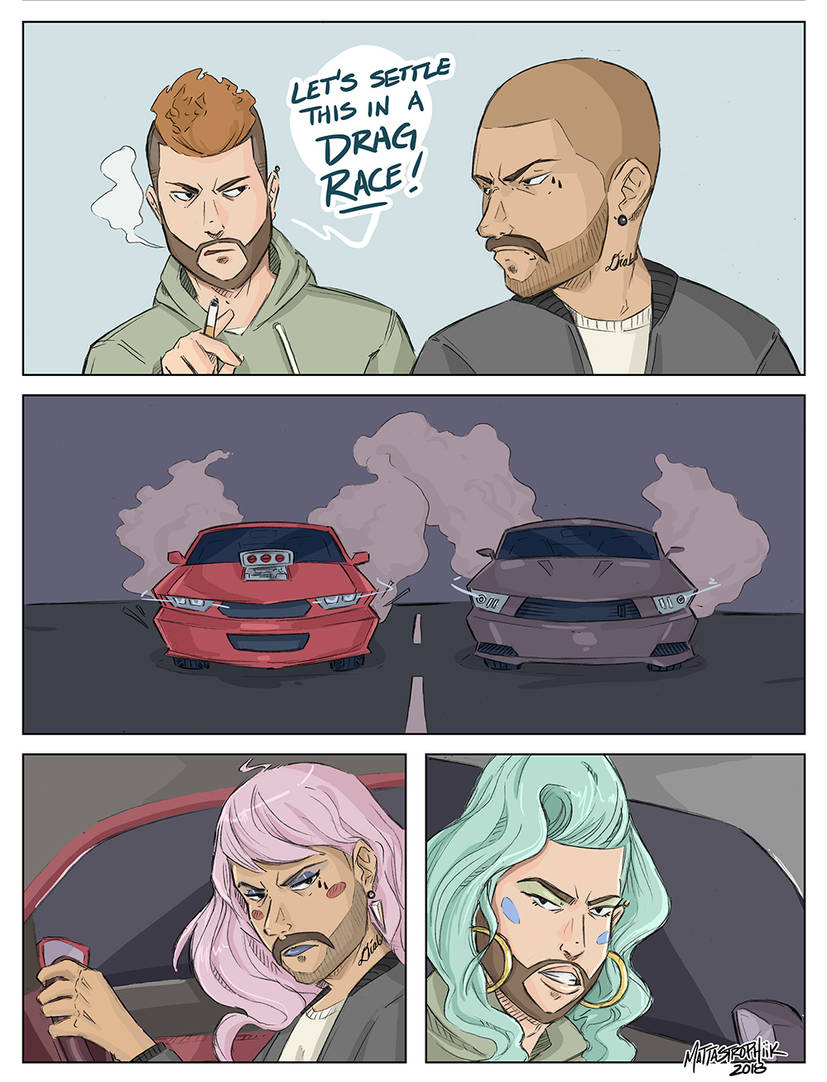
The text visible in the image reads, "LET'S SETTLE THIS IN A DRAG RACE!"
The meme depicts a couple of guys arguing over a racing plan that instantly turns into a fiery explosion, leaving the drivers devastated.
In the context of the "millenihilism" meme category, this visual represents a futility where a simple desire for competition leads to total disaster rather than victory.
simple-description (llama3.2-vision_11b)
The meme appears to be a humorous take on the concept of "Millenihilism," a term used to describe the perceived apathy and nihilism of the millennial generation. The image shows a split-screen comparison of two individuals, one with a "Let's settle this" caption, implying a confrontational or competitive tone.
detailed-analysis (gemma3-27b-vision)
Okay, here's an analysis of the comic panel, broken down by the requested theoretical frameworks, only addressing those that are relevant to the imagery. It's important to note that interpreting art is subjective, and this is one possible reading.
Visual Description
The comic panel is composed of four sections arranged in a grid. The style is somewhat stylized and illustrative, resembling a comic book or graphic novel aesthetic. The overall color palette is subdued, mostly consisting of dark blues, blacks, and greys, with pops of color from the cars and hair.
- Panel 1: Two men stand facing each other, in what appears to be a street setting at night. The man on the left has a short, shaved head with a tattoo and is smoking. The man on the right has a beard and prominent tattoos on his neck and is also smoking. A speech bubble above them says "Let's Settle This in a Drag Race!".
- Panel 2: Shows two cars, one red and one black, mid-drag race. Both are emitting smoke from their tires, indicating high speed.
- Panel 3: A close-up of a person applying lipstick in a car mirror. This individual has pink hair and visible tattoos. They are positioned as though they are in the red car.
- Panel 4: A similar close-up to Panel 3, showing a different person with blue/teal hair applying lipstick in their car mirror. They are positioned as though they are in the black car.
The composition suggests a narrative of confrontation, escalation, and preparation, possibly with a subversion of traditional gender roles.
Foucauldian Genealogical Discourse Analysis
This panel can be analyzed through a Foucauldian lens by looking at the discourses at play and how power operates within them.
- The Discourse of Masculinity and Conflict: The initial panel establishes a classic discourse of masculine conflict – the need to "settle" a disagreement through physical confrontation, here manifested through the symbolic act of a drag race. This isn't about a rational discussion, but about establishing dominance. The tattoos and rugged appearance of the men contribute to this construction of hyper-masculinity.
- Power/Knowledge & Surveillance: The act of applying lipstick, in the context of a high-stakes drag race, disrupts the expected. Lipstick is traditionally associated with femininity and self-presentation. The close-up on the application is a form of surveillance, but it's not simply about observing beauty; it is about how this individual performs gender in a space traditionally coded as masculine. This is where power operates - by defining what is 'appropriate' and the subversion of that appropriateness. The panels show the subjects actively constructing an image of themselves - this is an act of asserting agency and re-defining the rules of engagement.
- Genealogy of the Race: We can trace the "genealogy" of the drag race itself. It isn’t merely a sport, but a ritualized performance of power, a modern re-enactment of historical duels and contests of dominance. It speaks to a longer lineage of settling disputes through physical displays.
Queer Feminist Intersectional Analysis
This is where the panel really becomes interesting. The subversion of traditional gender roles, coupled with the visual cues of tattoos and defiant self-presentation, opens up space for a queer feminist reading.
- Deconstruction of Gender Performance: The individuals applying lipstick in the final two panels actively deconstruct the expected gender performance within the context of a drag race. They’re not simply “feminizing” the masculine space; they’re taking ownership of femininity and deploying it as a form of empowerment and self-expression. It’s a refusal to conform to binary expectations.
- Intersectionality: The presence of tattoos and non-normative appearances signals a potential intersection of identities—gender, sexuality, class, and potentially race or ethnicity. The individuals are not presenting as monolithic “feminine” figures; they are complex beings with layered identities. The tattoos can be read as markers of subculture, rebellion, or personal history.
- Reclaiming Power: The act of self-adornment (applying lipstick) becomes an act of reclaiming power in a situation where societal norms might expect them to be less concerned with appearance. It’s about owning their agency and defining their own terms. This challenges the traditional power dynamics where women are often objectified or pressured to conform to beauty standards.
- Challenging Masculinity: The scene challenges the very definition of masculinity. The men establishing the race are enacting a certain performance of power, but it is then disrupted by the individuals in the cars. The women are not simply passive participants; they are active agents who challenge and redefine the rules of the game.
Note: Some other theoretical frameworks (e.g., Marxist Conflict Theory, Postmodernism) are less strongly suggested by the imagery. While elements of those frameworks could be applied to the panel, they don’t seem to be at the forefront of the visual narrative in the same way as the Foucauldian and Queer Feminist readings.
Let me know if you’d like me to elaborate on any of these points or explore other possible interpretations!
tesseract-ocr
pets serie DD THIS IN A > \ ‘ RAG, ey : \ q liza 4m ow Ly a | — | LA Q ld Y Tae ),| 9 ~ NAN Ge » we, AS y , \Cae, ey) So ea.
simple-description (llama3.2-vision)
This meme is a humorous illustration of two people, one with a calm demeanor and the other with an aggressive one, in a "drag race" situation. The text "Let's settle this in a drag race" is written in a thought bubble above the aggressive person. The image is likely meant to be humorous and satirical, poking fun at the idea of settling disputes through a high-stakes, high-risk activity like a drag race.