First Seen
2024-04-02T08:05:36.951925+00:00
simple-description (qwen3.5_2b-q8_0)
Meme Analysis:
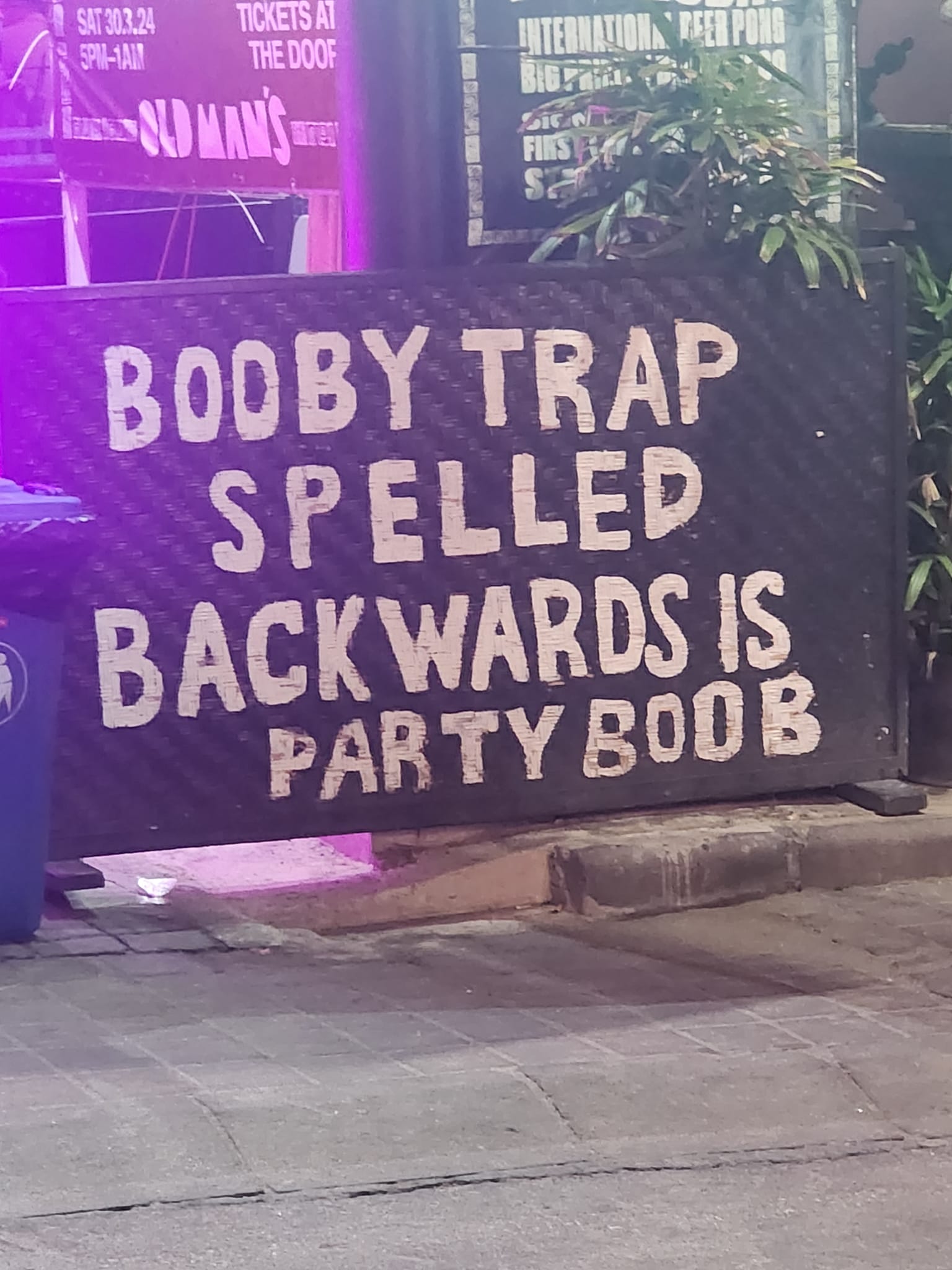
Millenihilism views this sign as a twisted, linguistic deconstruction that prioritizes sexual chaos over moral correctness. The text "BOOBY TRAP SPELLED BACKWARDS IS PARTY BOOB" relies on a linguistic trick where the phrase "Party Boob" spelled backwards visually mimics the offensive term "Booby Trap," creating a crude joke that rejects traditional safety rules in favor of an explicit, edgy, and chaotic "sluttrash" aesthetic.
simple-description (llama3.2-vision_11b)
The meme is a photo of a sign with the words "BOOB JOB" crossed out and replaced with "BOOBY JOB" crossed out, with a red "X" through it. The text on the sign reads "BOOBY JOB" crossed out, with a red "X" through it. The meme is a play on the phrase "booby job" being a euphemism for a breast implant or a surgical procedure to enhance the size of a woman's breasts.
detailed-analysis (gemma3-27b-vision)
Okay, let's break down this image with the requested theoretical lenses.
Visual Description
The image depicts a sign painted in white lettering on a dark, possibly metallic, surface. The text reads: "BOOBY TRAP SPELLED BACKWARDS IS PARTY BOOB". The text is stylized, not in a standard font, and appears hand-painted, giving it a rough or DIY aesthetic. The background is lit with a purple/blue hue, and is likely part of an event setting, as indicated by surrounding fliers and a green plant visible to the right. There is a suggestion of a crowd or space below the sign. The text and overall setting suggest it is likely advertising an event or is a sign within an event space.
Queer Feminist Intersectional Analysis
This sign is saturated with potential for intersectional analysis.
- Sexualization and the Female Body: The immediate and most apparent aspect is the direct engagement with the female body via the term "boob." It immediately puts the female body on display and positions it as a source of (potentially comedic) attention.
- Deconstruction of Language and Power: The phrase's clever linguistic trick ("booby trap" spelled backwards is "party boob") is not merely a playful pun. It subtly destabilizes the meaning of "booby trap." Traditionally a term denoting a dangerous deception, it is twisted and re-presented as celebratory. This can be seen as a deconstruction of traditionally gendered language.
- Reclaiming/Subverting: One could argue that the text attempts to reclaim the term 'boob' as a source of joy ("party") rather than objectification. However, this reclamation is problematic. It operates within a context that already centers the female body, and the language employed is inherently connected to a patriarchal gaze.
- Intersectional Complications: To truly understand the sign, intersectional factors must be considered. The use of this phrase might resonate differently with individuals based on their race, class, gender identity, sexual orientation, and body image. The sign could be seen as promoting sexual pleasure for some, or as perpetuating harm and objectification for others.
Postmodernism
The image strongly aligns with postmodern themes:
- Playfulness and Pastiche: The clever, deliberately silly wordplay ("booby trap" reversed) embodies a postmodern embrace of playfulness and a rejection of grand narratives. It's a linguistic "pastiche"—a playful imitation or remix.
- Deconstruction of Meaning: The reversal of the phrase deconstructs the traditional meaning of "booby trap," revealing how meaning is contingent and constructed through language. There is an inherent instability in the meaning.
- Irony and Self-Referentiality: The sign is, in a way, self-referential. It draws attention to the language itself, rather than conveying a straightforward message. The irony in taking something potentially dangerous and turning it into something celebratory is key.
- Rejection of Authenticity: The hand-painted, DIY aesthetic and the deliberately silly message can be interpreted as a rejection of the notion of authenticity or "high art." It is intentionally playful and informal.
Critical Theory
Applying a critical theory lens, we can analyze this sign in terms of:
- Power Dynamics: The sign, by focusing on the female body, reinforces the patriarchal power structure where women's bodies are often subject to scrutiny and commodification. The use of "boob" is inherently linked to the male gaze and societal expectations around female sexuality.
- Cultural Hegemony: The sign can be interpreted as an attempt to normalize or celebrate the sexualization of women. By presenting it in a playful manner, it could subtly reinforce existing cultural norms around female bodies.
- Ideology: The sign embodies an ideology that prioritizes sexual pleasure and objectification of the female body. It promotes a narrow view of female identity and sexuality, potentially excluding those who do not fit into this framework.
Foucauldian Genealogical Discourse Analysis
A Foucauldian approach examines how the concept of "boob," "booby trap" and associated language has evolved over time, and how it functions as a discourse within power structures:
- Historical Context: The historical evolution of the term "booby trap" itself is interesting – originally a physical trap, later a metaphor for deception, and here, repurposed through playful language.
- Disciplinary Power: The focus on the "boob" contributes to a discourse around female bodies as objects to be surveyed, categorized, and regulated. This ties into Foucault’s ideas about how discourse shapes our understanding of reality and exerts power over our bodies.
- Surveillance and Visibility: The sign functions as a form of visibility, drawing attention to the female body. The language employed suggests an expectation of viewing and evaluation, reinforcing power imbalances.
- Normalization: The playfulness of the sign, despite its potential for harm, can be seen as a form of normalization, making the objectification of women appear less problematic.
Marxist Conflict Theory
Though less directly applicable, a Marxist lens can still be employed.
- Commodification of the Body: The sign contributes to the commodification of the female body. The "boob" is presented as something to be consumed or enjoyed, reducing the woman to a mere object of desire.
- Ideological Control: The sign can be seen as a tool of ideological control, perpetuating a capitalist system that profits from the sexualization of women.
- Class and Representation: The event where this sign is displayed may cater to a specific socioeconomic class, reinforcing existing power dynamics. The sign could potentially exclude or marginalize those who do not fit into this framework.
Disclaimer: These interpretations are not exhaustive, and each lens provides a unique perspective. The meaning of this sign is open to debate and may vary depending on individual experiences and cultural contexts.
tesseract-ocr
oe a I ; oe StU! | fees Se: ME Re: Lm Ae. ee i, nt +s . y BOOBY TRAP ~ é : : - a a 1 oa). 1i ee — } " i Uy Se “ . =u “ky se : ge ae a —
simple-description (llama3.2-vision)
This meme is a playful take on the classic "Boo" phrase, but with a clever twist. The image shows a sign with the words "Boo" replaced with "Boo" spelled backwards, which is "ooB".