First Seen
2024-05-25T19:32:29.680803+00:00
simple-description (qwen3.5_2b-q8_0)
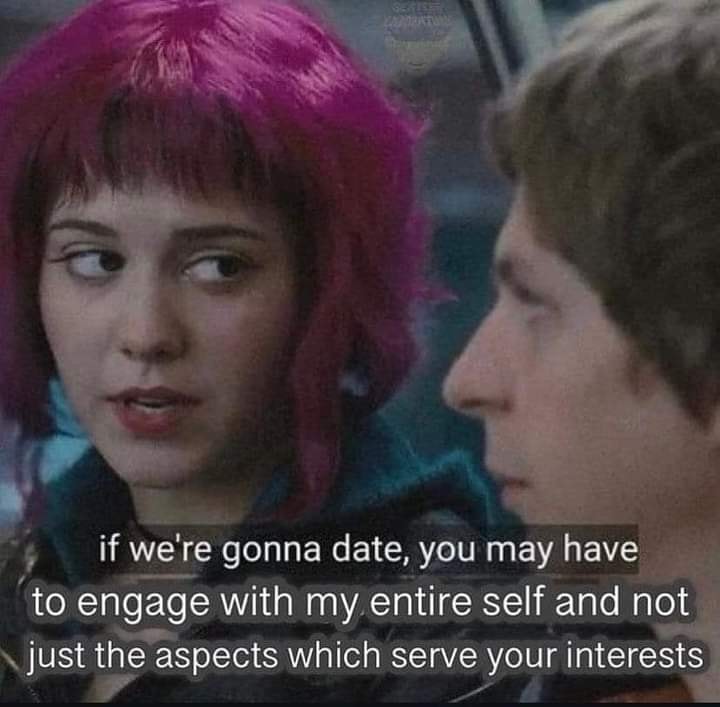
This meme captures a nihilistic worldview where a relationship is viewed as a futile burden rather than a meaningful partnership. In the scene from The Social Network, one character tells the other that if they are dating, they will essentially drown in the depths of their own character, illustrating a millenihilistic perspective that romantic connection is pointless and ultimately exhausting to endure.
simple-description (llama3.2-vision_11b)
The meme is a reference to the concept of "Millenihilism," which is a philosophical and cultural critique of modern society's values and priorities. The meme is likely a commentary on the idea that people are more focused on their personal interests and desires than on contributing to the greater good or making meaningful connections with others. The text "if we're gonna date, you have to be willing to engage with my existential dread" suggests that the speaker is looking for a partner who is willing to explore and confront the complexities of life, rather than just focusing on superficial relationships.
detailed-analysis (gemma3-27b-vision)
Okay, let's break down this image and the text it carries using the requested theoretical frameworks.
Visual Description
The image is a still from the film Jennifer's Body. It shows two characters in a close-up, intense conversation. The central figure is Jennifer Check (played by Megan Fox), with striking bright pink hair and pronounced makeup, staring directly at a male character, likely her friend/love interest, Neil (played by Alex Pettyfer). Her expression is direct, potentially challenging or demanding. The lighting is dark and moody, with a focus on the characters' faces. The composition emphasizes Jennifer's assertive posture and the implied power dynamic in the conversation. It projects an edgy, almost confrontational energy.
Queer Feminist Intersectional Analysis
This image and quote resonate profoundly within a Queer Feminist Intersectional framework. Here's how:
- Rejection of the Male Gaze & Objectification: Jennifer’s statement is a direct rejection of the reduction of a woman to objects of desire or fulfilling needs. She refuses to be fragmented or seen only in terms of what she can provide a male partner. This challenges the historical and societal tendency to define women through their relationships to men (a core tenet of patriarchal structures). Her vibrant, unconventional appearance itself is a disruption of typical expectations of femininity.
- Intersectionality: The statement speaks to a demand for holistic recognition. The "entire self" encompasses not only gender but also sexuality, class, race, and any other aspect of identity. Intersectional analysis recognizes that these identities are interwoven and influence one another. Jennifer is stating that she won’t allow a partner to cherry-pick aspects of her identity that fit their preferences while ignoring the rest.
- Reclaiming Agency: Jennifer is reclaiming agency over her own self-definition. By explicitly stating this demand, she is refusing to be passively defined by her partner or anyone else. This is a powerful act of self-determination.
- Challenging Heteronormative Dynamics: Jennifer is challenging the often-unspoken expectation in heterosexual relationships that women should accommodate their partner’s desires. This isn’t about being "difficult" or "demanding"; it’s about establishing a relationship built on mutual respect and recognition of full personhood.
- The Power of the “Bitch” Archetype: Jennifer, as a character, frequently embodies a "bitch" archetype in a way that subverts expectations. Her directness and refusal to conform are often perceived negatively, but can also be seen as empowering and challenging the status quo.
Foucauldian Genealogical Discourse Analysis
Foucault’s work focuses on power and knowledge, and how they shape our understandings of the world. Here’s how that applies:
- Discourses of Romance & Relationships: The quote exposes the dominant discourses surrounding romantic relationships, which often center around a male partner’s needs and desires. These discourses create norms about what is expected in a relationship, and Jennifer's statement is a direct challenge to those norms.
- The "Self" as Constructed: Foucault argued that the "self" is not a fixed entity, but a product of discourse and power relations. Jennifer’s insistence on being seen as an “entire self” highlights the ways in which individuals are fragmented and categorized by societal expectations.
- Power/Knowledge & Subjectivity: The power dynamic in the image is evident. The quote reveals how those in positions of power (often societal/patriarchal structures) define and categorize others. Jennifer is resisting being subjected to those categories. Her statement is an attempt to assert control over her own subjectivity—how she defines and understands herself.
- Genealogy of the Demand: A Foucauldian genealogy could trace the historical development of expectations surrounding relationships, highlighting how these norms have evolved over time and have served to maintain power imbalances.
Critical Theory
- Challenging the Status Quo: The quote is inherently critical. It questions the established norms and expectations within romantic relationships. Critical Theory is interested in exposing and challenging oppressive structures, and Jennifer’s statement fits neatly within that framework.
- Ideology and False Consciousness: The quote suggests that the male character might be operating under a certain ideology—the belief that relationships are about fulfilling personal needs. Jennifer is demanding that he overcome this "false consciousness" and recognize her as a complete person.
- Domination and Resistance: The situation in the image can be interpreted as a microcosm of broader societal power dynamics. Jennifer's statement represents an act of resistance against the domination inherent in the traditional power structures of relationships.
Postmodernism
- Deconstruction of Romance: Postmodernism often involves deconstructing grand narratives. The traditional narrative of romantic love is often presented as a universal truth, but Jennifer’s statement challenges that notion.
- Fluidity of Identity: The emphasis on the "entire self" aligns with postmodern notions of identity as fluid and complex, rather than fixed and essential.
- Rejection of Universal Truths: The quote challenges the idea that there’s a “right” way to engage in a relationship or define what constitutes love and intimacy. Postmodernism is skeptical of overarching narratives or claims to universal truths.
Marxist Conflict Theory
While not the strongest fit, a Marxist lens can also provide insight.
- Power Dynamics as Exploitation: The male character's potential desire to "engage only with aspects of her that serve his interests" can be viewed as a form of exploitation—treating Jennifer as a means to an end, rather than recognizing her inherent worth.
- Social Stratification: Relationships can reflect broader societal power structures. The quote suggests a power imbalance within the relationship.
Let me know if you'd like me to elaborate on any of these analyses!
tesseract-ocr
p 7" ae a S | “ | 7 st | a LAC aeColiLal ello (eLUNT-) A to engage with my entire self and not \ Just the aspects which serve your interests A a. ae
simple-description (llama3.2-vision)
The meme is a humorous take on the idea that some people's interests are so niche that they need to be with someone who shares them in order to have a fulfilling relationship. The image is likely a screenshot from a movie or TV show, but the text overlay says: "If we're gonna date, you have to be willing to engage with my entire self, not just the aspects that serve your interests."