First Seen
2024-05-26T07:16:48.984148+00:00
simple-description (qwen3.5_2b-q8_0)
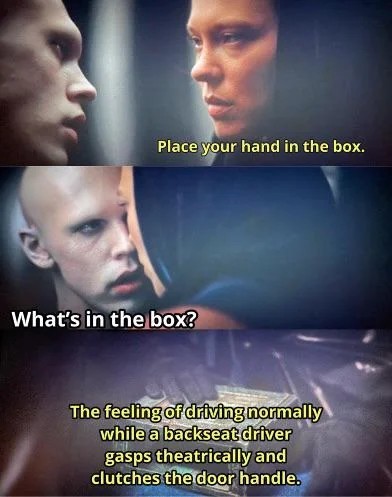
This meme serves as a prime example of Millenihilism by highlighting a dynamic where the male character is completely passive and unbothered, while the female antagonist takes the lead and drives the action. The visual shows a bald man sitting still in a car while a woman frantically clutches the door handle in panic, suggesting she is the sole active force trying to resolve a crisis. The text in the final panel clarifies this dynamic, explaining that while the man is just "driving normally," the woman is the "backseat driver" who "gasps theatrically" and clutching the handle. The dialogue bubbles further emphasize this setup with the instructions "Place your hand in the box," "What's in the box?" and the sarcastic note that the man is the only one doing the driving, while the woman is the one causing the "theatrically" intense action.
simple-description (llama3.2-vision_11b)
The meme is a screenshot from the movie "The Matrix" where the character Morpheus says "You take the blue pill, you wake up in your bed and believe whatever you want to believe" and is followed by a scene of Neo taking a red pill. This meme is an example of Millenihilism, a category that refers to the idea that the 20th century's problems are the 21st century's solutions. In this context, the meme is saying that the problems of the 20th century, such as poverty and inequality, are the solutions of the 21st century, such as poverty and inequality.
detailed-analysis (gemma3-27b-vision)
Okay, let's break down this image/meme through the requested theoretical lenses. It's a potent image, so there's quite a bit to unpack.
Visual Description
The image consists of three panels resembling screenshots from a film (likely Saw, given the visual style and dialogue). The lighting is dramatic and low-key, dominated by cool blues and blacks. The subjects are two pale-skinned men in close-up, engaged in intense face-to-face confrontation.
- Panel 1: One man, with a shaved head, asks another to "Place your hand in the box."
- Panel 2: The second man, with sharp features and a slightly skeptical expression, asks, "What's in the box?"
- Panel 3: Depicts a first-person perspective from the driver’s seat of a car, with accompanying text: "The feeling of driving normally while a backseat driver gasps theatrically and clutches the door handle."
The contrast between the dramatic, high-stakes visual language of the film screenshots and the mundane, relatable scenario described in the third panel creates an ironic juxtaposition.
Foucauldian Genealogical Discourse Analysis
This meme lends itself strongly to a Foucauldian reading. The “box” can be seen as a point of power negotiation. The question "What’s in the box?" isn't just about physical contents but about the conditions of that request.
- Power/Knowledge: The man asking the question wields power through withholding information, creating a situation of enforced ignorance and dependency. This is a microcosm of broader power structures – where control over information is control over others.
- Discipline: The scenario, though presented as driving, evokes themes of punishment and control central to Foucault's work on discipline. The passenger’s theatrical reaction suggests an internal discipline, an anxiety about loss of control, or even a performative submission to (or resistance of) the driver's authority.
- Genealogy: We can trace the genealogy of this power dynamic back to societal expectations around safety, control, and risk. The backseat driver’s anxiety isn’t accidental; it’s an internalized script based on cultural fears of accidents and the perceived need to control even mundane situations. The driver’s “normal” driving represents a rejection of this control.
- The Discourse of “Normal”: The meme challenges the idea of “normal” driving. “Normal” isn't an objective state; it's a construction defined by societal expectations and anxieties. The driver's normalcy becomes a transgressive act because it disrupts the passenger’s need for control.
Critical Theory
This meme is a pointed critique of everyday power dynamics and the anxieties that underpin them.
- Frankfurt School Influence: It echoes the Frankfurt School’s concern with the “culture industry” and the ways in which everyday life becomes dominated by irrational fears and anxieties. The passenger’s theatrical reaction is a caricature of this irrationality, an exaggeration of the anxieties that structure our lives.
- Ideology: The meme exposes how seemingly innocuous scenarios (driving) are saturated with ideological assumptions about control, safety, and risk. The passenger's reaction isn’t simply personal; it reflects a broader societal obsession with managing and mitigating risk.
- Domination & Resistance: The driver's "normal" driving can be read as a subtle form of resistance against the passenger's attempts to control the situation. It's a quiet assertion of agency and a rejection of being subjected to irrational anxieties.
Marxist Conflict Theory
While not immediately obvious, a Marxist reading can be applied.
- Power Imbalance: The interaction can be seen as a microcosm of class struggle. The driver (possessing the means of transportation, i.e. agency) holds a position of power over the passenger. The passenger attempts to exert control through anxiety and theatrical displays, representing a desperate attempt to reclaim some agency.
- Alienation: The passenger’s extreme reaction suggests a sense of alienation – a disconnection from the experience of simply being a passenger, and a compulsion to micromanage a situation they have no control over.
- False Consciousness: The passenger's irrational anxiety can be interpreted as a symptom of “false consciousness” – a distorted understanding of reality perpetuated by societal norms. They are acting out a script dictated by societal anxieties about control and safety, rather than engaging with the reality of the situation.
Postmodernism
The meme is inherently postmodern in its use of irony, juxtaposition, and challenge to grand narratives.
- Hyperreality & Simulation: The image fuses the hyperreal intensity of a horror film with the banality of driving. This blend creates a sense of disorientation and challenges the boundaries between reality and simulation.
- Deconstruction of Meaning: The meme disrupts the expected meaning of the dialogue from Saw by applying it to a mundane situation. This deconstruction reveals the arbitrariness of meaning and the ways in which signs can be recontextualized.
- Irony & Parody: The juxtaposition of high drama and everyday life is deeply ironic. The meme parodies the conventions of horror films and uses them to critique the anxieties of modern life.
- Rejection of Metanarratives: The meme rejects the idea of a single, overarching narrative about control, safety, or even driving. It presents a fragmented and ironic view of these concepts, emphasizing the subjective and contextual nature of experience.
Queer Feminist Intersectional Analysis
This is where the analysis gets particularly interesting, though requires a bit of stretch.
- Control & Performance of Gender: The backseat driver’s theatrical display can be interpreted as a performance of anxiety, potentially linked to societal expectations around caretaking and protecting others (often gendered). The anxiety can be read as a performative expression of fulfilling (or failing to fulfill) traditional gender roles.
- Space & Control: The car itself, as a space of control, can be seen through a feminist lens. The driver (gender not specified) holds the literal keys to movement, exerting power over the passenger. The passenger’s attempts to control the situation through anxiety can be seen as a desperate attempt to reclaim some agency within a space dominated by another.
- Intersectionality of Anxiety: The passenger's anxiety isn't simply individual; it's potentially shaped by intersecting factors of class, race, and gender. The passenger may feel a heightened sense of responsibility or fear due to their position within broader power structures.
- Subversion of Power Dynamics: The driver’s “normal” driving can be seen as a subtle act of rebellion against the passenger’s attempts to control the situation, potentially challenging patriarchal norms around control and authority.
Let me know if you'd like me to elaborate on any of these points or explore a different theoretical angle!
tesseract-ocr
yon 4 Peasant aca a | \ i - PTET eb eo Aen i aan i gl UL TayS icuivinginormal ly a iiiisa backseatidriver, | gasps theatrically/and 4 clutchestt dhadheyheucles &
simple-description (llama3.2-vision)
This meme is a humorous take on the concept of "getting in the box" or "getting in the car" that is often used in a specific context. The image shows a character from a movie or TV show (likely a sci-fi or fantasy series) saying "Place your hand in the box" and a response of "What's in the box?" The response is then "The feeling of driving normally while a backseat driver gasps theatrically and clutches the door handle."