First Seen
2024-05-28T03:11:45.033559+00:00
simple-description (qwen3.5_2b-q8_0)
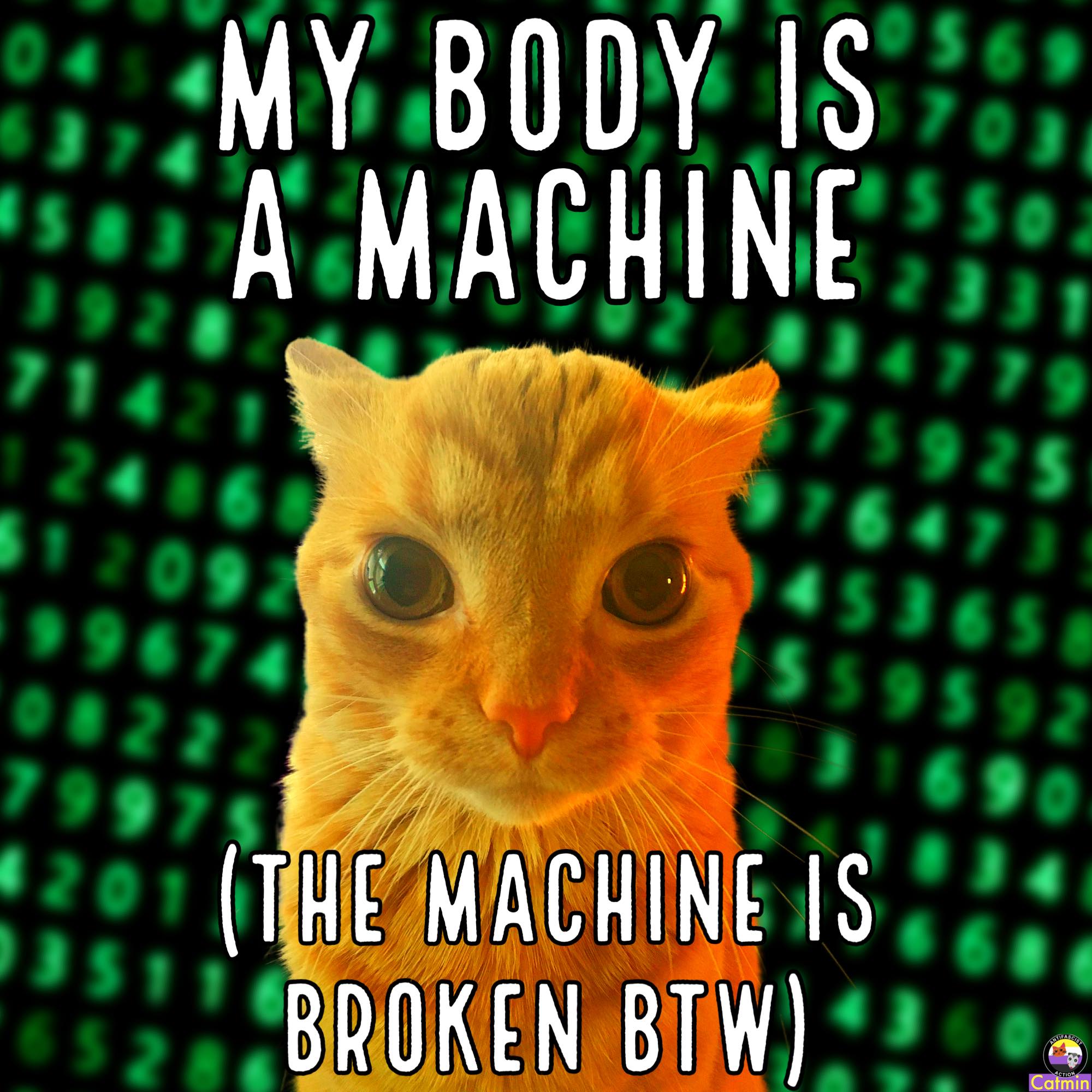
Millenihilism suggests that existence is a meaningless collection of events with no inherent purpose, much like a computer program. The text in the image, describing the body as a "machine," personifies the physical form as merely code running in a digital matrix that lacks value. By adding "(the machine is broken btw)," the meme humorously implies that since the underlying software of life is flawed, the biological entity is essentially useless and broken.
simple-description (llama3.2-vision_11b)
The meme is a play on the phrase "I'm not a machine, I'm a human being" and features a cat with a robotic eye, implying that the cat is a machine, and the text "I'm not a cat, I'm a human" is a sarcastic response to the idea that the cat is a machine. The meme is humorous because it's a cat that's trying to assert its humanity, but the cat's robotic eye suggests that it's actually a machine.
detailed-analysis (gemma3-27b-vision)
Okay, here's an analysis of the image, broken down into the requested sections, focusing on how different theoretical frameworks might interpret it. I’ll explain why certain sections aren’t as applicable if needed.
Visual Description
The image features a close-up portrait of an orange tabby cat, positioned in the center. The cat is looking directly at the viewer with a slightly perplexed or concerned expression. The background is a dark, digital matrix of cascading green numbers (reminiscent of The Matrix film). Superimposed on the image in white text are the phrases "MY BODY IS A MACHINE" above the cat and "(THE MACHINE IS BROKEN BTW)" below the cat. A small watermark "Catmin" is at the bottom right. The overall aesthetic is digital, slightly unsettling, and employs a juxtaposition of the organic (the cat) with the technological/artificial (the digital matrix).
Foucauldian Genealogical Discourse Analysis
This image is ripe for a Foucauldian reading. The statement "My body is a machine" immediately invokes the idea of the body as subject to power dynamics and discursive formations. Foucault argued that the body isn’t a natural entity but is produced by discourses – systems of thought, language, and practices.
- Discipline & Biopower: The "machine" metaphor aligns with the modern emphasis on efficiency, control, and normalization. Disciplinary power operates on the body to make it productive and docile, while biopower manages populations through mechanisms like health, reproduction, and surveillance. The cat, as an animal, becomes a site for understanding how these forces operate beyond the human.
- Genealogy: Examining the historical genealogy of the "machine" metaphor reveals how conceptions of the body have shifted – from Cartesian dualism (mind/body separation) to more mechanistic views prevalent in the industrial age and now, the digital age. The cat becomes an embodiment of these historical shifts.
- “The machine is broken BTW”: This addition is crucial. It disrupts the smooth functioning of the machine-body and introduces a sense of breakdown, resistance, and subjectivity. The 'BTW' is intentionally casual, hinting at everyday forms of resistance against these normalizing discourses. It suggests that the body isn’t completely controlled and can malfunction, or reject the expectation of functionality.
Critical Theory
This image can be analyzed through the lens of Critical Theory, which emphasizes the critique of societal structures and power dynamics.
- Commodification of the Body: The "machine" framing can be seen as reflecting the commodification of the body in modern society. Bodies are treated as resources, objects of labor, and subjects of consumerism. The cat, even in its animal form, implicitly engages with this idea, as animals are also often commodified.
- Alienation: If the body is a machine, it implies a separation of the individual from their own physicality, an experience of alienation. This alienation, a central concept in Marxist thought, stems from the division of labor and the loss of connection to the products of one's own labor (or, in this case, one’s own bodily functions).
- Ideology: The image can be seen as critiquing the ideology that presents the body as merely a functional entity, ignoring its complexity, subjectivity, and emotional life. The cat’s perplexed expression visually communicates this emotional disruption.
Marxist Conflict Theory
While not the primary framework, Marxist conflict theory can offer some insights.
- Body as Labor Force: From a Marxist perspective, the body is fundamentally a vehicle for labor. The "machine" metaphor emphasizes the body’s capacity for work and production.
- Exploitation of the Body: The image, if interpreted as representing a worker (even symbolically through the cat), could be seen as a commentary on the exploitation of the body in capitalist systems.
- The "Broken" Machine: The phrase "the machine is broken" could symbolize the breakdown of the worker due to overwork, alienation, or illness – a form of resistance through incapacity.
- However, this reading is less strong than others because the image lacks explicit references to class struggle or economic exploitation. The focus is more on the body itself and its relationship to systems of power, not specifically on economic relationships.
Postmodernism
The image readily fits into a postmodern framework.
- Deconstruction of Meaning: The juxtaposition of the organic (cat) and the digital (matrix) disrupts traditional categories and challenges fixed meanings. It destabilizes our understanding of what constitutes "natural" vs. "artificial," "body" vs. "machine."
- Simulation and Hyperreality: The digital background alludes to the concept of simulation – where representations of reality become more real than reality itself. The cat, presented within this simulated environment, can be seen as a signifier that has been detached from its original referent.
- Fragmentation and Discontinuity: The image fragments the body by equating it to a machine, suggesting a loss of wholeness and a sense of discontinuity.
- Irony and Playfulness: The casual "BTW" adds a layer of irony and playfulness, characteristic of postmodern art, and undermining any serious, monolithic interpretation.
Queer Feminist Intersectional Analysis
This is a particularly compelling lens for analysis.
- The Body as a Site of Control: Feminist theory examines how the body is often a site of control and regulation, particularly for women and marginalized genders. The "machine" metaphor extends this idea, suggesting that all bodies are subjected to forms of disciplinary power.
- Animal Studies: The use of a cat, as opposed to a human, is significant. Animal studies challenge anthropocentric views and examine the ways in which animals are also subject to power structures. It invites us to think beyond human-centered notions of the body.
- Deconstruction of Binary Oppositions: Queer theory challenges binary oppositions (male/female, natural/artificial). The image disrupts the distinction between the organic and the technological, and between the self and the machine.
- Intersectional Concerns: Intersectional feminism recognizes that power operates through multiple, intersecting categories of identity (race, class, gender, sexuality, etc.). The "broken machine" can be interpreted as a metaphor for bodies that are marginalized or disabled – those that don't conform to normative standards of functionality.
- Resistance and Agency: The "broken" machine introduces the possibility of resistance. A body that malfunctions or refuses to conform can be seen as a form of agency, a rejection of oppressive norms.
I've tried to cover the areas you've specified in a thoughtful manner, making note when certain frameworks are less directly applicable. Let me know if you’d like me to elaborate on any of these points!
tesseract-ocr
MY BODY IS VENT Rion TOC IGit ee
simple-description (llama3.2-vision)
The meme is a humorous image featuring a cartoon cat with a robotic and glitchy appearance, with a caption that pokes fun at the idea of being a machine. The text "My body is a machine" is written above the cat, while "The machine is broken btw" is written below. The meme is likely intended to be humorous and relatable, poking fun at the idea of being a machine and the frustrations that come with it.