First Seen
2024-06-26T00:19:32.563357+00:00
simple-description (qwen3.5_2b-q8_0)
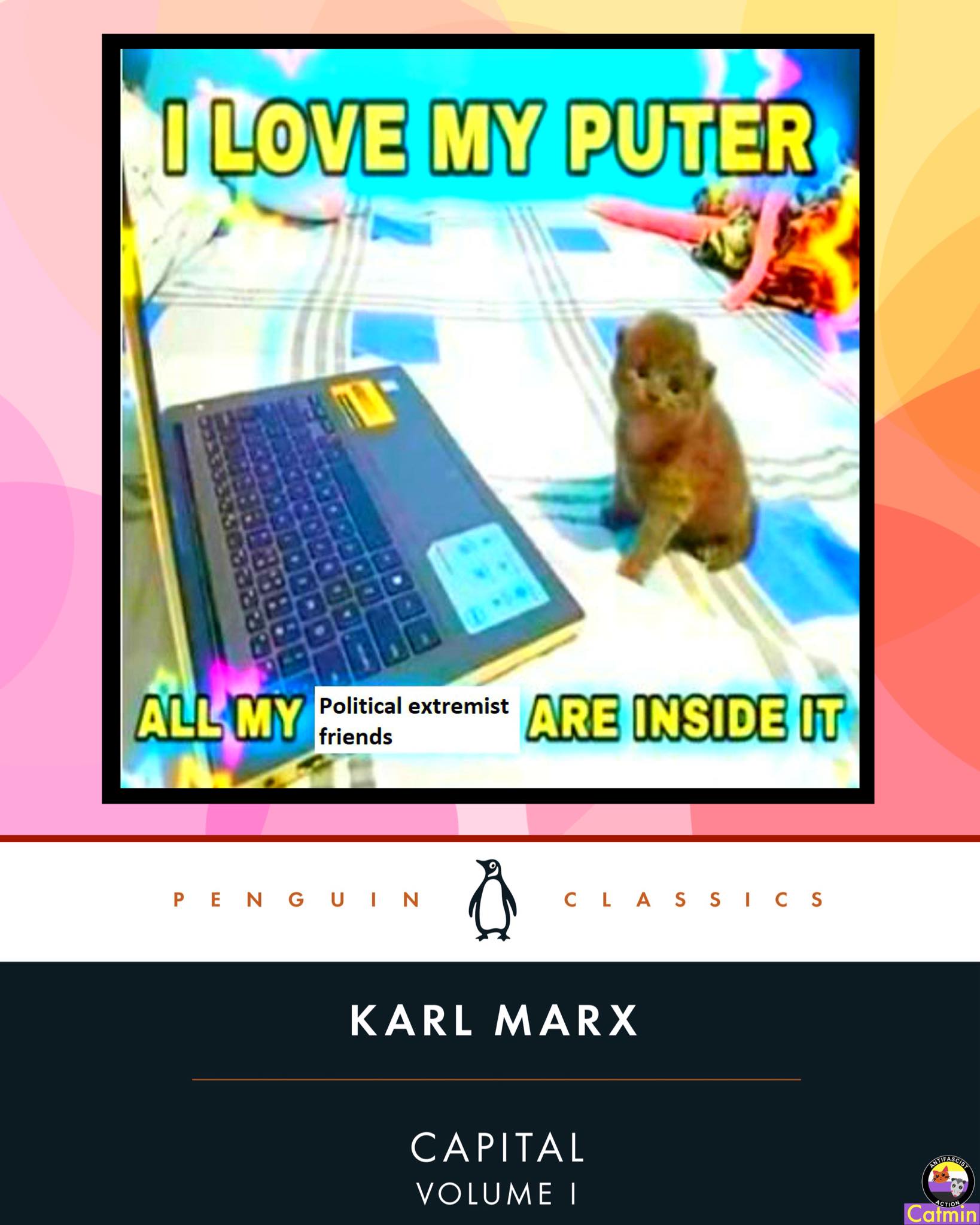
Based on the text visible in the image, here is an interpretation of the meme, followed by an explanation of the term "Millenihilism" (noted as likely a typo for "Millenihilism" or a specific internet subculture concept).
1. Meme Interpretation
This is a visual pun (text-based meme) that plays on computer slang. Here is the breakdown:
- "I LOVE MY PUTER": This is a variation of the common idiom "I love my [computer]." The term "puter" is internet slang for "computer."
- "ALL MY PUTER ARE INSIDE IT":
- Literal Meaning: The text "ALL MY [computers] ARE INSIDE IT" is a common phrase implying that one's entire identity/world revolves around their computer; they are "stuck" with it.
- Contextual Meaning: However, in this specific meme format (often seen on platforms like Reddit or Twitter), the meme person is suggesting that the computer is the entire universe to them. They feel so deeply connected to the digital world (the internet) that they treat the internet as their whole reality.
- "Political extremist friends": This appears to be the label, username, or specific reason for why this meme is being posted or categorized. It suggests that the person posting the meme views themselves (or their community of "friends") as political extremists because their interests (the internet) are so extreme and absolute that they define their entire existence.
In short: The meme depicts a person who is so obsessed with their computer (the internet) that they treat it as the entire world. The caption "Political extremist friends" labels this person as an extreme in the digital/online world.
2. Understanding "Millenihilism"
Millenihilism (likely a typo for Millenihilism) is a philosophical theory often used in internet circles and conspiracy communities.
- Core Belief: It posits that the universe is a cycle of nothingness. There is no meaning, no cause, and no outside world—everything is just the same cycle of existence and nothingness.
- Application: It is the belief that nothing is worth doing outside of this cycle.
3. Connecting the Meme to Millenihilism
While the image itself is about computer obsession, it can be interpreted as a Millenihilist worldview:
- The Universe is the Computer: In standard Millenihilism, the universe is a cycle of nothing. In this meme, the internet is the universe. The person who posted this meme is expressing that their world (the internet) is their entire reality, which fits the millenihilist view of the universe being a meaningless cycle.
- The "Cycle": The meme person is suggesting that their life in the internet is a cycle (of posting, deleting, and returning to the computer) with no external purpose. This mirrors the millenihilist belief that the universe is just a cycle of nothing.
- Extreme Obsession: The caption "Political extremist friends" implies that this person holds extreme, extreme views (often extreme political views) because their internet community is so extreme. The meme illustrates an extreme state of mind: seeing everything (the internet/universe) as the only reality, with nothing outside of it.
Summary
- The Meme: An extreme internet person who believes the computer is their entire world.
- Millenihilism: The belief that the universe (or reality) is just a cycle of nothingness.
- The Connection: The person in the meme is applying the Millenihilist idea to their digital world, seeing the internet as the only thing that exists and has meaning.
simple-description (llama3.2-vision_11b)
The meme is a humorous critique of the concept of "millenial nihilism," a philosophical movement that questions the value of modern life. The image shows a person sitting at a desk, surrounded by screens and laptops, with a caption that reads "I love my puter, all my friends are inside it." This is a tongue-in-cheek commentary on the idea that many millennials are so focused on their digital lives that they have lost touch with the world around them.
detailed-analysis (gemma3-27b-vision)
Okay, let's break down this image with analysis across several theoretical frameworks. It's a rich (and somewhat disturbing) visual, lending itself to a lot of interpretations!
Visual Description
The image is a digitally manipulated composite. A square image of a cat sitting, intensely staring while embracing a laptop is overlaid onto a background of bright pink and purple. The laptop appears to be running some sort of command-line interface (possibly Linux-based) or a program showing numerous chat windows.
Text is overlaid onto the image: “I LOVE MY PUTER” is at the top, and “ALL MY Political extremist friends ARE INSIDE IT” is at the bottom. The background is garishly colorful. Beneath the square image, the spine of a Penguin Classics edition of Capital, Volume I by Karl Marx is visible. The image contains a watermark that says "Catmin."
Foucauldian Genealogical Discourse Analysis
This image is ripe for a Foucauldian analysis. The "discourse" isn't simply the words written on the image, but the network of power/knowledge relationships it implies.
- Power/Knowledge: The image connects the ostensibly innocuous (a cat with a laptop) to the potentially dangerous (“political extremist friends”). This juxtaposition demonstrates how power operates by associating seemingly unrelated things, creating anxieties and fears. The image suggests that the digital space is the site of dangerous radicalization.
- Genealogy of the "Extremist": A genealogical approach might question how the category "political extremist" itself was constructed, by whom, and for what purposes. Is this an "othering" tactic used to legitimize existing power structures? The cat acts as a stand-in for the extremist. Why a cat? Is it a way to dehumanize and dismiss these individuals as 'animalistic' or irrational?
- Disciplinary Power: The image subtly implies surveillance. The laptop and the "friends inside" suggest a digital panopticon, where individuals are constantly monitored. The cat's intense stare and embrace of the laptop can be read as symbolic of this monitoring.
Critical Theory
The image embodies several key tenets of Critical Theory:
- Ideology: The image could be interpreted as a critique of the role of technology in perpetuating extremist ideologies. It suggests that technology isn't neutral; it can be used to create echo chambers and reinforce existing biases. The bright, jarring colors and sensational text contribute to a sense of hyperreality, characteristic of ideological manipulation.
- Commodity Fetishism: (Connecting to the Marx book) While less direct, the laptop itself can be seen as a commodity imbued with ideological significance. The cat's "love" for the laptop is a distorted relationship, mirroring our own often uncritical consumption of technology.
- Culture Industry: The hyper-saturated color palette and sensationalist text are reminiscent of the strategies employed by the culture industry to manufacture consent and distract from critical thought.
Marxist Conflict Theory
This image provides a fascinating point of entry for Marxist analysis:
- Class Struggle: The "extremist" friends within the laptop can be interpreted as those who are alienated by or actively resisting the dominant capitalist system. The laptop is the means of organization, communication, and potentially revolutionary action.
- False Consciousness: The cat's "love" for the laptop can be read as a metaphor for how individuals are lured into a system that ultimately exploits them.
- Revolution & Technology: The image posits a potential relationship between technology and revolution. The laptop becomes a tool for challenging the status quo. (Though the disturbing framing also suggests the potential for technology to be used for destructive ends.)
- Base and Superstructure: The image could suggest how the 'base' of society (economic structures, power relations) manifests in the 'superstructure' of culture and ideology. The cat, technology and extremist views can be seen as a manifestation of conflict.
Postmodernism
Several elements of the image resonate with postmodern thought:
- Simulacra and Simulation: The image is a simulation, a constructed reality that blurs the lines between the real and the artificial. The cat's emotions and the idea of "friends inside" are hyperreal, existing more as signs and symbols than as tangible experiences.
- Deconstruction of Meaning: The juxtaposition of the cute cat with extremist ideology undermines any simple or straightforward interpretation. It forces us to question the meaning of both.
- Fragmentation and Discontinuity: The image is a fragmented collage, lacking a coherent narrative. It reflects the postmodern condition of fragmented identity and knowledge.
- Irony and Parody: The image is potentially ironic, mocking both the naiveté of the cat (or the person projecting onto it) and the seriousness of political extremism.
Queer Feminist Intersectional Analysis
This area of analysis is perhaps the most challenging, but potentially rewarding:
- Animalization & Othering: The image’s use of a cat can be seen as an example of animalization, a tactic used to dehumanize and marginalize groups of people. This intersects with other forms of othering based on political ideology.
- Digital Spaces & Harassment: The claim that "extremist friends" are "inside" the laptop suggests that digital spaces can be sites of harassment, radicalization, and violence, particularly for marginalized groups.
- Intersectional Power Dynamics: The image implicates multiple layers of power: power dynamics between humans and animals, between political ideologies, and within digital spaces.
- Distortion of Affection: The cat's "love" for the laptop is a distorted form of affection, potentially mirroring how individuals seek connection in unhealthy ways within digital environments.
Final Thoughts:
This image is complex and unsettling. It invites a variety of interpretations and speaks to several important social and political issues. The combination of cute imagery with potentially dangerous ideology is particularly striking, and prompts us to consider the role of technology in shaping our beliefs and behaviors. It is a powerful, if disturbing, visual statement.
Let me know if you'd like me to elaborate on any of these analyses!
simple-description (llama3.2-vision)
This meme is an image of a cat sitting in front of a laptop, with a caption that reads "I love my puter, all my political extremist friends are inside it". The image is likely humorous because it's a playful take on the idea of a computer being a personal space, with the cat representing the owner's online identity.